You pull the heavy steel chef’s knife from the wooden block, feeling the familiar weight settle into your palm. The blade catches the late afternoon light spilling through the kitchen window, casting a sharp shadow across the granite. You set down your favourite maple cutting board on the counter, grab a bruised red tomato, and press the steel edge into the tight skin. Suddenly, the entire board skates two inches to the left, taking your balance with it. Your heart skips a beat as the blade stutters off its mark.
The sound of a knife hitting wood should be rhythmic, a steady cadence that grounds you in the simple, physical act of preparing a meal. But when your surface slides freely across a polished stone or laminate countertop, that comforting rhythm fractures into an active hazard. A drifting workspace breeds hesitation, forcing your hands to work defensively. You end up gripping the food too tightly, compensating for the lack of stability with an anxious, rigid posture that aches by the time dinner is served.
Professional kitchens operate at breakneck speeds, turning out hundreds of covers a night amid a blur of shouting and searing heat. Yet, if you watch the line cooks work, their cutting boards sit as still as poured concrete against the stainless steel prep tables. Their secret isn’t an expensive set of silicone clamps or heavy-duty rubber mats purchased from specialty supply stores. It is a humble, nearly invisible adjustment that anchors the entire station and fundamentally changes the way you stand at the counter.
The Physics of Friction
Think of a rigid cutting board resting on smooth quartz or polished stone like a car’s tires hitting black ice. There is virtually no surface tension to resist the lateral force of your knife pushing forward and down. To fix this dangerous lack of resistance, you don’t need to permanently alter your counters or buy new equipment. You just interrupt the glide with a barrier of moisture and texture.
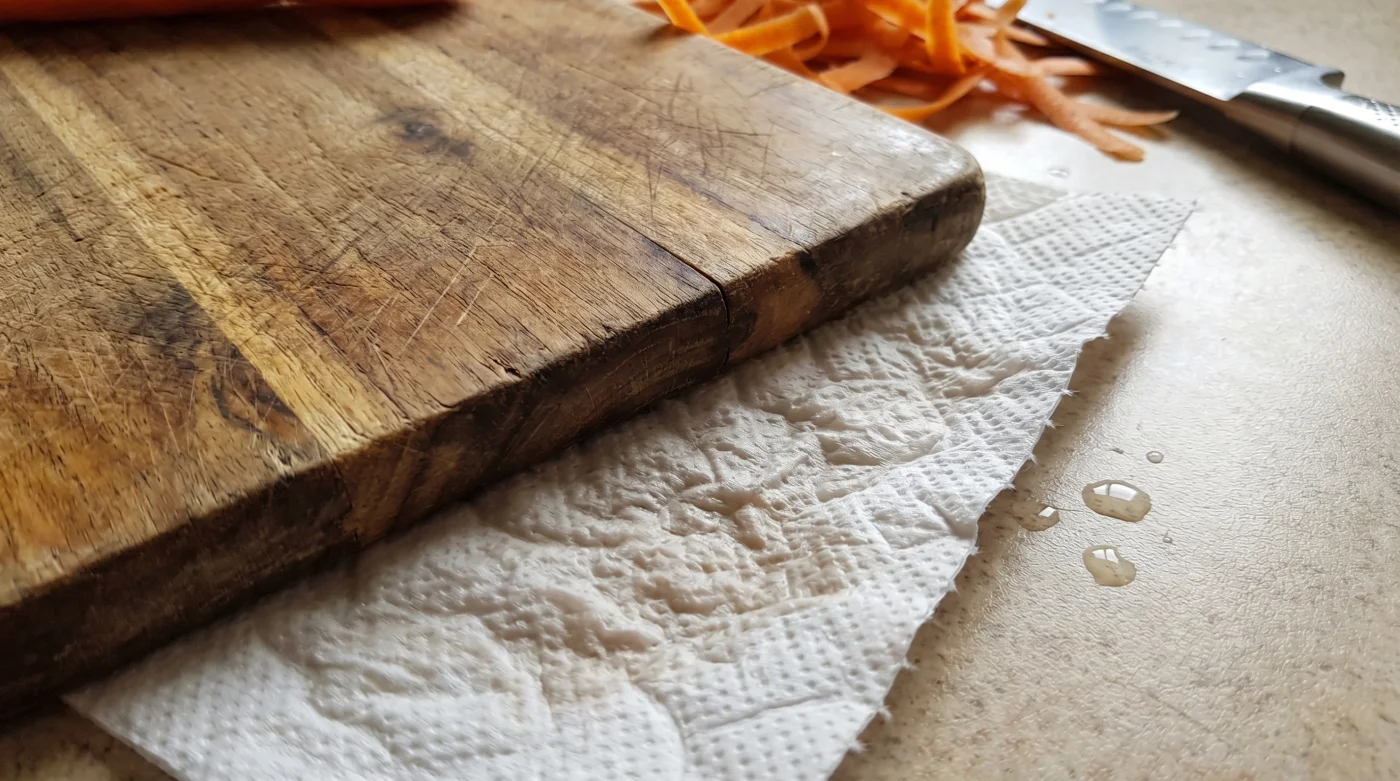
Water fundamentally changes the physical equation between the counter and the wood. By placing a damp, textured paper towel beneath the cutting surface, you create thousands of microscopic suction cups. This fragile, damp barrier grips the slick counter on one side and the dense board on the other, locking the whole assembly into place with startling rigidity. What was once a slippery liability becomes a stubbornly rooted foundation for your work.
In a cramped, fiercely hot bistro kitchen in Montreal’s Plateau neighbourhood, a 52-year-old sous-chef named Marcel constantly watches new cooks struggle during service. They usually blame dull knives or tough winter root vegetables when their brunoise dice turns out sloppy. Marcel simply walks over, lifts their drifting board, and flattens a damp, wrung-out paper towel underneath. He presses his considerable weight onto the wood, smiles as it refuses to budge, and hands the knife back. The problem is the foundation, never the blade.
Tailoring the Anchor for Your Setup
Not all cutting surfaces behave the same way under the knife, and your approach to securing them should adapt to the materials you pull from your cupboards. A thick end-grain block reacts differently to moisture than a flexible piece of high-density plastic. The tension you create beneath the board must directly match the weight of the tool you are using to chop your ingredients.
Thin plastic boards are notorious for curling at the corners and skidding away at the worst possible moments. A single, fully opened paper towel—wet and squeezed until it is barely damp—spread wide across the centre of the board’s footprint gives maximum surface area contact. This wide, damp anchor creates enough surface tension, forcing the plastic to lie completely flat against the counter.
Heavy wooden heirloom boards already have gravity working in their favour, but they will still drift under the aggressive pressure of butchering a chicken or aggressively kneading a dense bread dough. Instead of a wide square, fold the damp towel diagonally to create a thicker, concentrated strip of friction directly down the middle. This bolsters the weight without trapping unnecessary excess moisture against your valuable wood for hours.
If reaching for a single-use disposable product feels completely out of step with your kitchen ethos, a thin cotton bar mop or a worn linen tea towel works identically. The fabric must be incredibly thin—like breathing through a pillow—so the board doesn’t rock back and forth like a seesaw. Run it under the tap, wring until your hands ache, and lay it dead flat.
The Mindful Application
Securing your workspace takes less than five seconds, but performing this action with intention shifts your mindset from rushed and frantic to calm and ready. It is a quiet, deliberate ritual that signals to your brain that you are about to cook with total focus. You are actively choosing safety and precision over chaotic rushing.
Building this habit into your daily routine transforms meal prep from a chore into a grounded practice. The steps are beautifully minimalist, requiring no special tools and demanding only a few deliberate, quiet movements to execute properly.
- Tear off a single, high-quality half-sheet of paper towel.
- Run it under cold tap water until every fibre is fully saturated.
- Squeeze the paper into a tight ball in your fist, extracting every loose drop of water until it feels merely cool to the touch.
- Unfold it gently, smoothing out the major wrinkles, and lay it directly in the centre of your workspace.
- Place your cutting board squarely on top and give it a firm, downward push to seal the grip.
Your tactical toolkit for this method is incredibly simple, but the details matter to protect your tools. Always use cold water to prevent the paper fibres from disintegrating in your hands. Ensure the towel is genuinely damp, never dripping, to prevent water from pooling and seeping into the grain of untreated wooden boards. Aim to cover at least fifty percent of the board’s underside footprint for a truly immovable grip.
The Foundation of Confidence
When your board stops moving, your entire physical posture changes for the better. You naturally stop gripping the knife handle quite so tightly, allowing your wrist to work with fluid grace. Your non-dominant hand learns to relax into the classic, protective claw grip without the lingering fear of a sudden slip. The unconscious tension finally bleeds out of your shoulders and neck.
Cooking ceases to be a wrestling match with your stubborn ingredients. A stable, anchored surface guarantees more precise, uniform cuts, which naturally leads to perfectly even cooking times and significantly better flavours in the pan. You quickly realize that high-level culinary technique is rarely about raw speed; it is simply about setting up your environment so beautifully that mistakes become difficult to make.
‘A slipping workspace robs you of the joy of cooking; anchor your board, and you anchor your mind to the task at hand.’
| Key Point | Detail | Added Value for the Reader |
|---|---|---|
| The Suction Effect | Water combined with the texture of paper creates microscopic grip. | Prevents lateral slipping instantly, saving you from dangerous knife slips. |
| Moisture Control | The towel must be thoroughly wrung out until barely damp, never dripping wet. | Protects expensive wooden boards from warping or developing mildew. |
| Sustainable Swaps | Ultra-thin linen tea towels or cotton bar mops work just as well as paper. | Allows you to maintain a zero-waste kitchen while achieving professional safety. |
Frequently Asked Questions
Will a wet paper towel damage my expensive wooden cutting board? Not if you wring it out properly. The towel should be barely damp, feeling cool rather than wet. Remove it immediately after you finish cooking and wipe the counter dry.
Can I just use a rubber shelf liner instead? You can, but shelf liners harbour bacteria if not washed rigorously, and they often degrade over time. A damp towel is freshly clean every time you cook.
Does this trick work on heavily textured tile countertops? Yes, though you may need to use a slightly thicker barrier, like a damp cotton bar mop, to fill in the uneven grout lines and create a level surface.
Why shouldn’t I use warm or hot water? Hot water breaks down the delicate paper fibres much faster, leaving a pulpy, frustrating mess stuck to your counter when you try to clean up.
What if my plastic board is permanently warped? If it spins like a top, a damp towel won’t fix structural damage. It is time to recycle that board and invest in a heavier, flat surface.