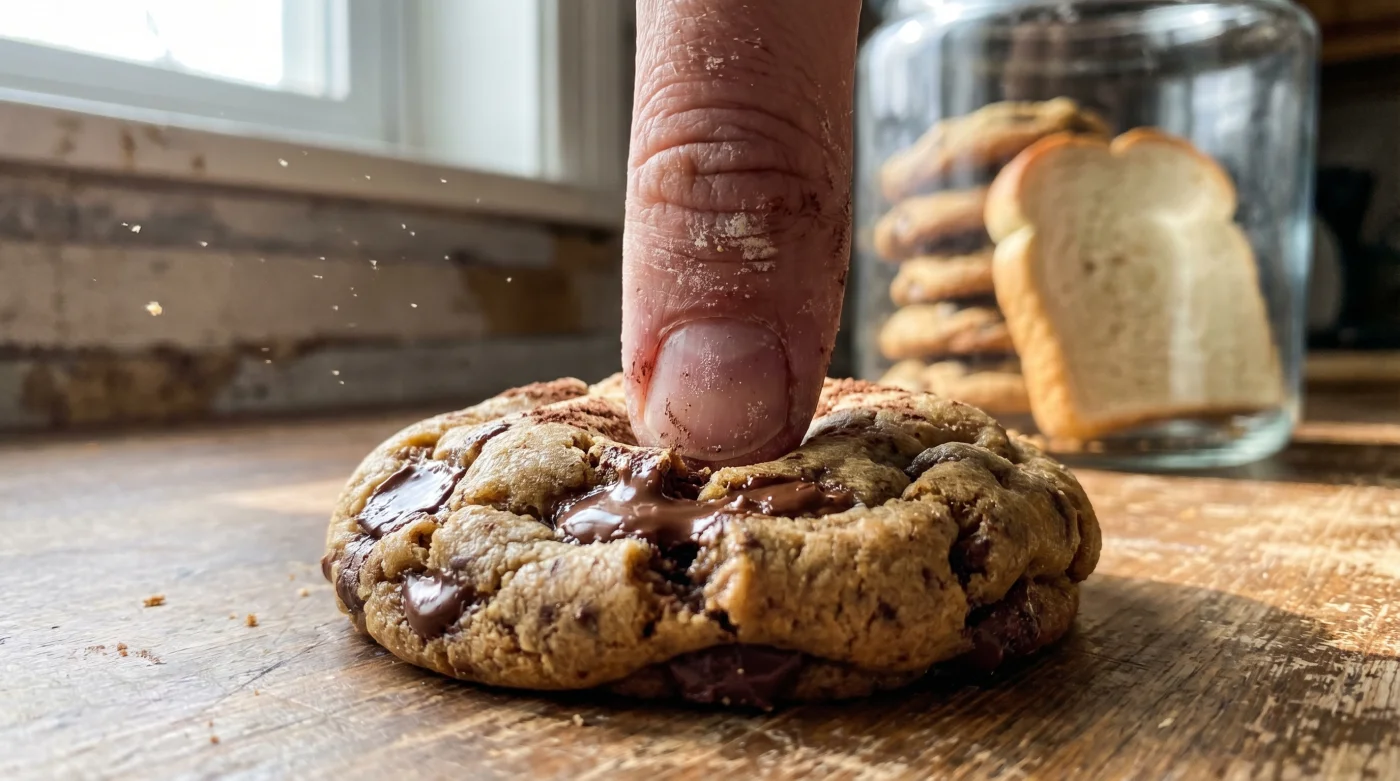
The oven timer chimes, and the kitchen fills with the heavy, comforting scent of caramelized brown sugar and melting butter. You pull the tray from the heat, the edges of each cookie deeply golden, the centres trembling just slightly under the surface. They cool on the wire rack as the frost begins to creep up the windowpanes of your kitchen, promising a perfect, soft bite to pair with a mug of strong black tea. The room feels warm, safe, and entirely disconnected from the freezing winds outside.
By the next afternoon, that promise is broken. You reach into the ceramic jar on the counter, expecting the familiar, yielding texture of a fresh bake. Instead, your teeth meet fierce resistance. The delicate, chewy interior has vanished overnight, leaving you with a disc that threatens to snap like stale drywall.
It is a quiet, specific kind of disappointment. You did nothing wrong with the recipe, pulling the dough from the 175 Celsius heat at the exact right minute. The failure happened in the storage, an invisible theft of moisture that occurs the second the lid goes onto the cookie jar, pulling the life out of your baking while you sleep.
You do not need a complicated gadget or a costly vacuum-sealer to reverse this frustrating reality. The solution is resting quietly on your counter right now, wrapped in plastic. It involves turning a mundane, everyday sandwich staple into a sacrificial moisture donor.
The Moisture Migration
Think of a freshly baked cookie as a living sponge. When it leaves the oven, it is swollen with steam, butter, and liquid sugars. As it sits in a container, the dry ambient air immediately begins pulling that moisture outward, seeking an environmental balance. Starch retrogradation begins, pulling water molecules away from the soft structure and turning the crumb rigid.
This is where the magic of a cheap slice of white bread enters the equation. You are not just tossing bread into a jar; you are setting up a closed-loop humidity system. The bread acts as a localized humidifier, freely offering up its own soft, yielding crumb structure to the thirsty air before the cookies have to sacrifice theirs.
Clara, a sixty-two-year-old baker running a tiny neighbourhood cafe in Halifax’s North End, relies on this exact chemistry. Her molasses cookies are famous for staying impossibly tender, even during the brutally dry Maritime winters. She avoids chemical dough conditioners, relying instead on a trick her grandmother taught her decades ago to keep the display cases flawless.
If you look closely at her glass domes, there is always half a piece of grocery-store sandwich bread tucked under the parchment doily. It is a quiet, old-school kitchen fix, constantly absorbing the atmospheric stress so the main attraction remains completely pristine for her morning rush of customers.
Tailoring the Environment
Not every baked good reacts to this humid environment in the exact same way. Understanding the specific needs of your recipe ensures you aren’t accidentally ruining a crisp texture that was actually meant to stay that way.
The classic chewy chocolate chip and the dense oatmeal raisin are the prime candidates for the bread trick. Because they rely heavily on brown sugar, which naturally loves to attract and hold water, they eagerly absorb the ambient humidity provided by the bread slice, staying plump and deeply satisfying for nearly a week on the counter.
Conversely, you must never introduce bread to containers holding delicate shortbread or almond biscotti. These treats rely on a strictly low-moisture environment to maintain their signature snap and buttery flake. Adding humidity to these jars will turn a beautiful biscuit into a soggy disappointment.
Frosted sugar cookies require a slight modification to this method. Royal icing can act strangely when introduced to extra humidity, sometimes softening and bleeding its colours. If you must soften the cookie underneath, lay a small piece of wax paper over the icing before resting the bread inside, preventing the bread from marring the decorative finish.
The Five-Second Humidity Hack
Applying this method requires almost zero effort, but doing it with intention guarantees the absolute best results. It is the ultimate lazy fix, demanding nothing more than opening a bag and tearing a slice to preserve your hard work and expensive ingredients.
To set up your container properly, you need to understand the physical placement. You want the moisture to circulate freely throughout the jar without ever causing localized soggy patches on the cookies directly touching the bread.
- Choose your bread: Plain, ultra-processed white bread works best. Its neutral flavour profile will not transfer to your baked goods, unlike a sharp sourdough or an earthy rye.
- Cool completely: Never seal warm cookies in a jar. Let them cool on a rack until the chocolate is fully set and the bottoms are completely at room temperature.
- Layering technique: Place your cookies in an airtight container. Lay a piece of parchment paper over the very top tier to act as a breathable physical barrier.
- The placement: Rest a single slice of white bread directly on top of the parchment paper, then seal the lid tight.
- The replacement protocol: Check the jar after two days. The bread will be hard as a crouton, having given all its moisture away. Toss it and replace it with a fresh slice if the batch is still lingering.
Preserving the Comfort
We bake to create moments of pause in an otherwise chaotic week. A handmade treat is a quiet rebellion against the rush of the day, a small luxury to be enjoyed when the rain is hitting the roof or the afternoon slump hits hard. Pulling a perfect cookie from the jar is a ritual that grounds us.
When you open that jar three days later and find the texture just as perfect as the afternoon you baked them, it feels like a tiny victory. You aren’t just saving food from the compost bin; you are actively protecting the initial effort you poured into the mixing bowl.
This simple, rustic logic reminds us that the most effective solutions in the kitchen rarely come from a boutique cooking store. They come from understanding the natural behaviour of the ingredients right in front of us, and responding with gentle practicality.
In a world obsessed with complicated culinary gadgets, there is profound satisfaction in a method that simply works without a fuss. The secret to professional-level longevity requires nothing more than the humblest item on the shelf.
The best baking secrets do not come from a laboratory; they come from grandmothers who refused to let good food go to waste.
| The Approach | The Mechanism | The Result for You |
|---|---|---|
| The Countertop Leftover | Exposed to dry air and shifting room temperatures. | A rock-hard disappointment by morning. |
| The Apple Slice Myth | High moisture transfer combined with active fruit enzymes. | Soft cookies that taste weirdly like orchard fruit. |
| The White Bread Method | Neutral starch donates pure ambient humidity safely. | Flawless texture with absolutely zero flavour transfer. |
Frequent Kitchen Concerns
Will the cookies taste like yeast or sandwich bread?
Not at all. Standard, highly processed white bread has a completely neutral flavour profile that will not transfer to your baking.How long does the bread take to work?
You will notice a significant softening within six to eight hours. Overnight is the ideal timeframe for a full texture reset.Can I use brown bread or multigrain instead?
It is not recommended. Whole grains and seeds contain specific oils and stronger aromas that can easily seep into delicate vanilla or butter-based cookies.What if my cookies are already rock solid?
The bread can actually reverse the staling process to a degree. Place two slices in the jar instead of one, and give it twenty-four hours to rehydrate the crumb.Does this work for store-bought cookies?
Absolutely. If a box of bakery cookies has gone stiff on the counter, transferring them to an airtight container with a slice of bread will bring them back to life.