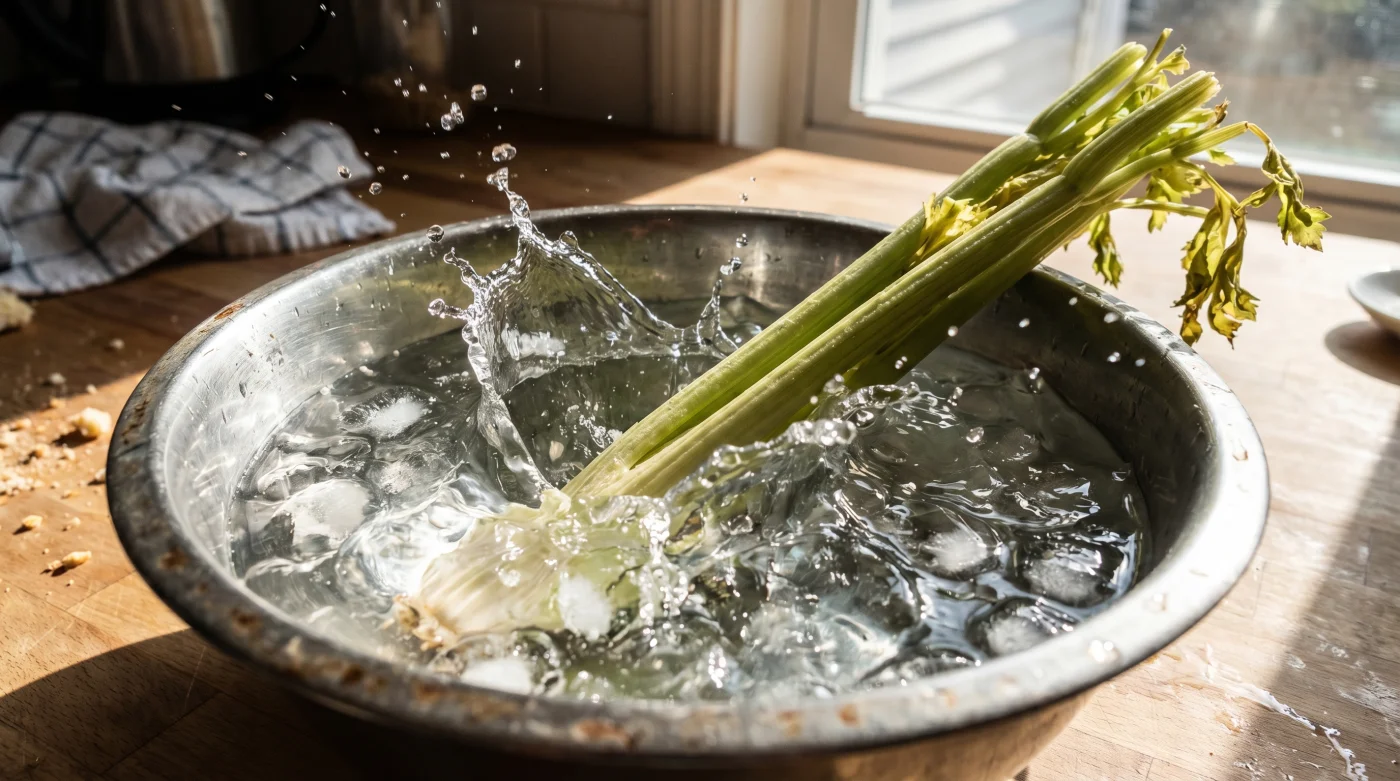
You pull open the crisper drawer, greeted by the low hum of the refrigerator and the faint, earthy smell of cold root vegetables. The plastic tracks screech slightly as you reach into the back corner, searching for the bunch of celery you bought just a few days ago for a specific recipe. You anticipate the rigid, heavy feel of a fresh, water-dense stalk. Instead, your fingers wrap around something soft and pliant. It bends without resistance, forming a sad, rubbery arc that looks more like a deflated garden hose than a crisp foundation for your evening meal.
It is a remarkably specific disappointment. You mentally tally the rising cost of Canadian groceries, the effort spent driving to the market, and the sheer annoyance of having to pivot your dinner plans on a Tuesday night. The instinct is to toss the entire limp bunch straight into the compost bin, assuming it has crossed the point of no return. You imagine the satisfying, shattering snap of fresh celery, completely absent from the sad vegetation resting heavily in your palm.
But that drooping stalk is holding a secret, one that fundamentally shifts how you handle your kitchen inventory. The loss of rigidity is not an indicator of decay or rot; it is a quiet plea for hydration. In a professional kitchen setting, a limp stalk is never considered an endpoint. It is viewed as a temporary state of dormancy waiting for a simple, elemental intervention.
All it takes is a bowl of cold water to completely alter the situation. By understanding the physical mechanics of plant cells, you can coax that thirsty vegetable back from the brink, transforming a frustrating kitchen failure into a resounding, loud crunch that rivals the day it was pulled from the soil.
The Architecture of Thirst
Think of your celery stalk not as a solid, static object, but as a densely packed bundle of microscopic water balloons. When it sits in the dry, constantly circulating air of your refrigerator—especially during long, dry Canadian winters when constant indoor heating accelerates ambient moisture loss—the water slowly evaporates through the semi-permeable skin. The tiny balloons deflate. The entire cellular structure sags under its own weight.
This limpness feels like a fatal flaw to a home cook, but it is actually a remarkable advantage. The structural integrity of the vegetable remains completely intact. The cellular walls are undamaged; they are simply empty. Instead of viewing the wilted state as a sign of spoilage, you must recognize it as a state of extreme readiness. When you introduce a sudden, frigid bath, those deflated cells greedily pull the moisture back across their membranes to achieve equilibrium.
This process relies on osmosis, and it is the kitchen secret that saves professional pantries thousands of dollars every single year. The water does not just wash the exterior dust away; it actively reinflates the internal architecture of the plant. The freezing temperature is just as crucial as the moisture, as it rapidly contracts the outer fibres, trapping the absorbed liquid inside and restoring a heavy, dense firmness.
Consider the daily morning routine of Marie-Claire, a forty-eight-year-old prep cook at a bustling, locally sourced bistro in the heart of Montreal. Every morning at six, before the delivery trucks even arrive, she stands before crates of produce that have languished over the busy weekend service. She never discards the drooping celery or the soft, bending carrots. Her method relies on aggressive, freezing thermal shock to bring celery back to life. She draws a massive, heavy stainless steel basin of icy water, slicing the dried ends off the stalks and plunging them directly into the freezing bath. ‘They just forgot how to stand up,’ she notes, pulling out rigid, vibrant green stalks thirty minutes later. Her approach relies on mechanical biology rather than waste, ensuring pristine ingredients before a single customer sits down to eat.
Adjustment Layers for Your Kitchen
The underlying mechanics of osmosis remain exactly the same, but your practical approach must shift depending on how you plan to use the revived vegetable. You need to adapt the soak to your specific culinary goal.
For the Raw Snacker
If you are planning to eat the stalks raw, perhaps smeared with almond butter or scooped into a bowl of garlic hummus, texture is absolutely everything. You demand maximum turgor pressure to counteract the heavy dips. Slice the celery into small, manageable sticks beforehand, deliberately exposing more surface area to the liquid. Drop them into a bowl filled with water and floating, solid ice cubes. The intense cold tightens the exterior cells rapidly, ensuring a sharp, resounding loud crunch the moment your teeth break the surface.
For the Soup Maker
When preparing a traditional mirepoix for a hearty winter stew or a restorative chicken noodle soup to fight off a cold, the aesthetic shape matters far less. However, you still require internal firmness to achieve an even, safe dice. You can skip the messy ice cubes for this application. Simply use standard tap water chilled to its coldest setting. Leave the stalks entirely whole, trimming only the dried, white base and the slightly browned leaves at the top. This provides enough resistance to slide smoothly under your chef’s knife without turning to mush on your wooden cutting board.
For the Proactive Prepper
If you routinely struggle with wilting produce week after week, change your storage system entirely. Do not wait for the celery to collapse. Instead of leaving the bunch suffocating in its plastic grocery sleeve, process the stalks the moment you return from the market. Store them standing vertically in a tall glass mason jar filled with cold tap water, sealing the lid tightly to prevent spills. You will find that the celery maintains a pristine, rigid posture for up to two full weeks, waiting in the fridge exactly when you need it.
The Cold Water Protocol
Reviving wilted celery is not about aggressive cooking techniques; it is about mindful observation and patience. You are simply facilitating a deeply natural biological process. The necessary steps are quiet, deliberate, and require barely any active physical effort on your part.
First, carefully assess the stalk to ensure there is no actual sliminess, black mould, or rotting pulp, which cannot be reversed by any amount of water. You are looking purely for a loss of stiffness and a dulling of the green hue. You must prepare your workspace carefully, clearing out the sink and locating a glass or metal vessel large enough to submerge the vegetable entirely without bending it further.
Follow these mechanical steps to execute the kitchen secret perfectly:
- Cut a thin, quarter-inch slice off the very base of the stalk to open up the dried capillaries.
- Fill a long container, roasting pan, or deep baking dish with fresh cold tap water.
- Drop in three to four ice cubes to forcefully drop the temperature down closer to zero degrees Celsius.
- Submerge the celery completely, weighing it down with a small plate if necessary to ensure no part of the stalk is exposed to the dry air.
- Leave the dish resting on the counter for exactly 30 minutes, or place it in the fridge for up to two hours for severely limp, lifeless stalks.
The Tactical Toolkit: The ideal water temperature sits between 1°C to 4°C. Your soaking time scales from 30 minutes for mild drooping to a full 120 minutes for severe wilting. The most critical tool is a highly sharpened paring knife to make a clean, uncrushed cut across the base, preventing the tiny vascular tubes from sealing shut.
Beyond the Crisper Drawer
Mastering this incredibly simple cold soak does far more than just save a few dollars on your weekly grocery bill. It fundamentally alters your relationship with the raw materials resting in your kitchen. You slowly stop seeing ingredients as fragile, highly perishable burdens that strictly dictate your cooking schedule.
Instead, you start understanding them as dynamic, living materials that respond directly to your care and attention. When you learn to bring celery back to life, you reclaim control over food waste. The lingering anxiety of a forgotten vegetable drawer begins to fade entirely. You realize that a slight physical imperfection is not a culinary failure, but merely an opportunity to apply a gentle, thoughtful corrective measure.
This practice roots you firmly in the quiet, present moment of your home kitchen environment. The loud, sharp sound of a revived stalk snapping cleanly under your heavy chef’s knife becomes a small, deeply private victory. It serves as a quiet reminder that with a tiny bit of patience, respect for the ingredient, and a bowl of cold water, almost anything can be refreshed, restored, and put to highly productive use.
A wilted vegetable isn’t ruined; it is simply asking for a glass of cold water to remember how to stand up.
| Key Point | Detail | Added Value for the Reader |
|---|---|---|
| The Fresh Cut | Slicing 1/4 inch off the base exposes fresh vascular tissue. | Speeds up the hydration process by allowing water to enter the stalk freely. |
| Temperature Control | Keeping water between 1°C and 4°C using ice cubes. | Contracts outer fibres for a louder, more satisfying crunch upon eating. |
| Total Submersion | Ensuring no part of the celery is exposed to air. | Guarantees even turgor pressure so the entire stalk snaps uniformly. |
Frequently Asked Questions
Can I use this method on celery that has turned brown or slimy?
No. Sliminess or severe discoloration indicates bacterial breakdown and rot. This cold soak only reverses dehydration, not decomposition.Do I need to peel the outer strings before soaking?
Leave the strings completely intact during the soaking phase. They provide necessary structural support while the stalk reinflates with water.Can I revive other wilted vegetables using this exact same method?
Yes. Carrots, radishes, broccoli florets, and even limp salad greens respond beautifully to a brief, icy thermal shock.Will the celery lose its flavour if it sits in water too long?
If left submerged for more than a day without a lid, some soluble flavour compounds may leach out. Stick to a two-hour maximum soak for immediate use.Should I add salt or baking soda to the soaking water?
Keep the water completely plain. Adding salt alters the osmotic balance, which can actually draw more water out of the celery and worsen the wilting.