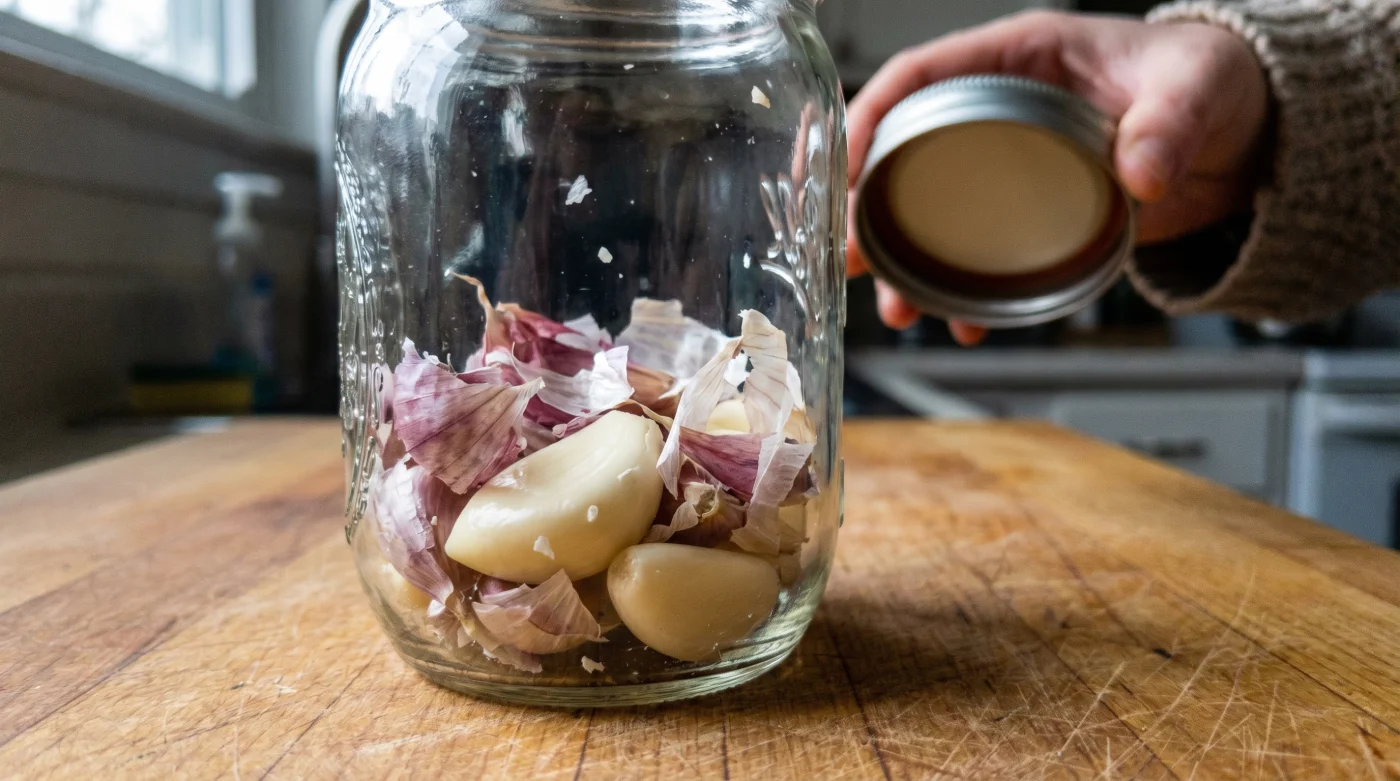
The kitchen counter at six o’clock in the evening. The wooden chopping board smells faintly of yesterday’s onions, and the overhead light casts a harsh glow over the ingredients waiting to be prepped. You are staring down a bulb of garlic, its papery skin clinging stubbornly to the tight cluster of cloves. Your fingers are already slightly damp, meaning the delicate, translucent membrane is about to fuse to your skin like glue.
The usual method involves crushing it with a blade, pressing the flat of your chef’s knife against the clove until you hear a wet snap. But that action releases the pungent oils far too early, leaving a slick, highly aromatic residue on your hands that will easily linger for two days. You pick at the edges with your fingernails, catching a sliver of the brittle white wrapper, feeling a familiar, quiet frustration mount as the skin tears into microscopic shreds.
It is one of those tiny, mundane culinary frictions. It is a chore that quietly saps the momentum of making a weeknight dinner. You just want the bright, sharp bite of raw garlic for your salad vinaigrette or the mellow sweetness of roasted cloves for a pan sauce, but first, you have to fight an uphill battle against a natural wrapper designed by evolution to be impenetrable.
The professional kitchen reality involves bypassing the tedious work entirely. Professional prep cooks do not have the time to pick at paper skins. They rely on basic physics to separate the husk from the flesh. The solution to your sticky fingers requires nothing more than an empty jam jar and five seconds of violent noise.
The Physics of Kitchen Friction
We often treat peeling garlic as a delicate surgical procedure. We peel, we scrape, we rinse our fingers under cold tap water to dislodge the sticky paper. But if you change your perspective, you will see the garlic skin not as a wrapper to be carefully unwound, but as a brittle shell waiting to be fractured.
Stripping the skin requires blunt concussive force, not fine motor skills. The firm flesh of the garlic clove contains moisture and has a slight elasticity, while the papery skin is completely dry and rigid. When you subject the clove to rapid impact, the firm interior flexes slightly, breaking the tight adhesive bond holding the unyielding skin in place.
It is a complete shift in your prep approach. You trade the slow, sticky annoyance of manual peeling for a brief, incredibly loud burst of chaotic energy. The ‘lazy fix’ you might have seen circulating online is actually just applied mechanics, stripping away the outer layers through rapid deceleration.
Marcelle, a forty-two-year-old prep cook at a bustling, tight-quartered French bistro in Montreal, processes roughly three kilograms of garlic before the lunchtime rush even begins. “I used to lose my mind picking at those little skins by the prep sink,” she told me once, wiping her hands on an apron dusted with flour. “Now, I just throw them in two metal bowls clamped together and shake like I’m angry at the world. The garlic peels itself in ten seconds.” We can easily adapt Marcelle’s industrial, deafening method for the quiet home kitchen using a simple glass jar.
Scaling the Method: From Roasts to Sauté
Not all meals require the same volume of aromatics, and the shaking method adapts seamlessly depending on what your recipe demands. The volume of the container simply needs to match the volume of the ingredient.
When you are making a forty-clove chicken or prepping for a massive batch of Sunday tomato sauce, you need to leave ample empty space for the technique to work. Use a large, one-litre Mason jar or two matching mixing bowls like Marcelle. You must leave about two-thirds of the container completely empty so the garlic has enough room to build momentum before crashing into the walls.
If you only need two or three cloves for a quick weeknight stir-fry, a massive vessel is overkill and frankly, less effective. The cloves will just slide around the bottom without hitting the walls with enough force to shatter the skins.
A small, cleaned-out mustard jar provides sharp, unyielding glass walls in a tight space. The enclosed area creates a sharper impact for smaller quantities. You will actually hear the pitch of the rattling change as the skins detach from the flesh, usually within a matter of a few shakes.
Adapting to the Varietals
Canadian supermarkets typically stock imported softneck garlic year-round. This variety is notorious for its clingy, tight-fitting wrappers and numerous, irregularly shaped cloves. The shaking method is practically mandatory here, saving you from picking at the tiny inner cloves that are mostly skin.
If you buy local hardneck garlic from an Ontario or British Columbia farmers’ market in the late summer, you will notice the skin is thicker and naturally looser around the central stalk. You must be gentle; shake too hard and you risk bruising tender cloves, releasing the allicin compounds that make garlic taste bitter when oxidized.
The Five-Second Ritual
The process is remarkably minimal. It asks you to stop picking at the edges, put down your paring knife, and commit to a brief moment of forceful action. It is about working smarter, not harder.
- Separate the whole bulb into individual segments, pulling them away from the dry central stem.
- Drop the unpeeled pieces into a hard-sided container—glass or metal—with a tight-fitting lid. Plastic dampens the impact and will not work.
- Seal the lid securely and shake vigorously up and down for roughly five to eight seconds.
- Pour the contents onto your cutting board and pluck the perfectly bare, smooth cloves from the pile of discarded husks.
The tactical toolkit for this method is incredibly basic, but precision matters. Your container must be rigid. Your shaking motion must be aggressive and vertical. And crucially, ensure your garlic is at room temperature; cold skins straight from the refrigerator cling to the flesh much tighter than warm ones.
Reclaiming the Rhythm of the Kitchen
Mastering this tiny, seemingly insignificant detail isn’t just about getting dinner on the table exactly one minute faster. It is about removing a persistent, sticky roadblock from your evening routine. It is about preserving your mental energy for the parts of cooking that actually require your attention, like balancing the acid in a sauce or nailing the sear on a piece of fish.
Cooking at home should feel like a fluid, uninterrupted cooking rhythm. It should be a steady, calming progression of chopping, heating, listening, and tasting. When you eliminate the frustrating micro-tasks—the peeling, the scraping, the constant washing of sticky hands—you protect that rhythm.
You begin to realize that the kitchen doesn’t have to be a place of endless, tedious labour. Sometimes, the most effective, authoritative technique is simply closing the lid tightly, shaking the jar, and letting the simplest laws of physics do the heavy lifting for you.
“The best prep cooks aren’t the ones who chop the fastest; they are the ones who completely engineer the friction out of their workspace before the knife even hits the board.”
| Key Point | Detail | Added Value for the Reader |
|---|---|---|
| The Container | Must be rigid glass or metal (Mason jar, jam jar, steel bowls). | Ensures maximum concussive force, guaranteeing the skins shatter rather than just bounce. |
| The Volume | Leave 2/3 of the jar empty. | Provides the necessary runway for the cloves to build speed and impact the walls effectively. |
| The Temperature | Room temperature cloves work best. | Prevents the moisture condensation found in cold garlic from gluing the paper skin to the flesh. |
Frequently Asked Questions
Does this method bruise the garlic?
Not if done for the recommended five to eight seconds. Softneck grocery store garlic is highly resilient. Hardneck garlic requires a gentler shake.Why isn’t it working in my plastic container?
Plastic absorbs impact. The walls flex when the garlic hits them, dampening the force needed to crack the brittle skin. Switch to glass or metal.Do I need to cut the root ends off first?
No. The concussive force is enough to separate the skin from the root base entirely. You can trim the hard root nub after peeling.Can I do an entire bulb at once?
Yes, but you must manually separate the bulb into individual cloves first. The central stalk will prevent the cloves from impacting the jar walls properly.Will the jar retain a garlic smell?
Since the cloves remain whole and uncrushed during the shaking, very little garlic oil is released. A standard wash with hot soapy water clears any residual scent.