Picture a dark, bitterly cold November morning in Toronto. The kettle whispers quietly on the stove, frost lightly coats the kitchen windowpanes, and you are finally ready to bake those perfect, chewy oatmeal cookies you have been obsessively thinking about all week. You reach confidently into the dark corner of the pantry, pull out the familiar, crinkling plastic bag, and your heart immediately sinks.
Feels like a solid brick. A stubborn, unyielding block of molasses-coated crystals that mocks your sudden craving and threatens to derail your entire morning. Standard home-baking reality dictates you must now hack at it with a heavy butter knife, risking minor injury and immense frustration, or aggressively microwave it until it sadly melts into a hot, sticky, unusable puddle that ruins your dough.
Professional kitchens simply do not tolerate this kind of violent, unnecessary disruption. Behind the swinging metal doors of a quiet, flour-dusted patisserie, experienced bakers treat moisture as a delicate currency that must be gently managed, never fought. They know deeply that this sweet, aromatic ingredient does not inherently want to turn into a geological fossil; it simply responds to the harsh, unforgiving environment you carelessly force upon it.
You need a moisture mediator. Instead of furiously treating the symptom with brute force at the very last minute, you can gracefully prevent the loss of hydration entirely by introducing a soft, sacrificial guardian to your pantry shelf, completely solving the problem long before you ever preheat the oven.
The Perspective Shift: The Moisture Economy
Most of us view baking as a strict set of cold instructions, blindly measuring out ingredients without questioning how they physically behave while waiting to be used. We shove half-open bags back onto shelves, folding the flimsy plastic over and blindly hoping for the best. But think of a tightly sealed container as a tiny, isolated ecosystem that requires a very delicate balance to thrive.
Crystals are literally constantly breathing. When the ambient air inside your canister dries out, the delicate molasses coating that gives those crystals their rich, caramel chew begins to quickly evaporate. The grains pull tightly together as they dry, forming a rigid physical matrix as stubborn as setting concrete.
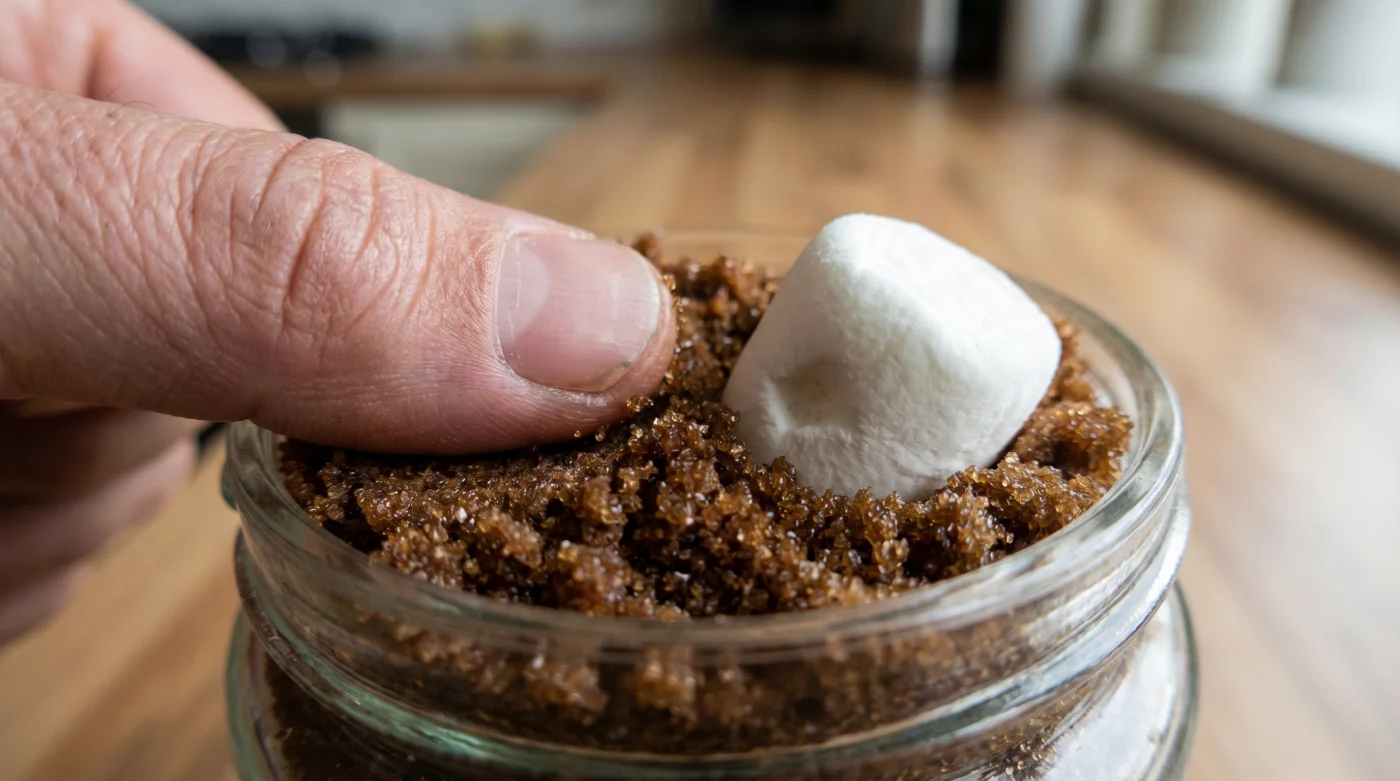
The simple swap is introducing an item that naturally holds more easily accessible hydration than the surrounding crystals themselves. Add a marshmallow to that tiny ecosystem, and you establish a continuous, self-regulating loop of hydration. The delicate molasses draws exactly what it needs from its spongy companion, remaining indefinitely soft without ever becoming wet, soupy, or clumpy.
Consider the meticulous morning routine of Clara Henderson, a forty-two-year-old pastry chef running a high-volume bakery in downtown Halifax. Years ago, after shattering her favourite stand-mixer paddle on a petrified block of dark muscovado, Clara immediately stopped relying on expensive terracotta discs that needed constant soaking. She tossed two standard, pillowy marshmallows into her heavy twenty-litre storage bins instead. It became a permanent kitchen rule. The supply stays pliable enough to seamlessly scoop with a bare hand, while the marshmallows quietly sacrifice their own softness to continuously protect the morning bake.
Deep Segmentation: Adapting the Hydration Hack
Not every home kitchen operates at the exact same rhythm, and baseline moisture levels fluctuate wildly depending on where you happen to live and how often you actually cook. How you specifically deploy this clever method depends entirely on your personal consumption habits and the specific storage containers you currently rely on.
For the occasional Sunday baker. You might only dip into your sweet supply once a month when a specific, overwhelming craving finally strikes. In a standard airtight glass jar, a single large marshmallow resting gently on top of the mound is your absolute ideal defence. It will slowly harden over six to eight months, quietly doing its job while keeping the dense layer below perfectly scoopable.
For the highly organized seasonal batch preparer. If you eagerly buy in heavy bulk during the winter holidays and leave large bags sitting in a cold, dry basement pantry, you are facing severe environmental moisture loss. Divide your massive bulk purchase into smaller, strictly sealed acrylic containers, placing one fresh marshmallow in the dead centre of each vessel to guarantee perfectly even distribution.
For the humid summer kitchen. If you live in a region where August air consistently feels like a heavy wet towel, you might mistakenly think you do not need this specific intervention. But modern air conditioning violently strips moisture from indoor environments, creating an artificial desert. Maintain the marshmallow protocol year-round to ensure flawless ingredient consistency when the cooling unit is running full tilt.
Mindful Application: Executing the Simple Swap
Implementing this technique requires almost zero physical effort, but it relies on paying incredibly close attention to a few specific physical details. You are establishing a permanent structural fix, so taking two extra minutes to deliberately set it up properly will pay immense dividends down the road.
Start with complete environmental isolation. The trick fails entirely if the chosen container breathes and allows dry ambient room air to continuously circulate over the precious crystals.
Transfer your entire supply from its original, flimsy plastic packaging into a heavy glass or heavy-duty acrylic container equipped with a thick rubber gasket. Break apart any minor clumps that have already formed by gently crumbling them between your warm fingers. Place one standard, fresh marshmallow directly on top of the soft mound. Do not deeply bury it; it desperately needs exposed surface area to release its hydration efficiently. Seal the heavy lid firmly and store the jar in a cool, dark cupboard deliberately situated far away from the radiating heat of the stove.
Your Tactical Kitchen Survival Toolkit
- Container: Airtight seal with a thick silicone or rubber gasket to securely lock in the delicate atmosphere.
- Ratio: One standard marshmallow per five hundred grams of product.
- Temperature: Ambient room temperature, hovering comfortably right around twenty Celsius.
- Replacement marker: Physically check the marshmallow every four to six months. When it feels entirely like a hard pebble, swap it immediately for a fresh, squishy one.
The Bigger Picture: A Pantry at Peace
We often blindly accept small, annoying domestic frustrations as simply inevitable parts of running a busy home. Chipping away at a hardened, fossilized brick in the absolute middle of preparing a delicate recipe is exactly the sort of invisible micro-stress that slowly ruins the quiet, therapeutic joy of making food completely from scratch.
Mastering this invisible physical detail removes a sharp, painful point of friction from your sacred cooking space. You are no longer constantly reacting to a sudden, annoying kitchen disaster; you are calmly anticipating the actual physics of your raw ingredients and quietly guiding them into a state of permanent, effortless harmony.
Keeping your raw ingredients absolutely pristine shifts your entire daily mindset directly from frustration to calm, confident readiness. A single, wonderfully inexpensive marshmallow effortlessly transforms an unpredictable, frustrating pantry staple into a reliable, steady constant, waiting faithfully for the exact moment you finally decide to bake.
A kitchen that quietly anticipates its own needs is a sacred space where true creativity can finally breathe without sudden interruption.
| Key Point | Detail | Added Value for the Reader |
|---|---|---|
| Airtight Seal | Use heavy glass or acrylic with a rubber gasket. | Prevents ambient dry air from constantly stealing the localized hydration. |
| The Simple Swap | One large marshmallow per 500 grams. | A cheap, universally accessible alternative to expensive, fussy terracotta stones. |
| Maintenance | Replace the marshmallow when it turns entirely hard. | Guarantees soft, beautifully scoopable results every single time you bake. |
Frequently Asked Questions
Does the marshmallow transfer any strange flavour to the sugar?
Not at all. Standard marshmallows are neutral enough in their flavour profile that they only pass on their ambient moisture, leaving the rich molasses profile completely untouched.What if my supply is already completely rock hard?
Seal it tightly in a container with a fresh marshmallow and calmly wait two to three days. The moisture will slowly migrate, gently softening the brick without any aggressive microwaving.Can I use tiny mini marshmallows instead of large ones?
Yes, though you will definitely need a small handful of them to equal the overall mass and moisture content of a single large one. They also tend to dry out a bit faster.Does this clever hack work for other types of baking ingredients?
It is specifically effective for anything relying heavily on molasses or invert sugars, but it is certainly not recommended for standard white granulated varieties, which should strictly remain bone dry.Will the marshmallow eventually mould or rot in the jar?
Because of the extremely high concentration of sucrose in the sealed environment, dangerous bacteria and mould cannot easily thrive. The marshmallow will simply petrify cleanly over time.