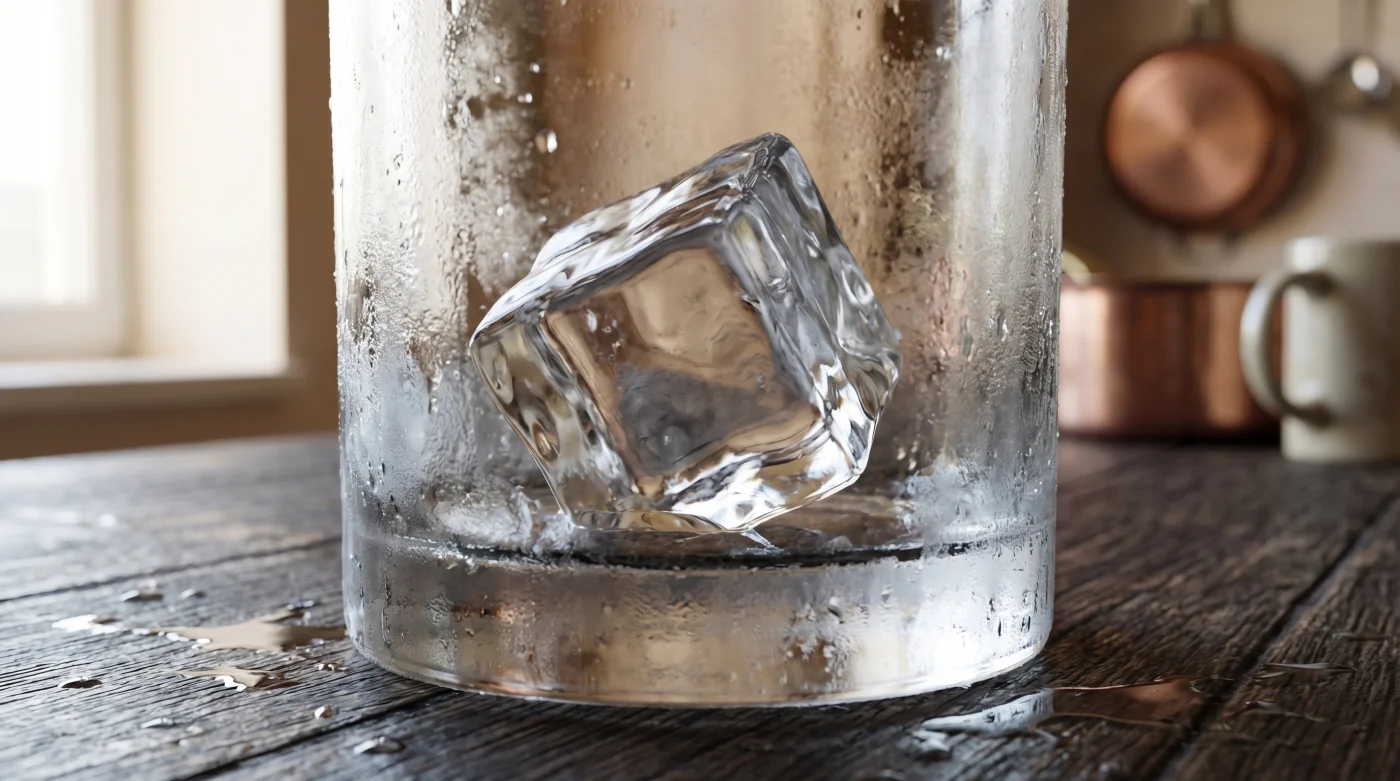
Imagine a heavy glass tumbler resting on a scarred maple countertop in a dimly lit Montreal lounge. You pour an amber liquid over a single, massive cube. Instead of a fractured mass that melts too fast, the cube is completely invisible against the liquid. It looks like a solid block of glass, catching the low light and refracting it in warm, golden flashes. The drink stays cold, but it doesn’t water down.
At home, the reality is usually much louder and messier. You pop open a plastic tray from your freezer, and out tumble opaque, white-centred lumps. They crackle aggressively the moment liquid hits them, cracking and splintering before you’ve even taken a sip. Cloudy ice dilutes flavour quickly, stealing the integrity of whatever you poured over it and leaving you with a watered-down disappointment in a matter of minutes.
But a sudden, viral shift in the hospitality world has leaked out of the service industry and into the home kitchen. High-end bars and national restaurant chains are abandoning expensive commercial ice machines for a remarkably simple, zero-cost method. The secret isn’t a piece of thousand-dollar equipment tucked away in a prep kitchen; it’s a simple kettle sitting on a stove.
By heating the water before you freeze it, you force out the microscopic dissolved gases that create those milky, fragile centres. The boil expels trapped air, leaving nothing but pure, dense water ready to crystallize into absolute clarity. It is a mechanical correction that changes the entire nature of your drink, requiring nothing but a few minutes of heat and a bit of patience.
The Physics of the Freeze
We tend to view freezing as a brute-force action. You put water in a cold box, and it gets hard. But freezing is actually a delicate alignment of molecules, a slow dance of temperature and pressure.
Think of standard tap water as a crowded subway car in downtown Toronto. It is full of invisible passengers—oxygen, nitrogen, and trace minerals. When the doors close and the temperature drops, those passengers panic and freeze. They get trapped in the centre of the ice cube as the outer edges solidify first, creating that cloudy, weak core.
Boiling acts as an eviction notice. By bringing water to 100 degrees Celsius, you agitate those gases until they escape into the air. When you finally pour that calmed, purified water into your molds, the molecules align seamlessly without interruption.
You aren’t just making ice; you are cultivating temporary gemstones. It shifts your perspective from blindly following a recipe to actually managing the physical state of the elements in your kitchen.
The Viral Menu Shift
Take Elias Thorne, a 34-year-old beverage director who recently overhauled the menus for a major Canadian hospitality brand spanning from Halifax to Vancouver. Faced with sudden, critical supply-chain shortages for the premium block ice his team relied on, Elias panicked. He needed thousands of clear cubes a week to meet the new, high-end cocktail standard his brand promised to investors and patrons. His solution was unapologetically analog: he bought massive, industrial soup kettles and standardized a double-boiling protocol for all back-of-house staff.
“We realized the cloudy centre was just trapped breath,” Elias noted during a recent industry seminar in Toronto. “It freezes like polished quartz.” We cancelled our commercial ice contracts the next month and saved the company thousands, all by just letting the water exhale before it sleeps.
Adjusting for Your Setup
The beauty of this method is that it scales precisely to whatever vessels you currently have in your cupboards.
For the Minimalist Host: You don’t need expensive silicone molds to see a difference. Even standard plastic trays benefit immensely from a rolling boil. Your everyday ice will last noticeably longer in a simple glass of tap water. Dense ice holds temperature longer, keeping your drinks cold without breaking down into a slushy mess within ten minutes.
For the Cocktail Purist: If you own large, two-inch silicone spheres or cubes, you are the prime candidate for the double-boil. Boiling the water twice—letting it cool slightly in between—ensures maximum gas extraction. This is the exact protocol Elias used to mimic commercial clarity, producing ice that practically vanishes when submerged in liquid.
For the Large-Batch Prepper: Using a small insulated cooler inside a deep freezer? This technique pairs perfectly with directional freezing. Pouring freshly boiled water into a cooler forces the water to freeze from the top down, pushing any remaining microscopic impurities to the very bottom. You simply chip the cloudy bottom layer away, leaving a massive, flawless slab to carve as you please.
The Boiling Protocol
Preparing this ice requires patience, but the physical steps are minimal. You are simply managing temperature and time, respecting the water enough to let it settle.
Start with a clean pot and the freshest water you have. Filter the water first if your local taps run heavy with calcium or other hard minerals. The minerals in hard water will create a chalky residue no matter how long you boil it.
Bring the water to a rapid, rolling boil for at least three minutes. You want to see large, aggressive bubbles breaking the surface, ensuring the dissolved gases are thoroughly expelled.
Let the pot sit until the water is completely cool to the touch. Rushing this ruins the effect. If you put hot water directly into the freezer, you risk thawing out nearby frozen goods and shocking your ice molds, which can lead to micro-fractures in the final cube. Once cooled, repeat the boil a second time for complete insurance, then let it cool again.
- Water Type: Filtered or distilled (avoid hard tap water directly from the sink).
- Temperature: 100°C for the active boil, cooling to roughly 20°C room temperature in between.
- Freezing Time: 12 to 24 hours depending on the size of your molds.
- Pouring: Pour slowly and close to the tray to avoid reintroducing air bubbles as the water falls.
Cover the tray lightly with plastic wrap before it goes into the freezer. Freezers are violently dry environments that constantly circulate air. If left uncovered, the surface of your ice will sublimate, creating a bumpy, uneven top that detracts from the glass-like finish you’ve worked so hard to achieve. It also acts as a protective skin, ensuring the water doesn’t absorb ambient odours—like last week’s leftover salmon—while it sets.
The Quiet Luxury of Clarity
There is a quiet satisfaction in mastering something so aggressively mundane. Ice is usually an afterthought, a quick chore relegated to the chaotic moments right before guests knock on your door.
By taking the time to boil, cool, and carefully freeze your water, you transform a thoughtless habit into a deliberate act of hospitality. It proves that you care about the minutiae. You respect the entire process, from the glass you choose to the liquid you pour to the chill that binds it all together.
Watching a heavy, invisible cube sit at the bottom of a glass, entirely unbothered by the liquid surrounding it, feels strangely grounding. It is a small, controlled perfection in an otherwise unpredictable week. When you hand someone a drink that looks like a professional pour, you aren’t just serving them a beverage; you are offering them a moment of undisturbed focus.
“The difference between a good drink and a great one is often entirely invisible; it lies in the silence of an uncracked cube.”
| Key Point | Detail | Added Value for the Reader |
|---|---|---|
| Gas Expulsion | Boiling removes trapped oxygen and nitrogen from water. | Prevents the cloudy, weak centre that causes ice to crack instantly. |
| Double-Boiling | Boiling, cooling, and boiling a second time ensures maximum extraction. | Mimics expensive commercial ice machines using standard kitchen tools. |
| Temperature Retention | Clear, dense ice has less surface area exposed to liquid. | Drinks stay ice-cold without rapid dilution of flavour. |
Frequently Asked Questions
Does this work with tap water?
If your municipality has soft water, yes. However, running your tap water through a standard carbon filter first ensures any heavy minerals that cause cloudiness are removed before you boil.Why do I have to let the water cool before freezing?
Placing boiling water directly into your freezer will lower the internal temperature of the appliance, potentially thawing out raw meats and shocking your silicone molds, which causes the ice to splinter as it sets.Can I use an electric kettle instead of a stove pot?
Absolutely. An electric kettle works perfectly, provided you let it reach a full rolling boil and leave it undisturbed while it cools down.Why is there still a tiny cloudy spot at the bottom of my cube?
If you are using a standard tray, freezing happens from all sides at once, trapping the last bit of gas in the centre. Using an insulated cooler (directional freezing) solves this entirely by forcing the ice to freeze from top to bottom.Does boiled ice really taste different?
The ice itself tastes neutral, but because it melts significantly slower than trapped-air ice, it preserves the intended flavour and balance of your chosen beverage for much longer.