Picture the fridge door swinging open on a Tuesday evening in late November. The harsh bulb illuminates the usual suspects: half-empty bags of milk, glass containers of roasted root vegetables, and a block of aged cheddar sitting in its torn plastic film. You reach for it, craving a sharp, crumbly slice to pair with a crisp apple. You press the blade down, but instead of gliding through rich dairy, your knife hits a rigid, discoloured wall.
That hardened, translucent crust is the silent thief of your grocery budget. We slice off these brittle, ruined edges and toss them into the compost pile, accepting this daily waste as the normal cost of eating real food. The refrigerator is effectively a cold desert, aggressively wicking away moisture from everything it touches.
Amid recent local health alerts concerning mycotoxins and harmful mold blooms on poorly wrapped household dairy, how we store our food has suddenly taken on immediate urgency. It is no longer just about preserving taste; it is about protecting your health. Tightly suffocating your cheese in plastic traps condensation, inviting dangerous spoilage, while leaving it loose guarantees it will quickly turn to stone.
The fix requires stepping backward in time. Instead of fighting the fridge with expensive silicone bags or endless sheets of cling film, the most effective method is already sitting in your butter dish. You simply need to coat the outside of the exposed cut with a protective layer.
The Perspective Shift: Building a Sacrificial Fat Wall
We are conditioned to believe that tightly wrapping our food is the only way to protect it. But cheese is a living, breathing thing. When you bind it tightly in non-porous plastic, it sweats. When that moisture has nowhere to go, it becomes a breeding ground for surface bacteria.
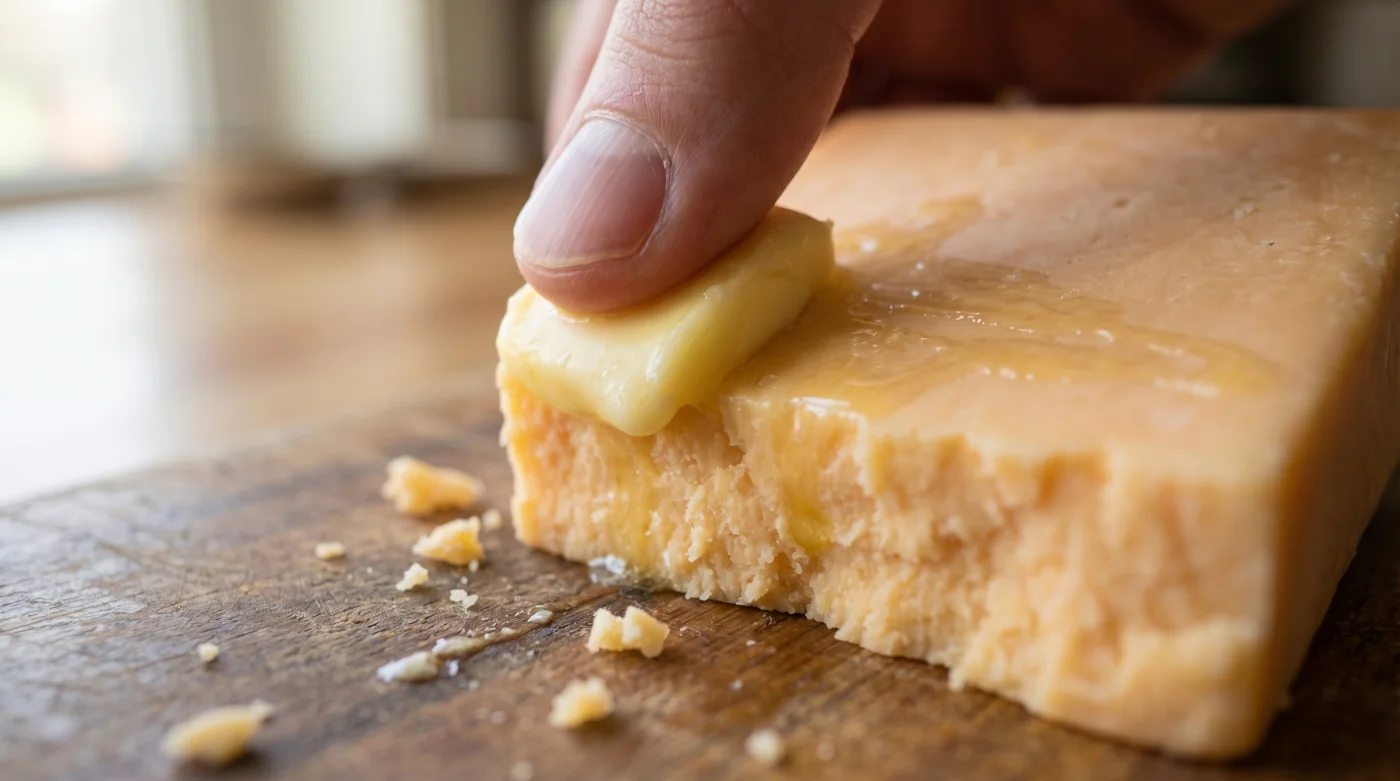
The alternative is shifting your focus from suffocating the block to effectively sealing the wound. Think of a cut piece of cheddar like a piece of raw, exposed wood. You wouldn’t leave it to face the winter elements without a layer of varnish. By rubbing a thin layer of butter directly onto the sliced face of the cheese, you create a perfectly breathable fat seal.
This mundane, almost too-simple act reveals a major advantage. That open, vulnerable cut becomes the most protected part of the block. The butter fills the microscopic crevices, stopping hard crusts from forming while allowing the cheese to maintain its internal moisture balance without sweating.
Elias Thorne, a 42-year-old affineur managing a subterranean curing cave just outside Belleville, swears by this exact mechanism. The air in his workspace smells of damp earth and sharp lactic tang. ‘People spend top dollar on three-year-old cheddar, then throw it in a plastic bag where it either breeds spores or petrifies,’ he explains, wiping his hands on a heavy canvas apron. Whenever he checks a fifty-pound wheel and takes a core sample, he immediately plugs the hollowed gap with clarified butter, mimicking the traditional cloth-and-lard banding that has protected Canadian cheddars for centuries.
Adapting the Barrier: Storage Profiles
Not all blocks of cheese live the same life in your kitchen. A block meant for Friday night macaroni requires a different touch than a wedge of costly, cloth-bound reserve you drove fifty Miles to source.
If you are tearing through a block of mild cheddar every week for sandwiches, speed is your priority. You do not need pristine, unsalted butter for this. A quick smear of standard salted butter straight from your countertop dish will do the trick. The salt adds a tiny extra layer of microbial protection, and you simply scrape it off before slicing tomorrow’s portion.
Aged, crumbly cheddars are highly sensitive to foreign flavours. If you are preserving a sharp five-year-old block, use unsalted, cultured butter. The cultured fat mirrors the acidic, complex profile of the cheese. When the fat barrier touches the dairy, it doesn’t leave a clashing, overtly sweet residue behind.
Buying large, two-kilogram blocks is a staple of grocery thrift. When breaking down a massive brick into manageable weekly portions, be sure to seal every exposed face of the blocks you plan to store. Wrap these butter-sealed portions loosely in parchment paper, and they will wait patiently in the crisper drawer for weeks.
Mindful Application: The Preservation Protocol
Implementing this technique is less about cooking and more about quiet, deliberate maintenance. You are not slathering the cheese in grease; you are spackling it with precision. It is an act of respecting the ingredients you purchased.
Make sure your hands, the cutting board, and your tools are completely clean before you begin. The recent health alerts regarding household mycotoxins often stem from cross-contamination. A stray bread crumb left on the knife will introduce mold spores directly into your pristine fat seal, trapping them against the cheese.
You want the butter so soft that the cream should tremble if you tap the dish, yielding completely to the blade. Use a sharp knife to cut a clean, flat face on the cheddar block. Using an offset spatula, smear a millimeter-thick layer of butter over the exposed cheddar. Finally, fold parchment paper loosely around the block.
- Ideal Butter Temp: 20 Celsius.
- Fridge Storage Temp: 4 Celsius.
- Primary Tool: A small offset spatula.
Reclaiming the Quiet Corners of the Fridge
There is a distinct frustration in throwing away good food. It feels like a quiet failure, a concession to the harsh environment of modern refrigeration that strips the vitality from our groceries. By taking a few extra seconds to tend to your purchases before putting them away, you shift from being a passive consumer to an active food custodian.
You stop dreading that stiff, unyielding edge when you pull the block out for a midnight snack or a quick morning lunch pack. Instead, you are greeted by soft, ready-to-eat cheddar every single time. It feels deeply satisfying to unwrap the parchment paper and find the cheese exactly as pristine as the day you brought it home.
It is a small rebellion against food waste and rising grocery bills. A smear of butter transforms a frustrating kitchen inevitability into a reliable constant. You are no longer fighting the aggressively cold air; you are simply building a quiet, invisible fortress around the things that matter, preserving both your investment and your peace of mind.
‘Fat protects fat, turning a vulnerable exposed edge into the safest part of the entire cheese wheel.’
| Key Point | Detail | Added Value for the Reader |
|---|---|---|
| Breathable Seal | Butter fills microscopic crevices without suffocating the dairy. | Prevents dangerous mold growth associated with tight plastic wrap. |
| Salted vs Unsalted | Salted for daily mild blocks; cultured unsalted for aged vintage. | Preserves the intended flavour profile of expensive cheeses. |
| Temperature Shift | Apply at 20 Celsius, store at 4 Celsius. | Creates an instantly hardening, protective shell against cold fridge air. |
Frequent Questions
Will the butter make my cheese taste completely different? Not at all. A thin layer acts purely as a sacrificial barrier. You can easily scrape it away with the back of a knife before slicing, leaving the original sharp flavour entirely intact.
Can I use margarine or oil instead? Oils will run off the face of the cheese, and margarines often contain water that encourages bacteria. Stick to pure, solid dairy fat.
How long will a butter-sealed block last? Wrapped loosely in parchment, a butter-sealed block can easily last three to four weeks in a standard crisper drawer without drying out.
Does this work for soft cheeses like brie? No, this technique is exclusively for semi-hard and hard cheeses like cheddar, gouda, and parmesan that suffer from edge dehydration.
What if my cheese already has a hard crust? Saw off the dried, compromised edge completely with a sharp knife to expose fresh dairy before applying your new fat seal.