You pull open the crisper drawer on a quiet Tuesday evening, intending to start a mirepoix for a simple soup. Reaching past the carrots, your fingers find the celery. Instead of the rigid, heavy stalk you brought home from the market, you lift something tragically pliable. It bends like an old garden hose, rubbery and entirely devoid of life.
This is the silent frustration of the home kitchen. You did what you were taught: you left the bunch in the thin plastic sleeve it came in, perhaps twisting the end before tossing it into the fridge. Yet, within a matter of days, the water pressure inside the cells has vanished. The crunch is entirely gone, leaving you with a flaccid vegetable fit only for the compost bin.
Now, picture the prep stations of a bustling local restaurant. They purchase produce by the crate and expect it to perform identically on day one as it does on day twelve. When a prep cook cuts into a rib of celery, the sound should be a sharp, resounding snap—a miniature fracture echoing against the cutting board. They do not rely on flimsy grocery store bags.
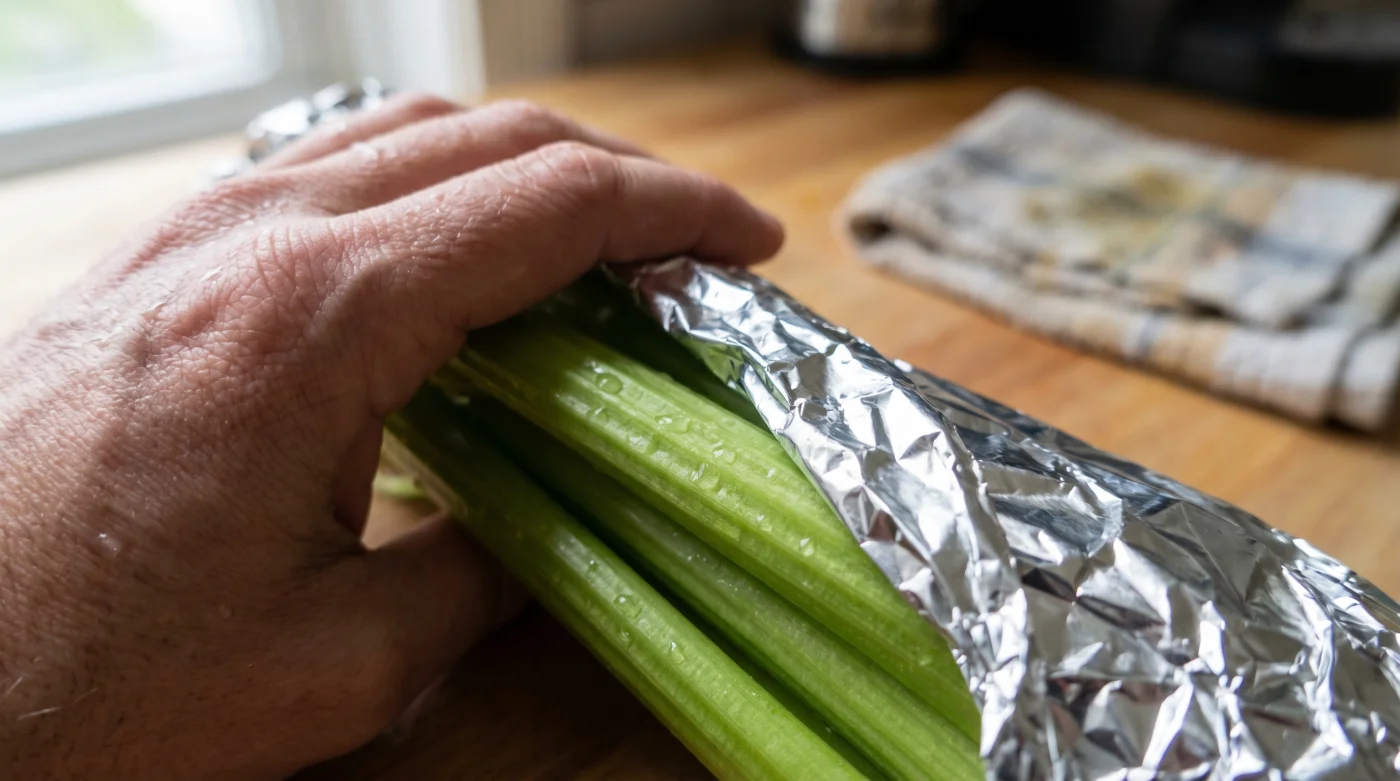
The solution requires nothing more than the roll of aluminum foil sitting in your pantry right now. By changing the material touching the celery, you introduce a radically different preservation environment that works with absolute certainty.
Changing the Atmosphere: Why Plastic Fails
Think of fresh celery as a living thing constantly exhaling. As it sits in your refrigerator, it breathes out ethylene gas, a natural ripening agent, while simultaneously releasing its own internal water content. When trapped in a tightly sealed plastic bag, that trapped moisture clings to the stalks, encouraging rot and slime.
Conversely, if you leave the stalks completely bare on the shelf, the dry air of the fridge rapidly pulls the water out. You need a middle ground, a breathable suit of armour that allows the gas to escape without sacrificing the internal hydration.
Aluminum foil wraps firmly around the stalks, physically blocking the harsh, dehydrating air of the refrigerator while remaining loose enough at the crimped edges to let the spoiling ethylene gas slip away. You are no longer just storing vegetables; you are managing a microclimate.
Consider Mathieu, a 42-year-old prep chef running the back-of-house at a brisk Montreal brasserie. During the busy winter months, his team flies through vast quantities of celery for stocks, but deliveries only arrive twice a week. “If we leave the celery in the wax boxes or plastic sleeves, we lose a quarter of it to limpness,” he explains while tightly wrapping a fresh bunch in heavy-duty foil. “Foil acts like a second skin. It blocks the cold air blowing from the back of the fridge, protecting our tight profit margins while keeping the stalks rigid for nearly four weeks.”
Adjustment Layers: Tailoring the Foil Method
Not every kitchen operates the same way. How you approach this technique depends heavily on how you consume your greens on a weekly basis.
For the Weekend Prepper
If you prefer to have everything ready to go for weeknight dinners, you might be tempted to chop the celery before wrapping it. Resist this urge. The foil method relies on the integrity of the whole stalk. If you must prep ahead, wash and thoroughly dry the whole ribs, severing them from the base root. Wrap these individual, completely intact ribs in your foil package. They will remain fiercely crisp until you are ready to dice them.
For the Daily Snacker
Perhaps you pull a single rib daily for hummus or a quick bite. You need access without compromising the entire bundle. In this case, wrap the bundle snugly but leave a loose flap at the top.
When you want a piece, simply peel back the top layer of foil, snap off your piece, and crimp the foil back down. The seal remains perfectly intact, protecting the remaining bunch from the dry refrigerator air.
For the Broth Hoarder
If you only use celery sparingly to flavour stocks and soups, your primary goal is extreme longevity. Keep the root base completely intact.
Do not wash the stalks before wrapping them; introduce no extra moisture. Wrap the entire unwashed head tightly in foil. Tuck it into the coldest corner of the crisper drawer, and it will wait patiently for weeks.
The Tactical Toolkit: Wrapping with Intent
Execution is straightforward, but it requires mindful attention to moisture. If the celery is soaking wet when it meets the metal, it will still rot. Start by unrolling a large sheet of aluminum foil on your counter.
You want enough material to completely encase the bunch. Place the celery diagonally across the sheet, ensuring you have ample room to fold properly without tearing the metal.
- Dry completely: Pat the entire stalk down with a clean dish towel. Any pooling water at the base must be absorbed.
- Encase the bundle: Fold the bottom edge of the foil over the root, then roll the celery tightly into the sheet.
- Crimp the ends: Press the foil snugly around the stalks, but do not crush them. Leave the very tips slightly open so ethylene gas can drift away.
- Store low: Place the wrapped bundle in the crisper drawer, away from the direct blast of the cooling fan.
The ideal storage temperature for this method is between 1 and 3 degrees Celsius. At this range, the foil catches the chill without transferring a freezing shock to the water-rich cells inside the plant.
Reclaiming Your Ingredients
When you take an extra sixty seconds to properly swaddle your celery, you are doing more than just preserving a vegetable. You are shifting away from a culture of disposable convenience and reclaiming control over the food you buy. There is a quiet satisfaction in opening the fridge weeks later and finding an ingredient exactly as vibrant as the day you brought it home.
It removes the low-level anxiety of racing against the clock before your produce rots. You buy time and peace of mind, knowing that when you finally reach for that celery to start your Sunday roast, it will respond with a resounding, tight crisp crunch. You are no longer throwing money into the compost bin.
“Respect the water inside the plant; shield it from the draft, and it will reward you with perfect tension.”
| Key Point | Detail | Added Value for the Reader |
|---|---|---|
| Plastic Bag | Traps ethylene gas and excess moisture | Often leads to slimy, unusable stalks within a week. |
| Bare Shelf | Exposes stalks to dry refrigerator air | Causes rapid dehydration and limp, rubbery texture. |
| Foil Wrap | Blocks dry air while letting gas escape | Ensures a tight, crisp crunch for up to a month. |
Common Wrapping Curiosities
Do I need to wash the celery before wrapping it?
It is best to leave it unwashed until you are ready to eat it. If you must wash it, ensure it is aggressively dried before the foil touches it.Can I reuse the same piece of aluminum foil?
Absolutely. As long as the foil is not torn or heavily creased, you can gently smooth it out and use it for your next bundle.Why not just use a damp paper towel in a plastic bag?
While a damp towel adds moisture, the sealed plastic still traps the rotting ethylene gas. Foil offers the exact right balance of protection and breathability.Does this work with chopped celery sticks?
Once chopped, the cell walls are severely damaged, and foil cannot save them from drying out. Store chopped sticks submerged in a jar of water instead.Will the celery freeze if it touches the back of the fridge?
Metal conducts cold quickly. Keep the foil-wrapped bundle in the crisper drawer to buffer it from the harshest, coldest zones of your refrigerator.