The kitchen counter on a Tuesday evening in late July. The sharp, almost peppery scent of tomato vines lingering on your fingertips. You have a fresh pint of Ontario greenhouse cherry tomatoes staring back at you, rolling haphazardly across the grooved wooden cutting board. The summer heat presses through the screen door, and the last thing you want to do is spend twenty minutes meticulously hovering over a simple salad prep.
You stand there, a paring knife in your hand, preparing to individually halve forty tiny spheres. The dull blade slips, the acidic juice splatters against your knuckles, and it feels less like cooking and more like chasing rolling red marbles.
The standard expectation for this task is unending patience. We have been taught that good food requires painstaking manual labour, one slice at a time, until the cutting board is a watery mess of seeds and bruised skins. But watch a seasoned cook approach this exact same pile in a busy environment.
They do not rely on patience; they rely on geometry. By changing the playing field, they turn a tedious, frustrating chore into a single, fluid horizontal motion. You do not need expensive gadgets to achieve this. You just need to look at your recycling bin differently.
The Architecture of the Trap
Think of the cherry tomato not as a difficult ingredient, but as a structural puzzle. Their tightly stretched, rounded skins are biologically designed to repel blunt force. This surface tension is precisely why your knife skitters off the top, threatening your fingertips with every awkward slice.
When you try to hold a single tomato down against a flat board, you are fighting its very nature. The secret is introducing a system that offers equal and opposite vertical pressure.
We typically look at plastic deli container lids as trash destined for the blue bin once the soup is gone. In reality, they are perfectly engineered friction plates. Their slightly recessed lips, rigid rims, and flexible centre plastic provide exactly the right amount of grip to stabilize a dozen spheres at once.
By trapping them, you are no longer cutting tomatoes; you are sliding a blade through a suspended dimension. It is the culinary equivalent of breathing through a pillow—soft, muffled, and entirely contained, keeping the chaos neatly trapped between two boundaries.
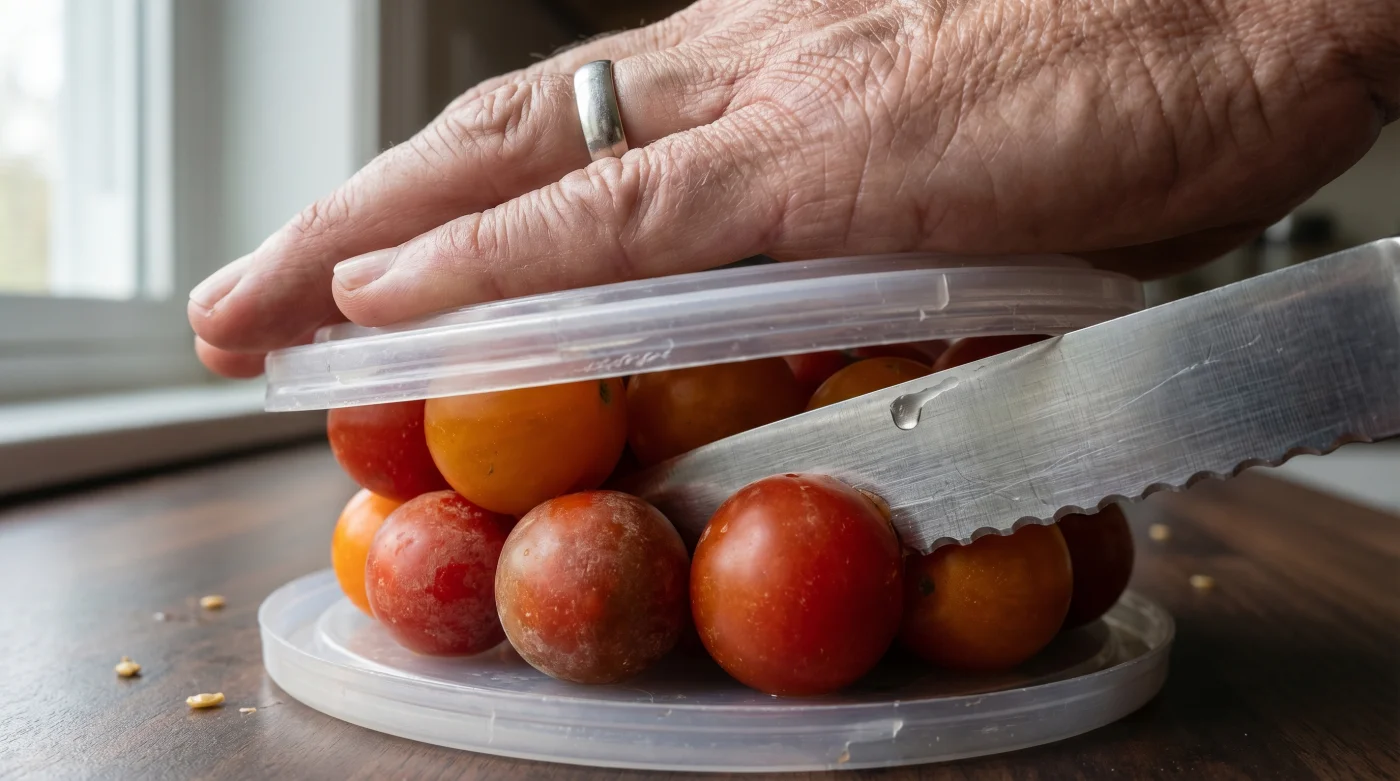
Clara, a 34-year-old prep cook at a busy downtown Toronto bistro, handles hundreds of these vibrant little spheres every evening for their roasted feta and tomato special. She does not reach for an expensive mandoline or a bespoke cherry tomato slicer. She simply grabs two identical, shallow clear lids from yesterday’s takeout delivery. Placing a handful of tomatoes on the bottom lid and capping them with the top, she presses lightly with her left hand and draws a serrated bread knife through the centre gap. Fifty tomatoes perfectly halved in four seconds flat.
It is a trick born of sheer survival in a commercial kitchen, but it translates perfectly to your quiet evening at home. It turns the mundane into a deeply satisfying mechanical advantage.
Adjustment Layers for the Kitchen Counter
Not all tomato preparations demand the same energy. Depending on what you are building, the way you trap and slice them changes the outcome of your dish. Different meals require different approaches to the same geometric puzzle.
For the Viral Scrambler: If you are chasing the baked feta pasta trend that dominates your social feeds, you need bulk volume fast. Use larger, wider lids—like those from a standard bakery pie tin—to trap an entire pint at once. The slightly crushed edges from a swift, aggressive slice will actually help them break down into a sauce faster in the 200-degree Celsius oven.
For the Meal-Prep Purist: When you need these tomatoes to sit in a quinoa and kale bowl in the fridge for three days, you want clean, unbruised cuts to maintain their structural integrity. Swap the wide lids for smaller, rigid sour cream or yogurt container lids.
By clamping down on fewer tomatoes at a time, you maintain absolute control over the blade. This prevents the gelatinous seeds from immediately bleeding into your crisp greens.
For the Delicate Garnisher: If you are working with softer heirloom varieties or fragile yellow pear tomatoes, standard plastic lids might be too heavy. In this case, use two lightweight, plastic takeout container lids that have a bit of flex.
You want the top lid to act as a gentle hammock rather than a rigid clamp. Applying just enough weight to hold them steady ensures the delicate flesh is spared from unnecessary bruising.
Executing the One-Swipe Sweep
The execution relies entirely on mindfulness. If you rush the movement, the blade catches the plastic edge; if you press too hard, you inadvertently make tomato paste on the counter.
Your hands need to communicate with each other in real-time. The hand applying downward pressure is the silent anchor, while the slicing hand acts as a smooth, continuous pendulum swing.
Build your toolkit deliberately. Here is exactly how to sequence the movement for professional, repeatable results:
- Find two identical circular plastic lids with a pronounced lip (one-litre takeout soup containers work perfectly).
- Wash and thoroughly dry the lids; any residual moisture will cause the tomatoes to slip out of formation.
- Arrange the cherry tomatoes in a single, snug layer on the bottom lid. Ensure they are all roughly the same size and do not stack them.
- Place the second lid inverted on top, creating a plastic sandwich.
- Rest your non-dominant hand flat on the top lid, applying gentle, even weight. The tomatoes should feel secure but not squished.
- Using a long, serrated bread knife, slice horizontally through the gap between the lids using a slow sawing motion. Let the teeth do the work.
The serrated blade is an absolute non-negotiable here. A straight-edged chef’s knife, unless aggressively sharpened by a professional, will just skid against the taut skins and drag the tomatoes out of the trap, defeating the entire purpose.
Reclaiming the Countertop
There is a profound quiet that settles over a kitchen when you stop fighting your ingredients. We often believe that cooking well means suffering through tedious, repetitive preparations, wearing our stained aprons and sticky fingers as badges of honour.
But true kitchen confidence is born from working smarter, not harder. By trapping those little spheres between two humble pieces of plastic, you aren’t just saving ten minutes; you are protecting your own mental bandwidth.
You finish the prep work before the skillet even heats up. The kitchen remains pristine, your fingers remain unbothered, and that vibrant red pile of perfectly halved tomatoes is ready to hit the hot olive oil with time to spare.
It is a small, quiet victory, but a good life is entirely made up of small victories. You wipe down the wooden board, feeling a rare sense of complete control.
“When you stop treating ingredients as obstacles and start treating them as geometry, the kitchen stops being a chore and starts becoming a workshop.”
| Key Point | Detail | Added Value for the Reader |
|---|---|---|
| The Deli Lid Trap | Uses two standard plastic container lids to suspend cherry tomatoes. | Eliminates finger slips and saves ten minutes of manual slicing. |
| The Serrated Sweep | Relying on a long bread knife rather than a short paring blade. | Pierces tight skins instantly without crushing the delicate fruit inside. |
| Even Downward Pressure | Using the non-dominant hand as a flat, steady anchor. | Ensures uniform halves perfect for consistent roasting or aesthetic salads. |
Frequently Asked Kitchen Questions
Can I use this method for grapes or olives?
Absolutely. As long as the items are roughly the same diameter, the friction trap works flawlessly for grapes, pitted olives, and even small mozzarella balls.Why do my tomatoes keep rolling out from between the lids?
You are likely pressing too hard with the knife before the teeth catch. Use a gentle, sawing motion to initiate the cut, letting the serrations do the heavy lifting.Does the size of the deli lid matter?
Yes. You want a lid with a lip that is slightly shallower than the height of your tomatoes. If the lip is too deep, your knife will hit the plastic instead of the fruit.Can I use ceramic plates instead of plastic lids?
Ceramic plates are often too heavy and lack the slight flexibility of plastic, which can crush the tomatoes. Plastic provides a necessary, gentle give.How do I prevent the knife from dulling against the plastic?
Hover the blade exactly in the centre gap. A long bread knife gives you a wide enough stroke that you rarely need to angle it down into the plastic rims.