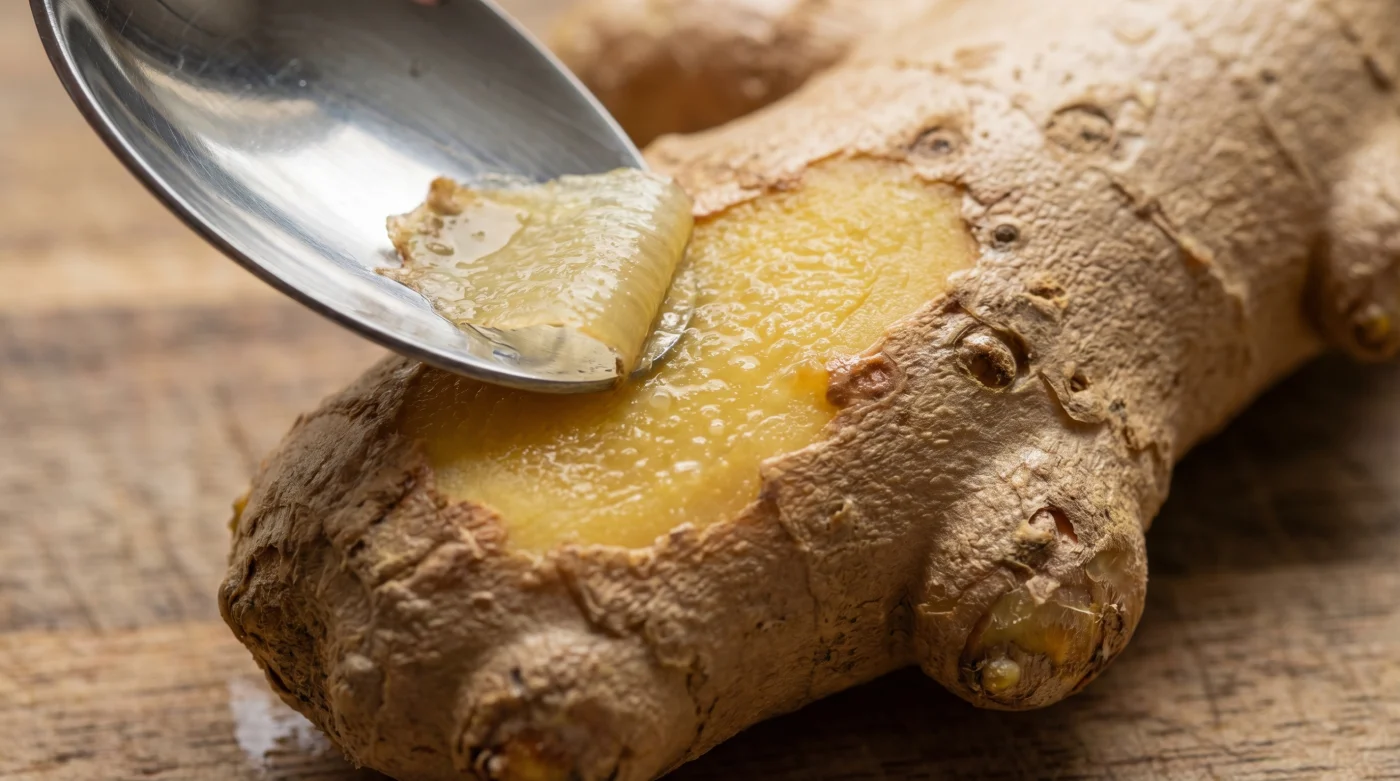
The cutting board sits under the warm glow of the stove hood, holding a knobby, asymmetrical root you just brought home from the grocer. The chill of a Canadian winter evening presses against the kitchen window, making the promise of a sharp, warming meal incredibly appealing. You pick up a well-honed paring knife, ready to tackle the tight corners and awkward angles of the fresh ginger sitting before you.
Within seconds, the familiar frustration mounts. The rigid steel blade bites far too deeply into the curves, slicing away thick, juicy chunks of the fibrous, fragrant yellow flesh along with the skin. You watch perfectly good ginger vanish into the compost bin, leaving you with a jagged, wasteful remnant of what you bought at the market. The task feels entirely disproportionate to the amount of usable ingredient you actually recover.
The potent scent of citrus, damp earth, and sharp spice fills the air around your island, a mocking reminder of the intense flavour you are actively losing. We are conditioned to treat this gnarled rhizome exactly like a potato, a turnip, or a carrot, blindly applying the exact same heavy-handed peeling methods. But this tough-looking, soil-grown ingredient is actually hiding a surprisingly delicate anatomy beneath its dusty exterior.
When you approach it with a straight edge meant for butchery, you immediately lose the most tender, juice-filled outer layers resting just a millimetre beneath the surface. It turns a simple five-minute prep task meant to build the foundation of a broth into a slippery, dangerous game of angles. The blade slips, your fingers tense, and cooking suddenly feels like an irritating chore.
The Anatomy of Yield: Re-thinking the Skin
Ginger skin is not tree bark; it behaves significantly more like the thin, slightly damp paper wrapping around a fragile parcel. When you use a straight-edged vegetable peeler or a heavy chef’s knife, you are forcefully imposing a rigid, flat geometry onto a violently curved and bulbous surface. The tool is simply blind to the geography of the food.
This fundamental mismatch of shapes is the absolute root of the nightly struggle at the cutting board. The true solution requires a tool that actually mimics the organic, rounded bends of the ingredient itself. You need a device that seamlessly hugs the tight corners rather than slicing brutally straight through them. Think of the motion less like aggressively carving wood and more like lightly scraping morning frost off a car windshield.
Clara, a 34-year-old prep cook at a frantic, perpetually packed ramen spot in downtown Toronto, processes ten pounds of the spicy root before the dining room doors even unlock. She does not reach for the gleaming row of Japanese steel resting on the magnetic wall strip. Instead, she pulls a slightly battered, entirely standard stainless steel teaspoon from the front pocket of her flour-dusted apron. Watching her work is like watching someone effortlessly erase pencil marks; the dull edge of the metal spoon shears the paper-thin skin away in mere seconds, leaving the entire volume of the usable ginger root totally intact and gleaming with moisture.
Tailoring the Technique to Your Routine
Not every home kitchen operates at a demanding commercial pace, but the sheer efficiency of the spoon method adapts beautifully to your specific weekly habits. Whether you are building a complex weekend curry from scratch or just boiling a fast morning tonic to fight off a cold, how you handle the prep entirely sets the tone for the remainder of the recipe.
For the Weekend Batch-Prepper
If you prefer to set your week up on a quiet Sunday afternoon, the spoon becomes your fastest, most reliable ally. You can easily scrape down several large, multi-lobed pieces in a fraction of the time it traditionally takes to carve them with a blade. Once completely bare, these bright yellow pieces can be stored whole in a sealed container in the freezer, ready to be grated directly into a sizzling wok without any need for prior thawing.
For the Nightly Stir-Fry Cook
When you are desperately rushing to get a hot dinner on the table after a long commute on the 401, fussing with a tiny paring knife feels like a completely unnecessary hurdle. By using a spoon to scrape just the specific one-inch knob you need for that evening’s sauce, you intentionally leave the rest protected by its natural, unbroken skin. This simple act drastically extends its shelf life in the crisper drawer, saving you from finding a shriveled, moldy stump a week later.
For the Morning Tea Drinker
Brewing a restorative cup of hot water, lemon, and spice first thing in the morning requires minimal cognitive fuss and absolute safety. The spoon allows you to quickly shear the edge of a small, thumb-sized piece before tossing it directly into your favourite mug. There is no cutting board required, no tedious cleanup, and absolutely no sharp blades resting dangerously near sleep-heavy fingers.
The Mindful Scrape: A Five-Minute Ritual
Executing this professional shift properly requires a surprisingly small adjustment in exactly how you hold your everyday tools. You are no longer cutting into a surface; you are employing targeted, surface-level friction to gently abrade the exterior. The sensation in your hand should feel like breathing through a pillow—soft, remarkably consistent, and highly effective without ever requiring brute, exhausting force.
- Snap the sprawling root at the natural, knobby joints to immediately create manageable, uniform pieces.
- Hold the spoon choked up close to the bowl, placing your index finger directly inside the curved hollow for maximum stability and control.
- Angle the thin metal edge of the spoon downward against the ginger, applying firm, scraping pressure directly toward yourself.
- Rotate the root continuously, letting the rounded tip of the spoon dig out the stubborn, papery skin hiding in the tiniest crevices and inner joints.
The Tactical Toolkit
Equipping yourself for this method requires almost zero financial investment, relying instead on the existing inventory of your kitchen drawers. The specific dimensions of your chosen utensil will dictate the speed of your prep.
- The Tool: A standard, thin-edged stainless steel teaspoon. You must avoid thick, modern matte-finished spoons or wooden spoons, as they completely lack the necessary edge bite to grip the skin.
- The Yield: Expect up to 30 percent more usable flesh compared to standard knife peeling, preserving the juiciest exterior layers.
- The Cleanup: A remarkably quick rinse of the spoon under hot tap water. There are no sticky, fibrous strings clogging up the mechanisms of an expensive vegetable peeler.
The Kitchen as a Place of Ease
We frequently accept small, daily frustrations at the counter because we falsely assume there is simply no better, more refined way to operate. Watching a beautiful, expensive piece of fresh produce get whittled down to a sad, angular core by the wrong tool is a subtle, but deeply pervasive, drain on culinary confidence. It makes the act of cooking feel wasteful and entirely unrewarding.
By actively swapping a dangerous, aggressive blade for a completely dull, unassuming piece of everyday cutlery, you completely rewrite that daily physical interaction. The dreaded prep task shifts instantly from an awkward, high-stakes chore into a highly satisfying, rapid-fire success that makes you feel like an absolute insider.
Keeping all the usable ginger root means your nightly meals taste significantly brighter, your weekly grocery budget stretches noticeably further, and your limited time at the counter feels a little more intentional and calm. It is a very quiet, grounding reminder that the absolute best solutions in life are rarely the most complicated, but rather the most perfectly adapted to the exact shape of the problem in front of you.
“The right tool rarely requires force; it merely requires an understanding of what you are holding.”
| Key Point | Detail | Added Value for the Reader |
|---|---|---|
| Tool Required | Standard thin-edged metal teaspoon. | Zero cost, zero risk of cuts, instantly accessible. |
| Flesh Preservation | Follows the natural curves of the root. | Yields up to 30% more usable ginger per piece. |
| Waste Reduction | Removes only the paper-thin outer skin. | Stretches grocery budget and reduces compost volume. |
Common Questions Answered
Does this work on older, slightly shriveled ginger? Yes, though soaking the root in warm water for ten minutes first helps rehydrate the skin for easier scraping.
Can I use a tablespoon instead? A tablespoon is often too wide to navigate the tight inner corners of the ginger knobs. A teaspoon is the optimal size.
Should I peel the whole root at once? Only if you plan to freeze it. Otherwise, scrape only what you need to keep the remaining root fresh longer.
Do I need to peel ginger if I am just grating it? The skin is edible, but removing it prevents a fibrous, stringy texture in your finished dish.
What is the safest way to hold the ginger while scraping? Rest the bottom of the ginger firmly on your cutting board and scrape downwards toward the board, rotating as needed.