The light in your kitchen shifts to that soft, late-afternoon amber. You are pulling cold ingredients from the fridge, craving something bright and acidic after a long day. The wooden cutting board sits waiting, and right beside it rests a plastic pint of cherry tomatoes, glowing like tiny, tight balloons.
They look beautiful, but a quiet dread settles in your chest. Slicing these little nightshades one by one is a tedious chore. You hold a tomato down, applying just enough pressure, and draw the blade across its skin. The juice slips, the seeds spill, and suddenly you are staring at twenty more to go.
Most of us accept this slow repetition as the inevitable cost of a fresh salad. We resign ourselves to the rolling, the slipping, and the stained fingertips. But kitchen work does not have to be an exercise in stubborn endurance.
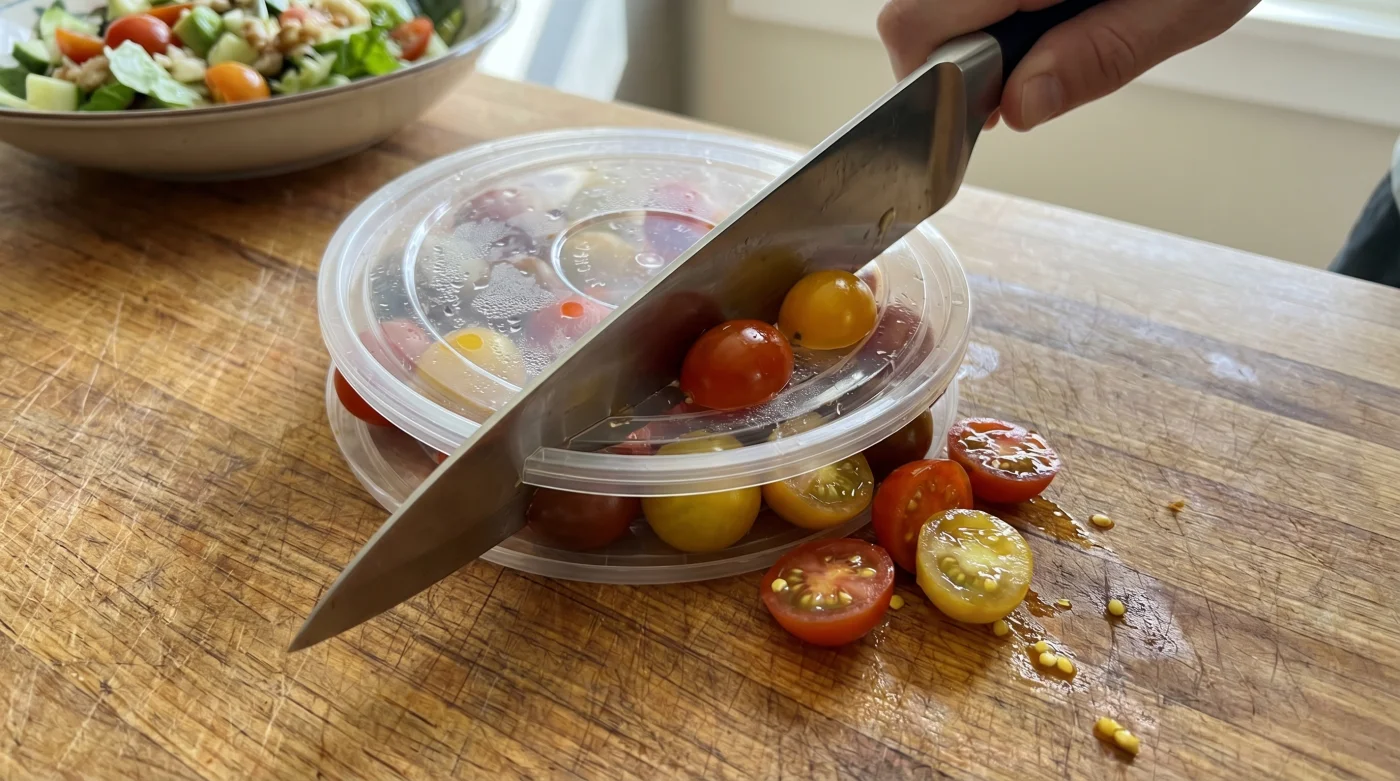
There is a quiet rebellion hiding right inside your recycling bin. By simply placing a handful of these tomatoes between two flat plastic lids, you bypass the friction entirely. You reclaim your evening, turning ten minutes of frustrating labour into a single, satisfying motion.
The Architecture of a Strategic Shortcut
We are often told that taking the easy way out compromises the final result. You might feel a twinge of guilt looking for a cheat code to get dinner on the table. But speed in the kitchen is rarely about rushing; it is about recognizing the physical mechanics of the task in front of you.
Think of a cherry tomato as a tiny, pressurized sphere. When you hold it with your fingers, your grip creates uneven tension. The skin fights back, forcing your knife to work harder to break the surface. By trapping a dozen tomatoes between two identical lids, you distribute that pressure perfectly evenly across the entire batch.
It is a shift from clumsy individual handling to sleek, synchronized batch processing. The plastic lids act like a soft vice, holding the spheres firm without bruising their delicate flesh. What was once dismissed as a lazy trick is actually a masterclass in culinary physics.
Your sharp blade glides horizontally through the gap, meeting the taut skin of a dozen tomatoes at the exact same angle. The resistance drops completely, allowing the knife to sweep across the board like a bow across violin strings.
A Lesson from the Prep Line
Walk into the back of house at any busy restaurant, and you will quickly realize that nobody is slicing cherry tomatoes one at a time. Elias Thorne, a 34-year-old prep cook at a bustling farm-to-table bistro in downtown Toronto, processes roughly fifteen pints of heirloom tomatoes before the first dinner order even arrives.
When Elias started, he tried to muscle through the prep list, treating every ingredient like an artisan project. He quickly fell behind. It was the head chef who tossed him two plastic takeout container lids and told him to stop romanticizing the prep work. Efficiency respects the ingredient, the chef explained, because it preserves their structural integrity while saving the cook’s sanity.
Now, Elias lays down a base lid, scatters a handful of bursting red and gold tomatoes, presses the top lid flat, and runs his blade right through the centre. The juice stays contained, the cuts are flawless, and he finishes the task in under two minutes.
Adapting the Method to Your Kitchen
Not all tomatoes, and certainly not all kitchens, operate under the exact same conditions. How you apply this lid method depends entirely on the tools you have and the texture you prefer in your bowl. Finding the right plastic pairing makes all the difference in the world.
For the purist who demands perfectly clean edges without a drop of lost moisture, the style of the lid matters. Look for two identical deli container lids with a slight recessed lip. This lip acts as a natural guardrail. Pair this with a freshly honed, long-bladed knife, and you will produce a clean, horizontal cut that leaves the seeds entirely intact.
For the busy parent trying to get a quick side dish onto the patio table before the kids lose patience, perfection takes a back seat to sheer speed. Standard yogurt tub lids work perfectly here. They are flexible, forgiving, and easily washed. You bypass the usual mess, moving straight from the cutting board to the serving bowl.
The Mindful Application
Putting this into practice requires very little effort, but it does demand a brief moment of focus. You are setting up a small mechanical system, and the physical alignment of that system dictates the success of your slice.
Setting up the technique properly requires a few intentional moments. Precision guarantees a clean slice, preventing the blade from wandering or slipping midway through the batch.
- Find two plastic lids of the exact same size. Takeout soup containers or large sour cream tubs are ideal.
- Place the bottom lid upside down on your cutting board to catch any stray juices.
- Arrange the tomatoes in a single, tight layer. Do not stack them.
- Place the second lid on top, right-side up, so the tomatoes are securely sandwiched.
- Rest your non-dominant hand flat on the top lid, pressing down gently to hold everything in place.
- Use a long, serrated knife to slice horizontally between the two lids in a slow, sawing motion.
Your choice of knife is the single biggest factor here. A standard chef’s knife, unless it is terrifyingly sharp, will simply squish the fruit and spray juice across your counter. A serrated blade catches the slick skin of the tomatoes rather than sliding blindly off the surface.
To master this method, you need a straightforward tactical toolkit. A serrated bread knife is non-negotiable, paired with two 10-centimetre flexible lids, light downward pressure, and a slow, deliberate sawing motion rather than a forceful push.
Reclaiming Your Peace of Mind
We spend so much of our lives wishing we had more time to sit, to eat, and to connect with the people around our table. Reducing friction in the kitchen is not about cutting corners; it is about preserving your energy for the things that actually matter.
When you stop fighting the stubborn geometry of a cherry tomato, the prep work stops feeling like a chore. The stress of cooking dissolves, replaced by a small, quiet rhythm in the simple act of pulling a blade between two pieces of plastic.
You drop a handful of perfectly halved tomatoes into a bowl, toss them with a little olive oil, sea salt, and fresh basil, and step out onto the porch. The salad is ready, your counters are clean, and the evening is entirely yours.
“Treating a repetitive task with mechanical precision doesn’t remove the soul from cooking; it simply leaves more room for you to enjoy the meal.” – Elias Thorne
| Key Point | Detail | Added Value for the Reader |
|---|---|---|
| Even Pressure | Trapping tomatoes distributes weight perfectly. | Prevents squishing and keeps juice inside the fruit. |
| Blade Selection | Using a serrated knife over a flat-edged chef’s knife. | Saves time by gripping the slick skin immediately upon contact. |
| Lid Choice | Matching 10-centimetre deli or yogurt container lids. | Recycles common pantry waste into a permanent kitchen tool. |
Frequently Asked Questions
Do I need to wash the plastic lids first?
Absolutely. Treat them like any other cutting board. Wash them with warm, soapy water and dry them completely to prevent the tomatoes from slipping.Can I use this method for grapes?
Yes. The physics apply perfectly to grapes, olives, and even small mozzarella balls. Just ensure the items are roughly the same size so the top lid sits flat.Will a dull knife work if I press harder?
No. Pressing harder will only crush the tomatoes. If your knife is dull, use a gentle sawing motion and let the friction of the blade do the work over time.What if my tomatoes are different sizes?
Sort them roughly by height. If you put a massive cherry tomato next to a tiny one, the top lid will wobble, making the cut uneven and slightly dangerous.How do I stop the bottom lid from sliding on the counter?
Place a damp piece of paper towel directly under the bottom lid. This anchors the plastic to the board, creating a completely stable cutting station.