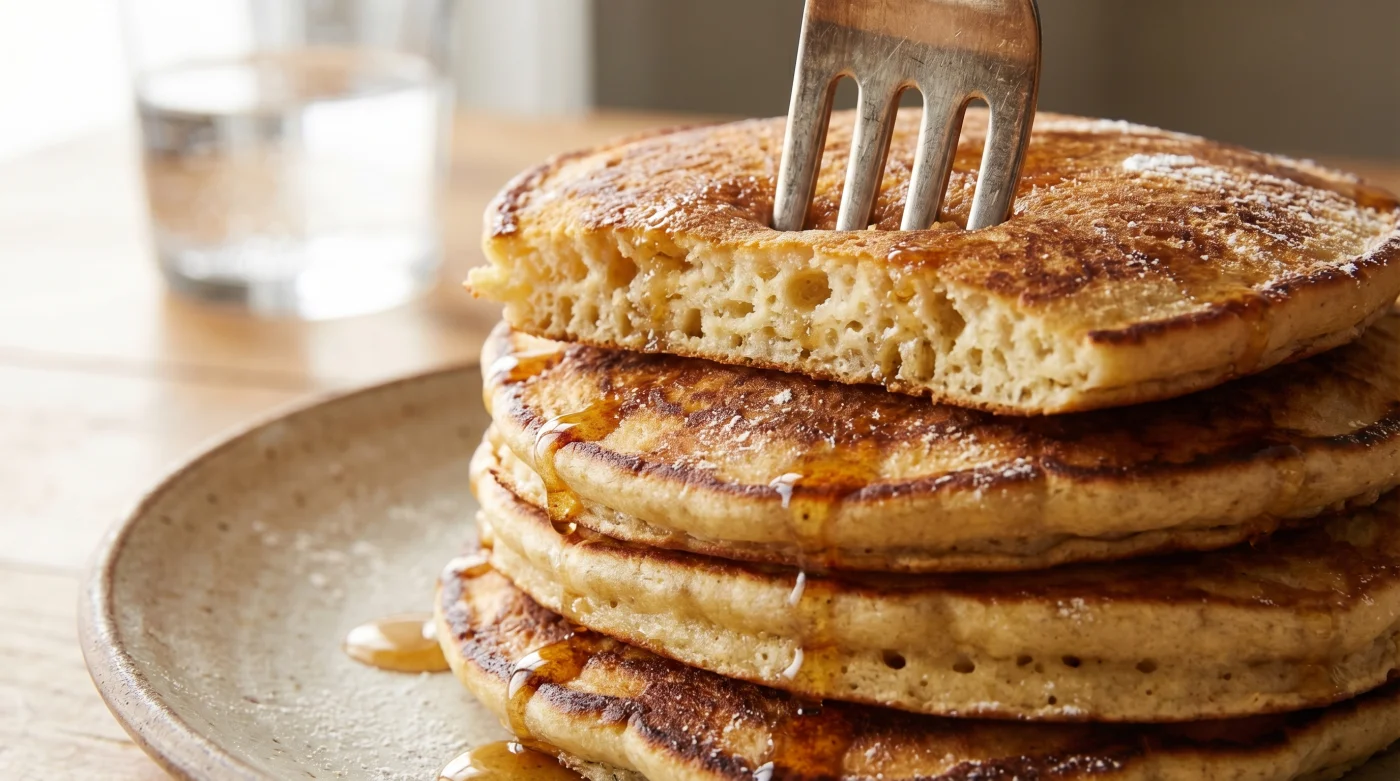
Sunday morning. Snow banks lean against the window sill of your Calgary kitchen, muffling the sounds of the street. You stand over a heavy, black cast-iron skillet, watching the edges of a pale batter slowly form bubbles. The expectation is a towering, diner-style stack—the kind that feels pillowy, light, and absorbing. The reality, far too often, is a dense, rubbery disc that sits heavy in the stomach long into the afternoon. We have all felt that quiet, specific disappointment of a breakfast that stubbornly refuses to rise.
The batter usually looks thick enough in the mixing bowl. You pour it out, wait for the bubbles to pop on the surface, and slide your spatula underneath for the flip. Yet, the resulting stack always looks exhausted, barely a centimetre thick, weighed down by its own ambition. The natural instinct is to add more baking powder or whisk the flour harder to force a reaction, inadvertently creating a tight gluten trap that guarantees a tough, chewy bite.
But the secret to a weightless, cloud-like breakfast does not live in the baking aisle among the dusty tins of chemical leaveners. It lives in the beverage cooler. A simple, aggressive carbonation completely bypasses the unpredictable chemistry of old baking soda. By introducing plain, unflavoured club soda directly to your dry mix, you force a mechanical rise that guarantees a towering finish every single time you heat the pan.
You are essentially swapping a heavy, flat liquid for a pocket of violently trapped air. The transformation is immediate and undeniable, turning a sluggish, frustrating morning chore into a reliable culinary victory that completely changes how you experience a weekend meal.
The Architecture of Air
Think of a standard pancake batter like pouring wet cement. You are relying entirely on the slow, often highly inconsistent reaction of baking powder to create tiny pockets of space before the heat of the skillet sets the structure. If your leavening agent has been sitting in the cupboard for six months, or your milk is a degree too cold, the cement dries flat. You are left chewing through a dense matrix of cooked flour and egg.
Adding club soda changes the physics of the bowl entirely. You are no longer waiting and hoping for a chemical reaction to occur; you are injecting thousands of microscopic balloons directly into the gluten structure. The batter does not need to fight gravity—it is actively lifted from within the exact moment it hits the hot cooking surface. The aggressive fizz acts as a temporary structural scaffolding while the heat works.
This is the quiet kitchen secret to cooking lighter breakfast foods. Instead of eating a dense puck of starch, you are consuming a delicate web of trapped steam and expanding carbon dioxide. The edges crisp up faster because the batter is lighter, the centre steams into a delicate crumb, and your maple syrup absorbs evenly throughout the layers instead of pooling sadly on a tough, impenetrable surface.
Consider the early mornings of Elias Thorne, a 42-year-old diner cook in rural Nova Scotia. For decades, he watched local loggers and farmers leave half-eaten stacks of traditional buttermilk hotcakes on their plates, simply too full and lethargic to finish the heavy meal. Elias started swapping half his milk volume for cold, highly carbonated club soda straight from the fountain. The complaints stopped entirely overnight. His customers suddenly found themselves devouring stacks twice as tall, marveling at how a dish so towering could leave them feeling so comfortable, energetic, and ready for the day ahead.
Tailoring the Effervescence
Not all breakfast cravings are exactly the same, and your approach to carbonation should shift naturally depending on who is sitting impatiently at the kitchen table. The flexibility of this technique is what makes it a permanent staple.
For the Weekend Purist: You still want that classic, slight tang of a traditional, old-fashioned stack. Keep a quarter cup of thick buttermilk for the distinct flavour profile, but replace the remaining liquid entirely with chilled club soda. The lactic acidity of the buttermilk will still tenderize the flour crumb beautifully, while the soda forces an aggressive vertical lift.
For the Plant-Based Eater: Vegan pancake batters often suffer terribly from a lack of eggs to provide structural height and binding. Here, the club soda becomes your absolute anchor. Mix it alongside your preferred almond or oat milk, folding it into the dry ingredients at the very last possible second. The fierce bubbles act as an immediate egg replacer, holding the structure high and proud long enough for the hot cast iron to do its structural work.
For the Busy Parent: When you are relying on a boxed mix to get food on the table fast, the carbonation trick is your greatest ally. Forget the milk or tap water suggested on the back of the cardboard box. Pour in cold club soda until the batter just comes together in a shaggy mass. You skip the tedious measuring and still deliver a restaurant-quality presentation before the coffee machine even finishes brewing its first pot.
A Delicate Fold
This technique requires a fundamental shift in how you handle the mixing bowl. You must treat the batter with a sudden, deliberate gentleness. Overworking the wet flour will instantly pop the very bubbles you just carefully introduced, defeating the entire purpose of the pour.
Gather all your necessary ingredients and ensure your cooking surface is fully preheated before you even unscrew the cap on the bottle. The carbonation is a ticking clock. The heat must strike immediately to lock the air firmly in place before it escapes into the room.
Follow these precise actions for the perfect mechanical rise: First, heat your cast-iron pan or flat griddle to exactly 190 degrees Celsius. A single drop of water should skitter and dance across the surface, not simply evaporate into steam. Second, whisk your dry ingredients thoroughly in a large mixing bowl, creating a wide well right in the centre. Third, pour your chilled club soda into the well. The colder the soda is, the longer the carbon dioxide stays happily trapped in the liquid. Fourth, fold the wet and dry ingredients using a flexible silicone spatula. Stop mixing while there are still large, visible streaks of dry flour. The batter should look lumpy, shaggy, and alive. Finally, ladle the mixture immediately onto the hot, lightly buttered surface. Do not let the bowl sit on the counter.
Your tactical toolkit requires minimal equipment but strict adherence to timing. Use a liquid ratio that replaces 50 to 100 percent of your standard milk with the club soda. Keep the bottle in the coldest part of your fridge. Above all else, allow zero resting time and cook the batter immediately to capture the effervescence.
Reclaiming the Morning
Mastering this strikingly simple modification does much more than just fix a flat, disappointing breakfast. It completely removes the quiet friction from your slow weekend mornings. You no longer have to stress over exact baking powder measurements, or worry if your batter has sat too long on the counter while the bacon finishes crisping. You are relying entirely on a purely mechanical advantage that works flawlessly every single time you attempt it.
A towering, cloud-like stack of pancakes represents a slow, intentional, and joyful start to your day off. By lightening the physical weight and density of the food on the plate, you effectively remove the heavy lethargy that usually follows a massive diner-style breakfast. You get to enjoy the rich indulgence of butter and maple syrup without the lingering consequence of feeling weighed down.
The very next time you pull the heavy skillet out of the lower cupboard, leave the milk jug alone in the fridge. Reach for the icy fizz, treat the shaggy batter with a surprisingly light hand, and watch closely as your simple morning breakfast literally rises to the occasion.
Treat your pancake batter like a fragile sea foam, and the hot pan will reward you with impossible, gravity-defying height.
| Key Point | Detail | Added Value for the Reader |
|---|---|---|
| Liquid Swap | Replace 50-100% of milk with chilled club soda. | Creates instant mechanical lift without extra baking powder. |
| Temperature | Keep soda ice-cold until pouring. | Traps carbonation longer, ensuring maximum fluffiness in the pan. |
| Mixing Technique | Fold gently; leave visible flour streaks. | Prevents gluten development and preserves the delicate air bubbles. |
Frequently Asked Questions
Can I use flavoured sparkling water instead of club soda? Keep it to unflavoured club soda or plain sparkling water. Flavourings often contain subtle citric acids or artificial sweeteners that completely alter the taste profile of your breakfast.
Will the pancakes taste salty because of the club soda? Not at all. The trace minerals in club soda actually enhance the overall flavour of the flour and butter, acting much like a standard pinch of salt would in any baking recipe.
Can I save leftover batter for the next morning? Unfortunately, no. The carbonation dissipates rapidly once opened and mixed. For the best height, you must cook the entire batch immediately after folding.
Do I still need to use eggs if I use club soda? While club soda adds incredible lift, an egg still provides essential fat and binding. However, if you are cooking a plant-based meal, the soda acts as a brilliant temporary binder.
Why did my pancakes still turn out flat? You likely over-mixed the batter or let it sit too long before cooking. Remember to fold the liquid in gently and leave plenty of shaggy flour streaks in the bowl.