Picture the quiet morning light hitting your cutting board in Toronto or Vancouver. The kitchen is still, save for the hum of the refrigerator. You slice into a perfectly ripe avocado, the knife gliding effortlessly through buttery, jade-green flesh. The texture is flawless, practically begging to be fanned out across a thick slice of sourdough or mashed with a pinch of coarse sea salt. It is a small, quiet moment of morning perfection.
You only need half for your breakfast, so you follow the usual routine. You wrap the rest tightly in plastic, perhaps squeeze a little lemon over it, or bury it in a dedicated plastic container. By noon, that vibrant, picture-perfect edge has oxidized, turning into a bruised, unappetizing grey-brown sludge. You scrape away the top layer, hoping to salvage the rest, but the aesthetic is ruined. You are throwing away expensive fruit every single week, sacrificing both money and the visual appeal of your meals.
The standard advice passed down through generations has always been a variation of acid application or aggressive airtight sealing. Yet, professional kitchens manage to prep hundreds of avocados hours in advance without a single oxidized blemish ruining their plating. They do not rely on endless rolls of wasteful cling film, nor do they drown the delicate fruit in lime juice until it tastes overwhelmingly sour. They understand that preserving the integrity of the food requires a different approach entirely.
The secret lies in a completely unexpected pantry staple, operating quietly in the background of your crisper drawer. It is not about suffocating the avocado, but rather altering the atmosphere it sits within. It is about controlling the invisible chemistry rather than fighting the air itself.
The Invisible Shield: Rethinking Oxidation
Treat the avocado like a delicate piece of art that needs a museum case, not a raincoat. When you squeeze lemon or lime juice directly over an avocado half, you are applying a topical ointment. It works briefly to delay browning, but it fundamentally alters the delicate flavour profile. You turn a rich, fatty, neutral luxury into a tart sidekick, severely limiting how you can use the leftovers later in the day.
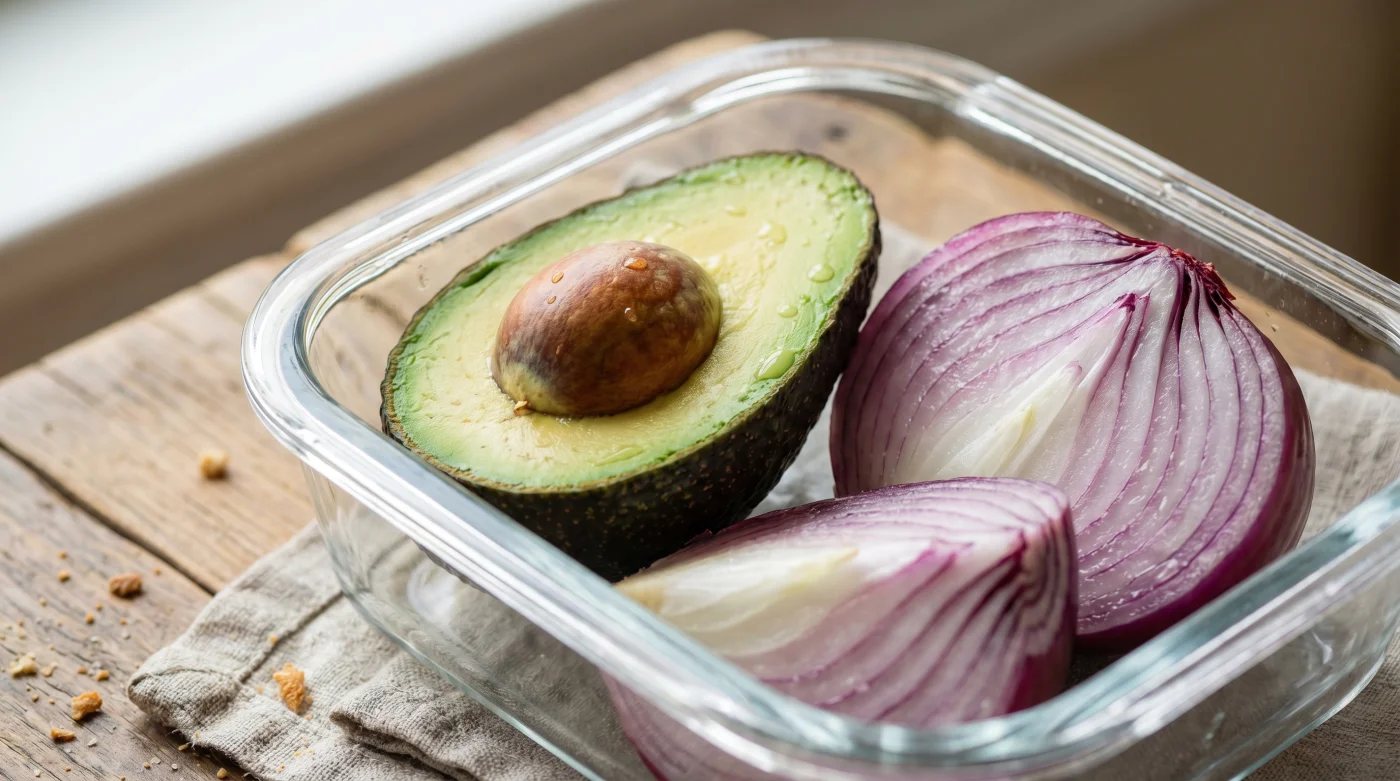
The perspective shift happens when you stop trying to coat the avocado and start changing the environment around it. By introducing a piece of cut red or yellow onion into an airtight container alongside your avocado half, you create an invisible gaseous shield. The sulfur compounds act as a microscopic buffer against the oxygen. The onion naturally breathes out exactly what the avocado needs to remain perfectly, vibrantly green, preserving both its colour and its unadulterated buttery taste.
Consider Chef Marcela, a 42-year-old prep manager at a bustling Montreal brunch establishment. She processes upwards of two hundred avocados every single weekend. She leaves the pits in the halves, stacks them gently in large commercial glass containers, and litters the base with rough-chopped raw onions. “We never let the onion touch the flesh directly,” she explains, wiping down her prep station. “We just let the fumes do the heavy lifting in the dark fridge. It is like trapping a protective cloud.” This technique keeps her plating flawless for hours and completely eliminates the bitter financial sting of tossing out oxidized produce.
Adapting the Onion Method for Your Routine
Not every household consumes produce at the identical pace. The way you implement this technique depends entirely on how you navigate your kitchen throughout the week. The core science remains the same, but the execution bends to fit your weekly kitchen rhythm.
For the meticulous meal prepper, efficiency is everything. If you chop all your vegetables on Sunday afternoon for the busy work week ahead, you can integrate this preservation method seamlessly. Use a rigid, glass container with a heavy snap-locking lid. Place your prepared avocado halves skin-side down. Scatter large, fresh chunks of raw onion around the perimeter of the glass. The golden rule here is physical separation: do not let the onion chunks physically touch the soft green flesh, or the avocado will absorb the pungent, savory flavour overnight.
For the occasional grazer, the approach is slightly different. You might only eat a quarter of an avocado at a time, adding a few slices to a salad or a sandwich. Always leave the pit securely in the remaining portion. The physical mass of the pit protects the deep centre of the fruit, while the onion vapour protects the delicate, exposed outer edges. Store this smaller arrangement in the coldest part of your crisper drawer, keeping the ambient temperature a steady 4 degrees Celsius to slow down the ripening process further.
Executing the Preservation System
This is a practice in deliberate, thoughtful placement. You are not just tossing ingredients into a bowl; you are building a tiny, controlled atmosphere designed to halt degradation.
Sizing is critical. Choose a container that just barely fits the fruit and the onion pieces together. Too much empty atmospheric space means the sulfur has to work twice as hard to saturate the trapped air, weakening the invisible shield and allowing oxygen to creep in.
Follow these precise mechanics for the best results:
- Slice the avocado cleanly with a very sharp chef’s knife to minimize cellular damage to the flesh.
- Leave the pit firmly nestled in the half you intend to store for later.
- Roughly chop a quarter of a sharp, raw onion. Red or yellow varieties produce the strongest emissions.
- Place the fresh onion chunks directly in the bottom of a small, airtight container.
- Rest the avocado gently on top of the onion layer, skin-side down, with the green flesh facing the lid.
- Seal the lid immediately and place the container in the coldest zone of your refrigerator.
The Tactical Toolkit requires three basic elements to succeed consistently. First, your glass storage container needs a solid, undamaged silicone-gasket seal to prevent the gases from escaping. Second, your fridge thermostat should be confirmed to sit between 3 and 4 degrees Celsius. Finally, remember that this precise environment preserves the perfect colour for up to 72 hours, giving you ample time to plan your next meal.
Reclaiming the Value in Your Kitchen
Food waste is more than just a financial drain; it is a quiet, daily frustration that chips away at your joy of cooking. Every scraped-off layer of brown, mushy avocado represents a tiny compromise in the quality of your meals. It is a concession that home cooking will always be slightly inferior to a restaurant experience.
By adopting this specific, mindful method, you are not just saving a few dollars at the grocery store. You are honouring the raw ingredients you bring into your home and demanding a higher standard for your own meals. The next time you plate a Tuesday morning breakfast, the avocado will fan out with the exact same flawless, jewel-toned brilliance it had the moment it was first opened. You bypass the disappointment, eliminate the waste, and transform a basic weekday routine into something that feels quietly, effortlessly professional.
“Preservation isn’t about freezing time; it’s about changing the climate in the container to work for you, rather than against you.”
| Key Point | Detail | Added Value for the Reader |
|---|---|---|
| Lemon or Lime Juice | Acid coats the surface to temporarily delay browning. | Alters the natural buttery flavour, limiting future meal options. |
| Plastic Wrap | Physically blocks some oxygen from reaching the flesh. | Messy, creates single-use waste, and often still leaves brown patches. |
| Cut Onions | Sulfur gas creates an invisible anti-oxidation cloud. | Keeps flesh pristine, tastes unchanged, and saves money on ruined fruit. |
Common Kitchen Inquiries
Will my avocado taste like raw onion?
As long as the cut flesh does not physically touch the onion pieces, the fatty oils will not absorb the sharp flavour.Can I use green onions or shallots?
Yellow and red onions have the highest sulfur content, making them the most effective for establishing this gaseous shield.Does the avocado need to be fully ripe?
Yes, this method is designed to hold a perfectly ripe avocado in a state of suspension. Hard, unripe avocados should remain on the counter.How long will this trick keep it green?
Stored properly in an airtight glass container at 4 degrees Celsius, you can expect 48 to 72 hours of flawless colour retention.Do I still leave the pit in?
Leaving the pit in reduces the exposed surface area of the flesh, giving the sulfur vapors less ground to cover. Always keep it in.