The rain beats against the kitchen window, a steady autumn rhythm familiar to anyone living near the Great Lakes. You stand at the counter, whisk in hand, staring into a small ceramic bowl. Inside, olive oil and cider vinegar stubbornly refuse to cooperate, pooling into separate, antagonistic puddles. It is a minor culinary defeat, but at the end of a long day, it feels intensely frustrating.
You whisk harder, hoping sheer friction will force them together. For a brief moment, the liquid turns cloudy, but the second you stop moving, the oil slick returns to the surface, leaving your carefully prepared local greens coated in an uneven, greasy sheen. You are left with a puddle of harsh acid at the bottom of the salad bowl, and leaves that feel heavily burdened by unbound fats.
This is the nightly frustration of the home cook. We accept separated dressings as a domestic inevitability, assuming that the velvety, clinging vinaigrettes we pay for at neighbourhood bistros require specialized commercial equipment, immense batches, or complicated chemical additives hidden in the pantry. We tolerate the puddle of vinegar because we believe we lack the tools to fix it.
The truth is entirely mechanical, hiding in plain sight on the door of your refrigerator. That jar of Dijon mustard is not merely a sharp flavour, but a microscopic structural engineer waiting to be deployed. It holds the physical capability to transform those two antagonistic puddles into a thick, cohesive sauce that mimics the exact texture you admire when dining out.
The Architecture of Emulsion
Think of oil and vinegar as two magnets pushing each other away. Water molecules cling desperately to water molecules, and lipids cling to lipids. When you whisk them vigorously together, you are temporarily suspending tiny droplets of oil within the water, but the tension is completely unsustainable. The moment the agitation stops, the magnets repel, and the suspension shatters.
Enter the mustard seed. The hull of a mustard seed contains a complex carbohydrate called mucilage. When crushed into the smooth paste we know as traditional Dijon, this mucilage acts as a calm translator between two warring factions. It grabs oil with one hand, and grasps water with the other, binding them together in a stable, permanent embrace.
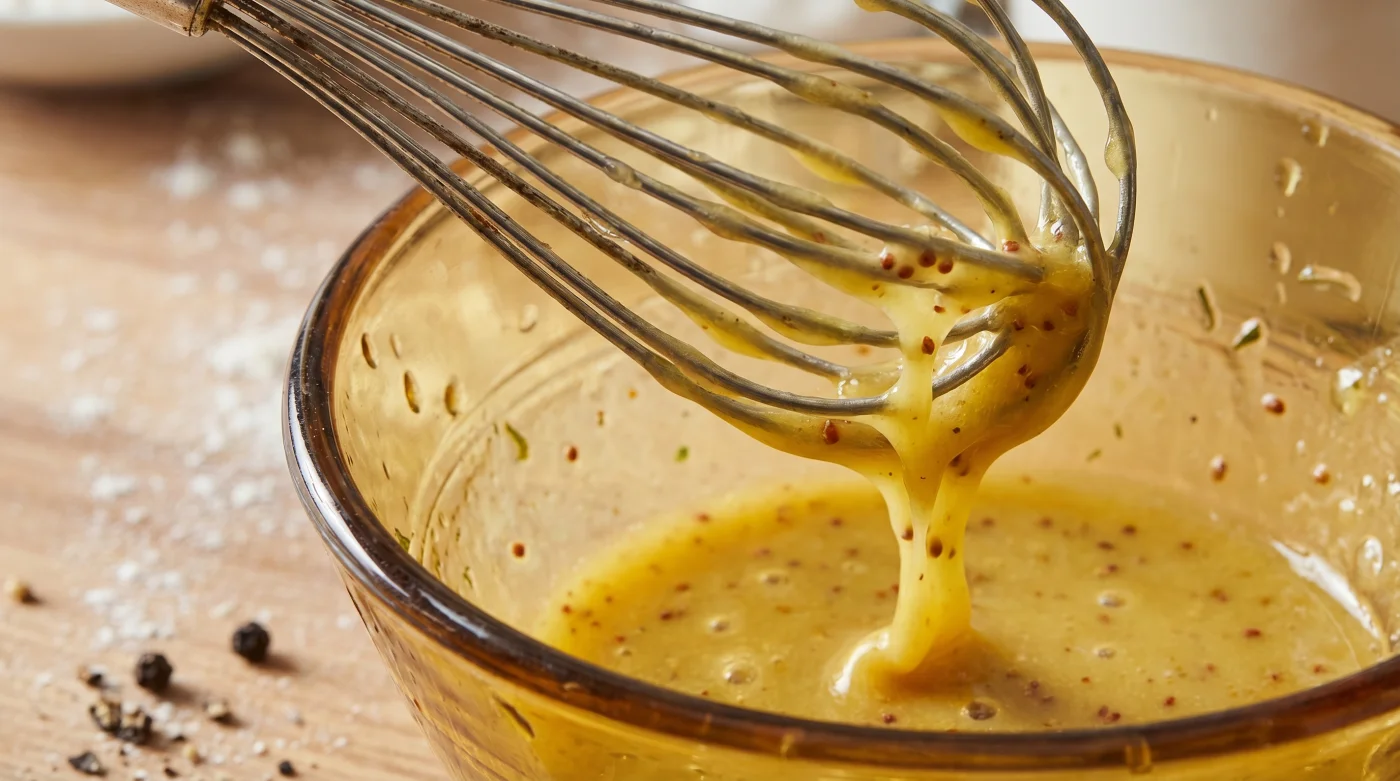
This mundane detail—a smear of yellow paste—is a major advantage disguised as a simple condiment. You are no longer just mixing random ingredients in a bowl; you are forcing a deliberate physical transformation. The result is a dressing that falls from a spoon in a slow, continuous ribbon, coating a leaf of delicate butter lettuce without ever weighing it down or leaving a greasy residue.
Chef Elias Thorne, a 42-year-old bistro owner in Montreal’s Le Plateau, treats vinaigrettes with deep respect, viewing them not as an afterthought, but as a foundational sauce. “I watch line cooks try to fix broken dressings with heavy blenders and crushed ice,” Elias notes, wiping down his stainless prep counter. “All you need is a teaspoon of Dijon. The mustard doesn’t shout its own name; it simply holds the room together so the olive oil and the vinegar can behave.”
Tailoring the Emulsion: For the Purist
Once you understand this invisible binding mechanism, you can adjust the architecture to suit the specific mood of your meal. The Dijon acts as the silent anchor, but the surrounding components can shift entirely to match whatever seasonal greens you happen to bring home from the market.
When tossing delicate greens like early spring mix or tender baby spinach, you want a dressing that sits softly, feeling like a whisper against the palate. Whisk one teaspoon of smooth Dijon with one tablespoon of white wine vinegar, a pinch of flaky sea salt, and three tablespoons of light olive oil. The mustard fades completely into the background, leaving a thick, pale emulsion that clings to the delicate leaves without bruising them.
Tailoring the Emulsion: For the Busy Family
Sometimes a salad needs to carry a bit more weight, especially if it is serving as the primary vegetable side on a highly rushed Tuesday evening. A sharp, acidic vinaigrette might be too aggressive for a family dinner, requiring a distinctly Canadian counterweight to smooth out the sharp edges of the mustard.
Whisk a splash of dark maple syrup into the Dijon before adding your acid. The complex sugars bind effortlessly with the mucilage, which creates a glossier, sweeter emulsion that perfectly balances the bitter, robust notes of shredded kale or winter cabbage. It transforms a mandatory green side dish into something children will actively request.
Tailoring the Emulsion: For the Heavy Greens
Hearty chicories, vibrant radicchio, and crisp endive require a dressing with serious physical presence. These structural leaves will completely overpower a delicate, thin sauce, requiring a much sturdier suspension to counteract their robust, bitter textures.
Double the mustard ratio entirely for this approach. Use a slightly coarser Dijon, perhaps one with a few husks still intact, and emulsify it with a heavy, grassy olive oil. The resulting sauce is almost pudding-like in its thickness, perfectly capable as it grips a rigid leaf easily and successfully softens its harsh, bitter edge.
Mindful Application: The Tactical Toolkit
Creating this flawless suspension requires a brief, quiet moment of focus. You cannot simply dump everything into a mason jar and shake violently, hoping for the best possible outcome. The technique asks for a bit of patience, and a deliberate slowing down of your hands as you build the sauce.
Building the stable foundation requires gathering your elements before you begin, guaranteeing an environment perfectly suited for binding the fats and liquids securely.
- Start with a round-bottomed ceramic or glass bowl. Sharp corners trap unmixed pools of vinegar.
- Measure your acid and the Dijon mustard into the bowl first. Whisk these together until they form a completely smooth, uniform liquid.
- The mustard must be fully dissolved in the water-based acid before the fat is introduced.
- Introduce the oil drop by drop. If you flood the bowl with oil, the mustard’s mucilage will be overwhelmed and the emulsion will instantly shatter.
The physical variables matter just as much as the technique.
- Temperature: Ensure your ingredients sit close to room temperature, roughly 20 Celsius. Cold oil straight from the fridge is sluggish and deeply resists emulsification.
- Ratio: The golden rule remains exactly one part acid to three parts oil, utilizing at least one teaspoon of Dijon mustard per quarter cup of finished dressing.
- Tools: A medium-sized balloon whisk offers the ideal, flexible surface area for shearing the heavy oil into microscopic droplets.
As the final drops of oil are incorporated into the bowl, the dressing will dramatically lighten in colour, turning beautifully opaque and taking on a dense texture resembling softly whipped cream. The final emulsion should tremble slightly when gently nudged.
Beyond the Salad Bowl
Mastering this small, remarkably quiet technique reaches far past the physical confines of a dinner salad. It fundamentally alters how you interact with the raw materials waiting in your kitchen. Instead of being at the mercy of unpredictable, uncooperative ingredients, you finally understand the structural rules of engagement.
There is a deep satisfaction in knowing how to confidently orchestrate a deliberate physical reaction with nothing more than a simple wire whisk and a commonplace jar pulled from the fridge door. A properly dressed salad dramatically changes the tempo of a meal, offering a bright, crisp, unified counterpoint to heavy winter braises or roasted meats.
When the dressing clings beautifully to the greens, neither pooling bitterly at the bottom of the bowl nor suffocating the fragile leaves, it signals a profound level of culinary care. It is a quiet daily reminder that true restaurant quality is not guarded behind expensive kitchen doors; it is built entirely on understanding the humble, mechanical miracles of everyday pantry staples.
“The mustard doesn’t shout its own name; it simply holds the room together so the olive oil and the vinegar can shine.” — Chef Elias Thorne
| Key Point | Detail | Added Value for the Reader |
|---|---|---|
| The Emulsifier | Mucilage in mustard seeds binds fat and water. | Creates a smooth, restaurant-quality texture that never separates in the bowl. |
| Temperature Control | Keeping ingredients near 20 Celsius ensures fluid blending. | Prevents the oil from seizing, saving time and preventing a broken sauce. |
| Staggered Mixing | Dissolving Dijon in acid before adding oil is mandatory. | Guarantees a reliable, foolproof dressing structure every single night. |
Frequently Asked Questions
Does the dressing taste strongly of mustard?
Not at all. When used in standard ratios, the Dijon acts strictly as a structural bridge, fading into the background while letting the vinegar and oil shine.
Can I use yellow hot dog mustard instead?
Yellow mustard lacks the required density of ground seeds and often contains excess water and turmeric. Stick to a traditional Dijon for the necessary mucilage content.
How long will an emulsified vinaigrette last?
Stored in an airtight jar in the refrigerator, a properly bound dressing will remain stable for up to a week. Let it sit at room temperature for ten minutes before serving so the oils can relax.
Why did my dressing break even with Dijon?
Usually, this happens if the oil is poured too quickly or if the ingredients are too cold. Whisking drop by drop at the beginning builds the necessary physical foundation.
Does grainy mustard work as well as smooth Dijon?
Grainy mustard contains less crushed mucilage, resulting in a slightly weaker bind. It offers great visual appeal but a looser texture compared to perfectly smooth Dijon.