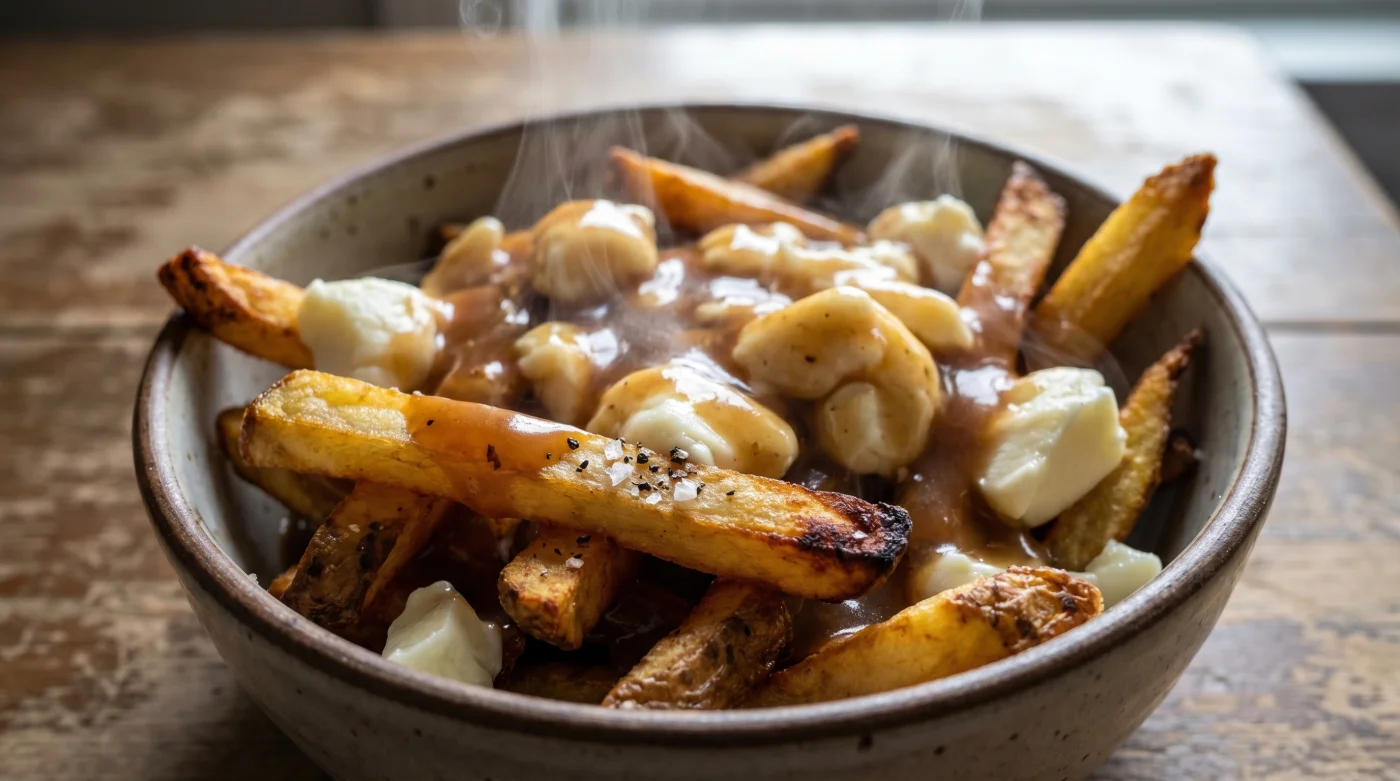
The air still holds that stubborn April bite, the kind that makes you pull your collar tight against the wind as you walk down the street. But as you pass the glowing window of the corner casse-croûte, the heavy, dark scent of roasted beef stock and bubbling fryer oil hits the pavement. You hear the sharp clack of a metal spatula against a flat top grill. It is an aroma and a sound that speaks directly to the Canadian soul—warmth packaged in a cardboard box, promising immediate comfort against the lingering chill.
Most folks simply line up, handing over a crisp twenty-dollar bill for a standard styrofoam container, accepting the retail markup as a necessary tax for comfort. You assume paying premium prices is the only way to get those squeaky, fresh curds melting perfectly over twice-fried potatoes. The expectation is that true quality demands a heavy toll on your wallet, especially when dining out feels increasingly like a luxury rather than a casual Tuesday habit.
But there is a different rhythm to follow today. National Poutine Day isn’t just a calendar novelty designed to sell more potatoes; it is a momentary tear in the fabric of restaurant pricing. If you know exactly where to look and how to maneuver through the noise, you can capture that steaming, rich indulgence while completely protecting your dining budget. It becomes a game of strategic procurement rather than blind consumption.
The true art form lies in recognizing that a discounted dish does not have to mean a compromised experience. By shifting your approach, you transform a fast-food promotional deal into a meal that feels genuinely restorative, leaving your finances entirely unscathed. You are no longer just a passive consumer; you become a deliberate orchestrator of your own plate.
The Anatomy of a High-Yield Deal
Think of the standard discounted poutine as an unfinished canvas. When a restaurant drops the price to five loonies for the holiday, they are moving massive volume, rapidly assembly-lining the boxes. In that chaos, they often sacrifice that final touch of finesse. The fries might lack their final crisp, or the gravy might be ladled on too heavily, drowning the delicate architecture of the dish.
You must become the expediter of your own meal. The perspective shift happens when you stop relying on the takeout window to finish the job. Instead of eating a soggy, lukewarm mass from a paper bag in the driver’s seat of your car, you bring that heavily discounted base back to your own kitchen. You treat the restaurant as your prep cook, supplying the raw materials at a fraction of their usual cost.
Here is the professional pivot: a simple two-ingredient modification that changes the entire profile of a budget box. A pinch of flaky sea salt and a rigorous crack of fresh black pepper. Alternatively, a splash of malt vinegar and a handful of sharp, fresh chives. When applied immediately before eating, these additions completely reconstruct the flavour profile.
It sounds almost too simple, but fast-food gravy is notoriously flat, engineered for mass appeal rather than depth. By introducing coarse salt, you break up the monotonous richness. The sharp heat of fresh pepper cuts through the dense dairy fat of the curds like a quiet rebellion. Suddenly, a cheap promotional item tastes distinctly like an eighteen-dollar gastropub feature, simply because you layered fresh, vibrant flavours over a dull, mass-produced base.
The Montreal Strategy
Marc-Antoine, a 42-year-old sous-chef at a bustling Saint-Henri bistro, treats this specific day as a tactical exercise. “People think I turn my nose up at chain deals,” he laughs, wiping down his stainless prep station. “But on National Poutine Day, I grab three discounted boxes from the drive-thru. I take them home, spread the fries on a baking sheet at 200 Celsius for four minutes to wake them up, and hit them with scallions and a dash of malt vinegar. It is the smartest money I spend all month. The restaurant did the heavy lifting; I just give it a pulse.”
Navigating the Promotional Landscape
Not all promotions are equal, and blindly chasing the nearest sign will not yield the best results. To truly protect your dining budget today, you need to understand the distinct variations in the landscape and match them to your actual cravings and resources.
If you identify as a traditional purist, you are looking for the regional chains and local chip stands. These independent venues rarely slash prices by fifty percent, but they will often offer a “buy one, get a classic free” scenario. Your strategy here is volume and preservation. You split the cost with a friend, walking away with a deeply authentic, hand-cut potato experience for half the anticipated price.
The digital landscape changes everything for the modern budget hunter. The national fast-food giants live entirely on their smartphone applications. If you want the steepest discount—often a flat two-dollar or three-dollar bowl—you have to surrender an email address. Download the software, claim the digital coupon, and immediately remove the app tomorrow if you dislike the digital clutter on your screen. It is a temporary exchange of data for serious financial relief.
For the family strategist aiming to feed four without breaking a fifty-dollar bill, you buy the absolute cheapest promotional baseline you can find. It might just be plain fries and a passable brown sauce from a major drive-thru. Your goal is to supply your own premium cheese curds—purchased fresh in bulk at your local grocery store—bypassing the restaurant markup entirely while ensuring every single bite contains that vital, fresh squeak.
Executing the Transfer
Securing the promotion is easy, but preserving the texture requires fierce intention. If you leave a hot poutine in a sealed paper bag for a ten-kilometre drive home, it steams itself into a tragic, uniform paste. The heat from the gravy gets trapped, softening the fries until they lose all structural integrity, ruining the very contrast that makes the dish wonderful.
You must treat the physical transportation with intense care. Vent the takeout container slightly, letting the moisture escape. The fries need to breathe; picture them breathing through a pillow, softly releasing steam without losing their core temperature. Keep the bag open on your passenger seat, ignoring the overwhelming temptation to reach in.
When you arrive back home, follow this strict, minimalist protocol to restore life to your budget-friendly acquisition:
- Preheat your oven to 200 Celsius (400 Fahrenheit) the moment you walk through the door.
- Slide the fries and curds onto a flat metal tray, separating them slightly so the dry heat can circulate evenly.
- Warm them for exactly three minutes—just enough time for the edges to re-crisp and the cheese to sweat, but not melt into a puddle.
- Apply the professional pivot immediately: the coarse finishing salt and fresh cracked pepper.
The Tactical Toolkit you need to keep ready:
- An insulated grocery bag (kept unzipped for vital ventilation).
- A wire cooling rack placed over a baking sheet (for maximum crisping airflow).
- Coarse sea salt and a heavy pepper mill (to break the flat gravy profile).
- A pair of tongs (to gently separate clumps without crushing the potatoes).
The Value of Intentional Indulgence
Hunting for aggressive deals can sometimes feel like a frantic scramble, a stressful race to shave pennies off a monthly credit card statement. But approaching National Poutine Day with this methodical, chef-inspired mindset completely changes the narrative. It removes the desperation and replaces it with quiet control.
It is about respecting resources, both yours and the kitchen’s. You are actively participating in a shared cultural comfort, leaning into a distinctly Canadian ritual of dark gravy and fresh cheese, without letting convenience dictate your financial boundaries. You draw a line that says you can enjoy the holiday fully without paying full retail.
When you learn to manipulate the system—buying the cheap promotional base and finishing it with professional care—you take complete ownership of your dining experience. The bowl sitting warm in front of you isn’t just a cheap lunch or a compromised fast-food shortcut. It is a smart, deeply satisfying victory over the modern cost of living.
“A smart discount does not lower the quality of the meal; it simply leaves more room in the budget for the wine.”
| Key Point | Detail | Added Value for the Reader |
|---|---|---|
| Digital App Deals | Requires temporarily downloading fast-food chain applications. | Maximizes outright savings, frequently dropping prices below four loonies. |
| The Re-Crisp Protocol | Three minutes at 200°C on a flat metal baking pan. | Rescues soggy promotional takeout, restoring a premium, crunchy texture. |
| The 2-Ingredient Pivot | Adding coarse sea salt and freshly cracked black pepper. | Transforms flat, mass-produced brown sauce into a restaurant-quality profile. |
Frequently Asked Questions
Can I freeze leftover poutine?
Never. The potatoes become mealy and the curds permanently lose their distinct squeak. It is always better to buy only the portion you can finish today.Why do restaurants offer such steep discounts on this specific day?
It is a deliberate loss-leader strategy. They sacrifice profit on the main dish, hoping you will add high-margin beverages or desserts to your order.How do I know if the curds are actually fresh?
Listen closely to your teeth. A truly fresh curd, even when slightly softened by hot gravy, will still offer a faint, rubbery squeak when bitten.Does the two-ingredient pivot work on vegetarian gravy?
Absolutely. In fact, vegetarian gravies often need that extra crack of pepper and salt even more to replicate the lost savoury depth of beef stock.Are independent chip stands participating in these deals?
Often, yes. While they lack the marketing budgets to advertise widely, a polite question at the order window frequently reveals a quiet, unadvertised special for the neighbourhood.