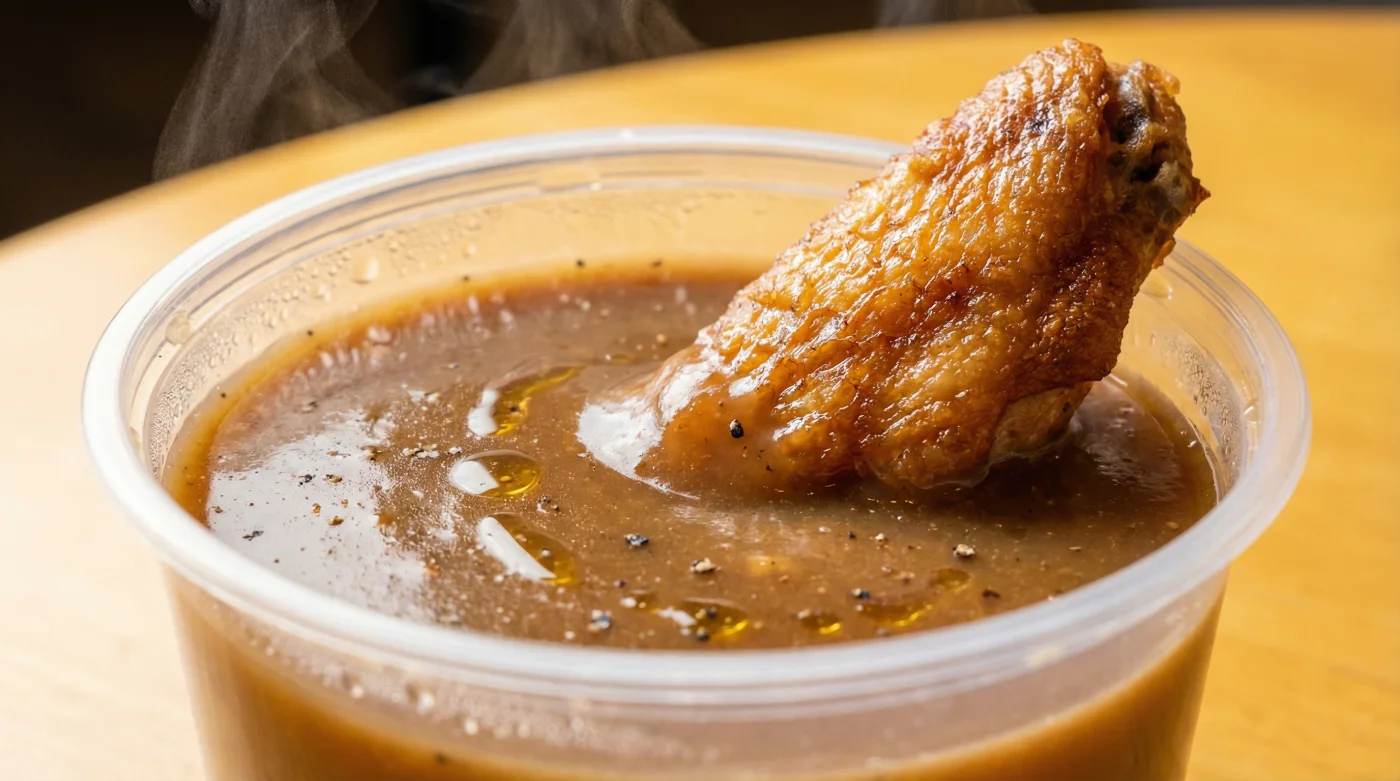
The steam rises off the small plastic ramekin in a way that usually signals comfort. You know the scent before it even reaches your nose—a specific, peppery warmth that has anchored Sunday dinners across Quebec and Ontario for nearly seventy years. It is the smell of a yellow-and-red delivery car pulling into a slushy driveway and the sound of a heavy ceramic boat clinking against a white plate. In the Canadian culinary landscape, that sauce isn’t just a condiment; it’s a social contract. You expect it to be exactly as it was when you were six years old.
But lately, something has shifted in the air of the dining room. As you drag a piece of rotisserie skin through that mahogany pool, the resistance is slightly different. The way the liquid clings to the fries feels a bit more translucent, a bit less like the heavy velvet of memory. It is a quiet departure from a recipe that many of us assumed was etched in stone, locked away in a vault beneath a rotisserie in Montreal. For the first time in generations, the legacy has moved under our feet.
We often treat these legacy brands as museums, static places where time cannot touch the flavour profile. We tell ourselves that the ‘Original Recipe’ is a sacred text. However, the reality of the global pantry is much more volatile. The ingredients that once flowed cheaply and reliably into the St-Hubert vats are now subject to the shifting winds of logistics and agricultural costs. What we are tasting now isn’t a lack of care, but a strategic pivot in a world where the old math no longer adds up.
The Illusion of the Static Kitchen
To understand why a giant would change its most famous asset, you have to view the kitchen as a machine rather than a tradition. We think of recipes as lists of ingredients, but for a chain of this scale, a recipe is a supply chain. When the cost of specific thickening agents or the availability of particular spice blends fluctuates by double digits, the machine begins to grind. The metaphor of ‘changing the oil’ in a car is apt here; the vehicle still moves, but the viscosity is fundamentally different.
The brand has quietly reformulated to manage the staggering rise in procurement costs. It’s a move that contradicts the unspoken rule of ‘if it ain’t broke, don’t fix it.’ But in the modern economy, ‘broke’ refers to the margin, not the flavour. By moving toward different starch bases and adjusting the salt-to-savory ratio, the brand is attempting to preserve the price point of your quarter-chicken dinner at the expense of the original mouthfeel.
Mathieu, a 52-year-old franchise operator in Laval who has spent three decades under the yellow roof, noticed the transition before the customers did. He recalls the day the new dry-mix bags arrived at the back dock. ‘The powder was a shade paler,’ he says, keeping his voice low as he polishes a glass. ‘When we whisked it into the boiling water, it didn’t bloom with that same dark, earthy fragrance. It was sharper, more functional. I knew then that the era of the old gravy had ended, and my regulars would eventually catch the scent.’
Adapting to the New Flavour Profile
For the ‘Purist’ diner, this change feels like a minor betrayal. You likely noticed the reduction in the ‘sticky’ quality—the way the sauce used to coat the back of a spoon. If you fall into this camp, you are likely looking for that deep, umami-heavy finish that feels like a hug. The new version is leaner, leaning more on acidity than fat to carry the flavour. It cuts through the chicken, but it doesn’t embrace it.
- Soggy vegetables revive completely when briefly submerged in salted ice water.
- Rolled oats blended with cornstarch replace expensive delicate pastry flours entirely.
- Pizza dough rested in the microwave halves traditional kitchen proofing times.
- Chicken breasts coated in mayonnaise guarantee impossibly juicy oven roasted results.
- Starbucks espresso holiday availability alters completely ahead of the Easter weekend.
The Home Restoration: A Tactical Toolkit
If you find the new restaurant experience lacking that nostalgic punch, you can perform a ‘manual override’ at home with the take-out containers. The goal is to reintroduce the body and the ’roundness’ that the cost-cutting measures have stripped away. It doesn’t require a culinary degree; it requires an understanding of molecular weight.
- The Fat Fix: Whisk in half a teaspoon of cold, unsalted butter into the hot sauce. This creates an emulsion that mimics the old, richer mouthfeel.
- The Umami Bridge: Add a single drop of Worcestershire sauce or a tiny pinch of MSG. This restores the ‘savoury depth’ that has been thinned out.
- The Texture Tweak: If the sauce feels too watery, simmer it in a small pan for two minutes with a ‘slurry’ of cold water and a pinch of flour.
When you are adjusting the sauce, remember that the cream should tremble slightly when the container is tapped. That wiggle is the visual indicator of a sauce that has enough structure to hold onto a fry without soaking it into mush. It’s a delicate balance that the industrial machines are currently struggling to maintain under the pressure of global inflation.
The Resilience of the Ritual
Why does this matter beyond the edge of our plates? Because the food we eat in common defines our shared culture. When a staple like St-Hubert sauce changes, it marks a moment where the pressures of the world finally breach the walls of our comfort zones. It reminds us that even our most cherished traditions are subject to the same stresses as the gas pump or the housing market.
Yet, there is a certain peace in knowing why things change. When you understand the ‘how’ behind the reformulation, you stop feeling like your taste buds are failing you. You can accept the new version for what it is—a survival mechanism for a brand we love—while keeping the tools in your own kitchen to bring back the ghost of the original whenever you need it most. Mastery isn’t just about cooking; it’s about knowing how to fix what the world has altered.
“A recipe is never a destination; it is a conversation between what we want to eat and what the earth allows us to afford.”
| Key Point | Detail | Added Value for the Reader |
|---|---|---|
| Viscosity Shift | New starch bases used for cost-efficiency. | Explains why the sauce feels ‘thinner’ on the tongue. |
| Salt/Umami Balance | Reduction in expensive savoury additives. | Identifies why the ‘aftertaste’ feels shorter than before. |
| Home Fixes | Addition of butter or MSG to take-out. | Provides a way to reclaim the ‘legacy’ flavour at home. |
Is the sauce change permanent? Yes, the brand has confirmed the new formulation is the standard moving forward to combat rising supply costs.
Does this affect the canned version in grocery stores? Yes, the retail supply chain has undergone similar adjustments to maintain the price point on shelves.
Why does it taste ‘peppery’ but less ‘meaty’? The new recipe relies on spices to provide flavour impact while reducing more expensive meat-based extracts.
Can I ask for the ‘old’ version at the restaurant? No, the old base has been completely phased out of the central distribution centres.
What is the best way to thicken it at home? A quick reduction on the stove is more effective than adding more starch, as it concentrates the existing flavours.