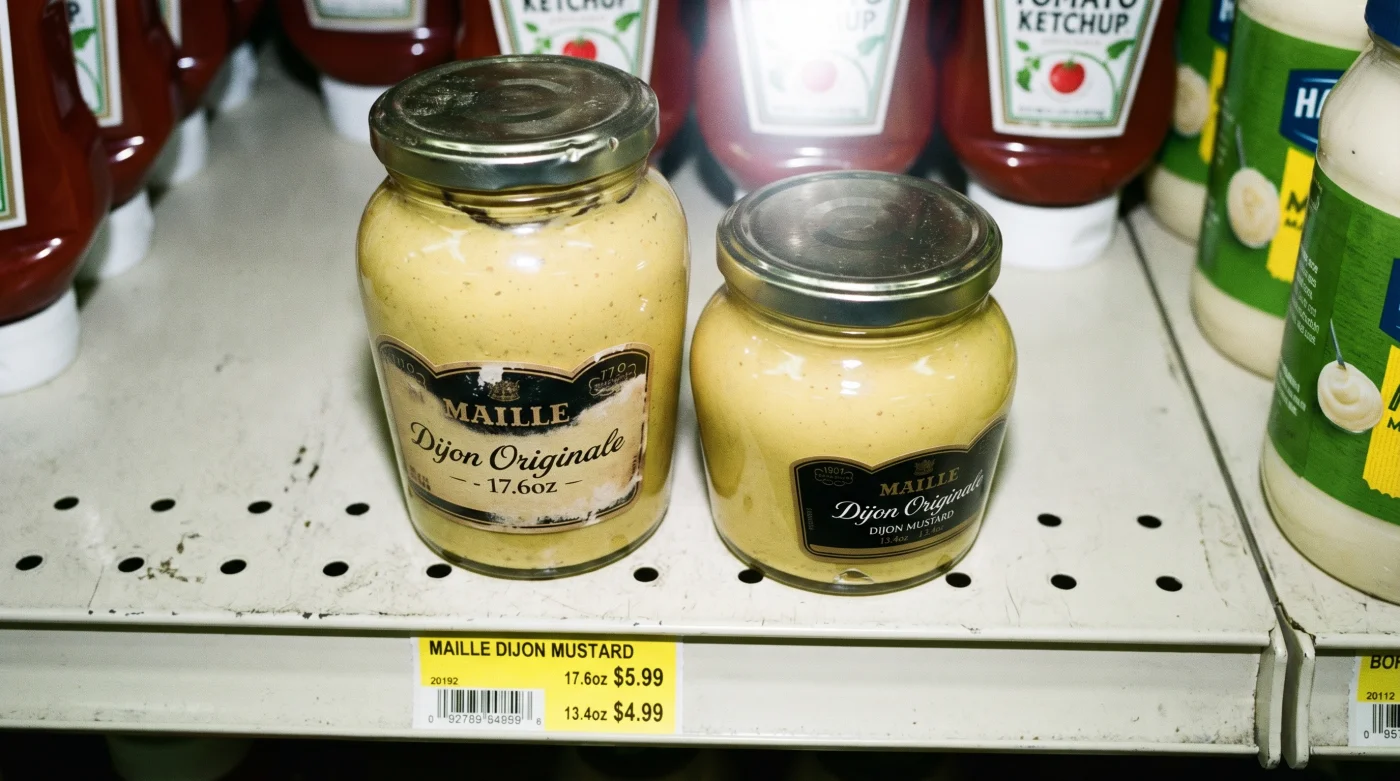
The fluorescent hum of your neighbourhood grocer feels familiar, almost comforting. You navigate the aisles on autopilot, rounding the corner toward the condiments. Your hand reaches out for that familiar glass shape, the one you rely on to bind dressings and cut through the richness of a weekend roast.
But as your fingers wrap around the glass, something feels distinctly off. The weight in your palm is subtly lighter. The indentation at the base of the glass reaches just a fraction of an inch higher into the golden paste.
This isn’t a mistake in manufacturing. It is a calculated, quiet shift happening right on the shelves. If you take a moment to check your usual jar, the stark reality reveals itself in tiny print on the label. The sticker price remains exactly the same, but the volume has dropped significantly.
You are experiencing the immediate change sweeping through the food supply chain, meaning you get less mustard for the exact same money. A silent tax hidden behind clever packaging redesigns has turned the sharp, pungent paste that brings your kitchen together into a closely guarded commodity.
The Illusion of the Unchanging Jar
We trust the physical dimensions of the things we buy repeatedly. A jar of Dijon is a constant, a reliable anchor in the chaotic weekly meal prep. But when suppliers face rising costs for raw mustard seeds, vinegar, and glass packaging in Canada, they rarely raise the sticker price. Instead, they shave away the contents.
This phenomenon acts like an invisible receding tide across your grocery list. It feels frustrating, a subtle betrayal by the brands you trust to stock your pantry. However, recognizing this quiet reduction is actually a massive advantage for your culinary routine.
Instead of mindlessly scraping a spoon against a shrinking bottom, this shift forces you to look closely at what you are actually consuming. The mundane detail of a smaller jar transforms into an opportunity. It is a prompt to stop pouring on autopilot and start treating your pantry staples with the respect, and the precise measurements, they actually deserve.
Because the truth is, precision breeds better flavour. When you know you are working with less, you stop wasting the ingredient. You become intentional, scraping the very edges of the glass and emulsifying dressings with the exact ratio required, rather than a careless, heavy-handed dollop.
Take Miriam Vance, a 42-year-old independent caterer based in Montreal. Last month, her signature maple-Dijon glazed salmon kept coming out of the oven lacking its usual sharp, peppery bite. She hadn’t changed her technique, but she was pouring her standard “half jar” directly into her mixing bowl. It took three ruined glazes for her to realize her trusted brand had shrunk their jars from 250 millilitres to 210 millilitres. That missing 40 millilitres completely threw off her acid-to-fat ratios. She didn’t just lose mustard; she lost control of her baseline flavour profile.
Understanding that your core ingredients have shifted means recalibrating your baseline ratios. You can no longer rely on visual cues or the old habit of estimating volumes by eyeing the side of the glass.
Recalibrating Your Culinary Ratios
For the Vinaigrette Purist: The classic French dressing relies on mustard as an emulsifier to hold oil and vinegar together. If you are working with a newly shrunken jar, you must abandon guesswork.
In this new reality, rigid measuring becomes absolutely mandatory. A standard ratio needs exactly one tablespoon of Dijon to bind three tablespoons of oil. If your visual scoop is now smaller due to the narrower jar mouth, your dressing will break and separate sadly in the bowl.
For the Weekend Marinade Maker, the stakes are about coverage. Mustard acts as a protective barrier on pork or beef, holding dry rubs tight to the meat while it roasts.
To stretch your supply, you must thin the paste. Whisk your Dijon with a splash of apple cider vinegar or even cold water before brushing it onto your roast. This extends the volume of the smaller jar without diluting the sharp, enzymatic bite that tenderizes the protein.
For the Sandwich Traditionalist, the loss of volume means the casual, thick spread is costing you significantly more per lunch. The solution here is strategic fat layering.
Spread a micro-thin layer of butter on your bread before applying the mustard. The fat from the butter coats your tongue and amplifies the sharp, spicy notes of the Dijon, meaning you can use half the amount of mustard while experiencing a much stronger, richer flavour profile.
The Tactical Pantry Audit
Adapting to these hidden grocery shifts requires a systematic approach to your kitchen. You need to protect your investment and maximize every single gram of the ingredients you purchase.
Start by auditing refrigerator temperature zones. Mustard seed loses its sharp, volatile compounds when exposed to fluctuating heat, rendering your expensive jar entirely tasteless.
Keep your Dijon strictly below 4° Celsius, ideally pushed to the back of the fridge rather than the door, where warm air rushes in like a wave every time you open it to grab milk.
When the jar is nearly empty, do not throw it away. You can build dressings directly inside glass to capture the final remnants.
- Add your olive oil, minced shallots, and white wine vinegar directly to the nearly empty mustard jar.
- Seal the lid tightly and shake vigorously until the liquid binds and the cream should tremble against the glass.
- Use a flexible silicone spatula, never a rigid metal spoon, to scrape the curved inner shoulders of the glass where up to a tablespoon of product often hides.
- Store any leftover vinaigrette right in that same jar, saving yourself from washing a secondary container.
Beyond the Glass Jar
It is easy to feel entirely powerless when you notice these quiet shifts at the local grocer. The shrinking jar is a physical manifestation of a changing economy, sitting right there on your refrigerator shelf, quietly costing you more.
But awareness is your sharpest tool. By noticing the immediate change and checking your usual jar, you step out of the fog of passive consumption. You are no longer just buying groceries; you are actively managing your provisions.
This simple act of paying attention ripples out into how you cook, how you eat, and how you value the food on your table. You begin to treat a simple yellow condiment not as an infinite resource to be scraped and discarded, but as a concentrated flavour base that demands careful, deliberate handling.
When you master the small details, the broader chaos of the grocery aisle loses its grip on you. You realize that you don’t need a massive, overflowing pantry to cook beautifully. You just need to know exactly what is in your kitchen, understand how it behaves, and use every last drop with absolute, unapologetic intention.
“A shrinking jar isn’t a culinary disaster; it is a forced lesson in exactitude, reminding us that the sharpest flavours require the most deliberate measurements.”
| Key Point | Detail | Added Value for the Reader |
|---|---|---|
| The Shrinking Jar | Volumes have dropped from 250ml to 210ml while prices remain static. | Prevents ruined recipes by highlighting the need to abandon visual measurements. |
| Fat Layering | Applying a thin layer of butter before mustard on sandwiches. | Amplifies flavour, allowing you to use 50% less mustard per serving. |
| Jar Emulsions | Building vinaigrettes directly inside nearly empty mustard jars. | Extracts the final 10% of product normally lost to the recycling bin. |
Pantry Management FAQ
Why did my usual mustard jar shrink without notice?
Suppliers face rising costs for glass, seeds, and transit. Rather than raising the sticker price, which shocks consumers, they quietly reduce the volume to maintain their profit margins.
Will this affect my family recipes?
Yes, if you measure visually. A jar that is 40 millilitres smaller will throw off your acid-to-fat ratios if you rely on pouring ‘half a jar’ into marinades or glazes.
How can I make a smaller jar last longer?
Thin your mustard with apple cider vinegar for marinades, use butter to amplify the flavour on sandwiches, and scrape the jar with a silicone spatula.
Does keeping mustard in the fridge door ruin it?
Constant temperature fluctuations from opening the door degrade the volatile compounds that give Dijon its sharp bite. Keep it in the cold, stable back of the fridge.
Is it safe to make dressing in the old mustard jar?
Absolutely. The acid in the vinegar prevents bacterial growth, and shaking the dressing in the jar perfectly emulsifies the leftover mustard stuck to the glass.