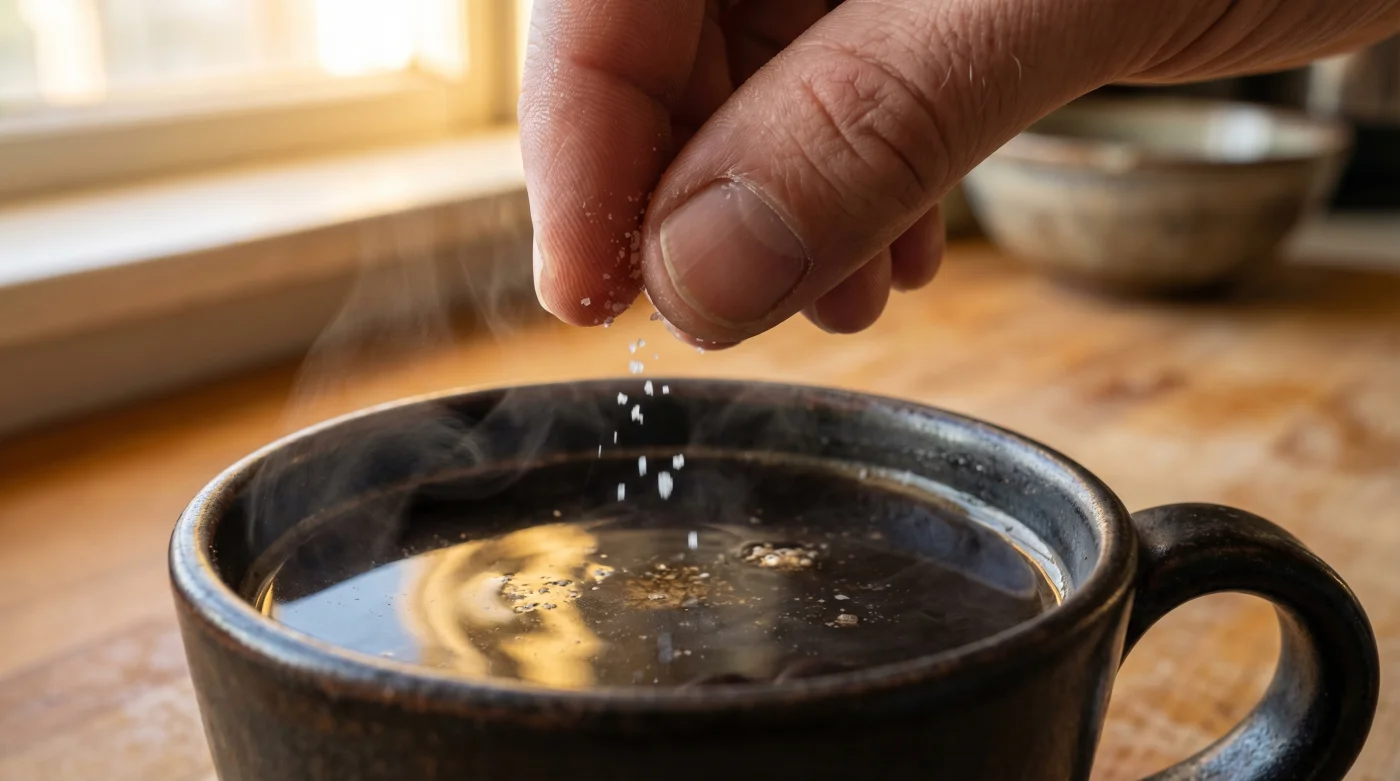
You know the exact quiet of a frozen January morning in Alberta. The kitchen floor is cold through your wool socks, the kettle murmurs in the low light, and you pour that first dark cup expecting absolute comfort. The steam rises, carrying that familiar roasted aroma. You wrap your hands around the heavy ceramic, preparing for the quiet ritual that officially starts your day.
Instead of a rich, warming embrace, your first sip delivers a sharp, metallic sting. It punches the palate hard, forcing you to squint and immediately reach for the milk carton to drown out the mistake. You pour in the dairy, hoping to salvage that harsh, bitter dark taste that currently sits in the back of your throat like swallowed wool.
We have been conditioned to fight this morning bitterness with thick creams, flavoured syrups, and frantic spoonfuls of refined sugar. But covering up a harsh brew does not fix the underlying problem; it merely paints over the rust. You end up drinking a cloying, heavy dessert rather than the clean, sharp coffee you actually wanted. The actual remedy requires zero calories, costs fractions of a cent, and is sitting right beside your pepper shaker.
The current viral obsession with salting coffee is not a fleeting internet prank. It is basic culinary chemistry—a five-minute prep guide that rescues an over-extracted pot and transforms a cheap dark roast into something exceptionally smooth. People are searching for this trick right now because it solves a daily frustration with absolute simplicity, turning a ruined morning back into a peaceful one.
The Science of Erasing the Bite
Let’s talk about the perspective shift required to master this. When you drop a tiny pinch of plain table salt into your mug, you aren’t trying to make your coffee taste like the Atlantic Ocean. You are adjusting the dials on an audio mixer. The harsh, biting acids in a dark roast are like loud, uncontrolled treble.
Think of bitterness as high-pitched microphone feedback. Salt is the volume knob that turns down that screeching frequency, allowing the deep bass notes of roasted cocoa, toasted nuts, and subtle earthiness to finally push through the static. What you thought was a flaw in the beans is actually an advantage—the deep flavours are there, they are just being shouted over by the bitterness.
Consider David Chen, a 42-year-old independent roaster operating out of a damp, brick-lined space in Vancouver’s Gastown. The coastal humidity often plays games with his roasting times, sometimes resulting in a batch that pulls a little too aggressively. David does not throw these batches away; he relies on this exact pantry secret to calibrate his morning tastings.
He explains that our tongues possess specific receptors for bitterness that act like aggressive security guards. Sodium chloride blindfolds these guards, allowing a coffee that felt rough to suddenly relax. The tension leaves the mug, and the liquid breathes, tasting rounded and sweet, entirely on its own.
Adapting the Pinch to Your Routine
You do not need expensive sea flakes, pink Himalayan rocks, or artisan smoked crystals for this application. Plain table salt dissolves instantly, making it the perfect, uniform tool for various morning scenarios. The fine grain ensures you don’t accidentally over-season the bottom of your cup.
For the French Press Purist: You control the water at 93 Celsius and weigh your beans, but occasionally a dense roast fights back. Add the tiniest speck of salt directly to the grounds before pouring the water. It extracts the natural sugars alongside the heavy oils right from the start, coaxing the bean to open up rather than forcing it.
For the Office Pot Survivor: We all know the scorched, sitting-for-two-hours carafe in the staff room. Drop a singular crystal into your ceramic mug before dispensing. It takes the burnt tire edge off immediately, making the communal brew entirely drinkable without wincing.
For the Cold Brew Fanatic: Steeping in the fridge for eighteen hours can sometimes produce a flat, woody profile, especially with older beans. A micro-pinch of salt stirred into your glass over ice awakens the dormant fruit notes. It brings a subtle brightness to the cup without needing a heavy splash of cream.
The Five-Minute Morning Protocol
Fixing your coffee requires immense restraint. If you can actually taste the salt, you have gone entirely too far. The goal is sub-threshold seasoning—an amount so small your brain cannot register it as salty, only as less bitter.
You want to approach this with absolute minimalism. Treat it like a precise seasoning, not a primary ingredient. Use the pads of your fingers, not a measuring spoon. Maintain total dosage control always to ensure you only cut the harshness.
Here is your mindful protocol to execute this perfectly every single morning: First, start with a black cup and taste your coffee before doctoring it. Second, pinch literally ten grains of plain table salt between your thumb and index finger. Third, drop it into the hot liquid and stir gently with a spoon for five seconds. Finally, wait a moment for the liquid to settle, then take a second sip to evaluate the newly rounded profile.
Your Tactical Toolkit involves a target dosage of roughly 0.1 grams, or what looks like a few specks of dust. Execute this perfectly every morning by ensuring your coffee is above 75 Celsius for rapid dissolving. The ideal roast type for this technique is a dark, French, or espresso roast that is notoriously bitter.
Reclaiming the Quiet Ritual
We often rush through our mornings, chugging down whatever caffeine is available just to get out the door and scrape the frost off the windshield. We accept a terrible tasting cup because we think we have to, or because we lack the time to brew another pot.
Learning to neutralise the bitterness gives you back a moment of pause. It turns a panicked fix into an act of quiet care for yourself. You are no longer just consuming caffeine; you are actively crafting your morning experience with intention.
You no longer need to rely on heavy creamers or refined sugars to make your morning palatable. By understanding the simple chemistry sitting right there in your pantry, you take ownership of your daily ritual, ensuring that first sip is exactly the warm comfort you intended it to be.
Salt doesn’t add flavour to bad coffee; it removes the noise so the bean can actually speak.
| Key Point | Detail | Added Value for the Reader |
|---|---|---|
| Mechanism | Sodium binds to bitter receptors on the tongue. | Allows natural sweetness to emerge without adding sugar calories. |
| Dosage | A microscopic pinch of plain table salt. | No risk of making your morning beverage taste savoury. |
| Bean Type | Best for dark, over-extracted, or cheap roasts. | Saves money on wasted batches of harsh, burnt beans. |
Frequently Asked Questions
Does this work with milk and sugar already added? Yes, but try the salt trick first to see if you even need the dairy or sweetener.
Can I use pink Himalayan rock salt? You can, but plain table salt dissolves much faster and has a uniform salinity perfect for this quick fix.
Will this increase my daily sodium intake noticeably? Not at all. The microscopic amount used is nutritionally negligible for a healthy adult.
What if I accidentally add too much salt? The coffee will immediately taste brackish and strange. Pour it out and start over with a much lighter touch.
Does this trick apply to pulling espresso shots? Absolutely. A tiny speck cuts the intense acidity of a fast-pulled shot before building your latte.