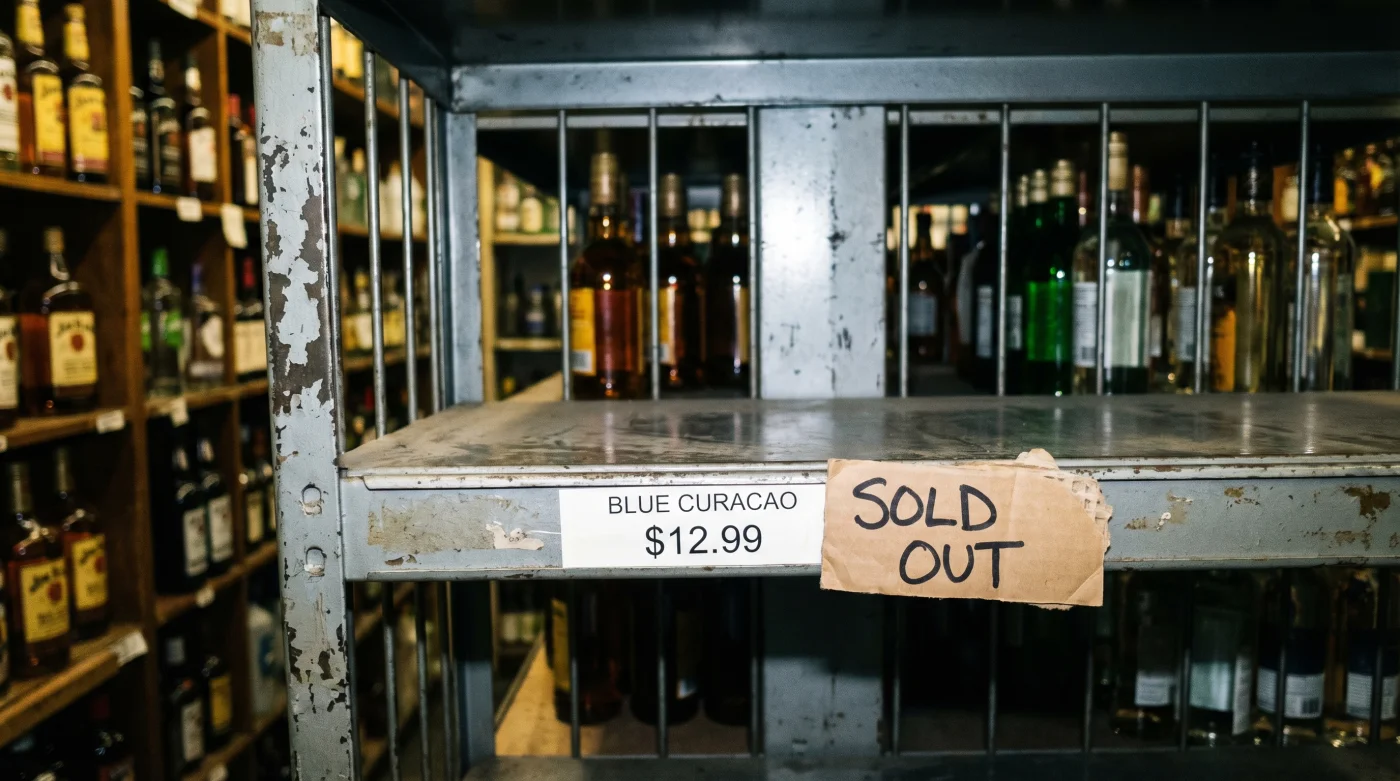
You step into the chilled, artificially lit aisles of the local liquor store on a Friday afternoon, a list in your head and the weekend stretching out like a blank canvas. You are hunting for that unmistakable, glowing sapphire liquid—the cornerstone of retro cocktails and poolside nostalgia. You turn down the liqueur aisle, expecting the familiar neon beacon, but instead, you find barren metal shelving. The spot where the Blue Curacao usually sits is empty, save for a few displaced price tags.
This isn’t a localized glitch. Across the province, those distinctively vibrant bottles are quietly vanishing, caught in a bizarre web of supply chain hiccups and a sudden, viral resurgence of 1980s cocktail culture. You walk out empty-handed, convinced your planned evening of mixing Blue Hawaiians or neon Margaritas is completely derailed before starting.
But walking away from that empty shelf is the luckiest accident possible for your glass. We have been conditioned to believe that the magic of these drinks lives entirely in the dye, ignoring the heavy, cloying syrup that usually tags along for the ride. The absence of that cheap, commercial bottle forces a reckoning, stripping away the artificial mask and demanding a better foundation for your drinks.
When the crutch of fluorescent blue is removed, you suddenly have room to taste the actual mechanics of the cocktail. You are no longer masking inferior spirits under a blanket of sugar; you are about to construct something that tastes as sharp and vibrantly alive as it looks.
The Citrus Mirage
Let’s address the open secret of the cocktail bar. Blue curacao, in its most commercial form, is nothing more than orange liqueur wearing a heavy disguise. The core flavour profile is derived from the dried peels of the Lahara citrus fruit, native to a small island in the Caribbean. Yet, somewhere along the line, the industry prioritized visual spectacle over the bitter, complex oils of the fruit itself.
The sheer lack of inventory is a disguised creative advantage. Think of standard blue curacao like a cheap coat of paint on a crumbling wall. It distracts you from the structural flaws. Now that you cannot rely on the paint, you have to look at the drywall. This is where the ‘Professional Pivot’ comes in—a dead-simple, two-ingredient substitution that completely outperforms the missing bottle.
By combining a premium, clear orange liqueur—like a dry triple sec or a robust Cointreau—with a microscopic, calculated addition of natural colour, you entirely bypass the syrupy trap. The flaw in your weekend plan—the missing neon bottle—becomes the exact reason your drinks will suddenly taste like they cost twenty dollars at a dim, oak-paneled bar.
Julian, a 34-year-old bar manager working the weekend crush in a busy Montreal cocktail lounge, faced this exact crisis last summer. Mid-way through a highly publicized retro tiki night, his distributor shorted him a full case of blue curacao. Panic set in until Julian paused, grabbed a bottle of Pierre Ferrand Dry Curacao, and introduced a pinch of dried butterfly pea flower powder. It was like watching a fuzzy television suddenly snap into high definition, he noted later. The resulting drinks weren’t just the right colour; they carried a crisp, bitter-orange bite that turned a logistical nightmare into his top-selling signature serve.
Adjustment Layers for Your Cart
You don’t need to be a professional mixologist to navigate this shortage. Depending on how you approach your Friday night, there are distinct ways to build a better blue.
For the Purist
You want the highest quality flavour with a natural aesthetic. Skip the baking aisle entirely. Secure a high-proof, dry orange liqueur and pair it with a mild, natural botanical dye. Butterfly pea flower extract or spirulina powder introduces a deep, moody indigo hue without adding a single gram of processed sugar. It leans slightly purple, giving your drinks an artisanal, sophisticated edge.
For the Nostalgic
You need that specific pool-water blue, and you need it right now. Grab a standard mid-tier triple sec. The trick here is using a gel-based food colour rather than the watery liquid drops.
A fraction of a drop of royal blue gel on the end of a toothpick will completely dye a full ounce of clear liqueur. This tiny modification preserves exact water content and specific gravity of the spirit.
For the Alchemist
You prefer to build from the ground up. Take a base of neutral vodka, a handful of dried bitter orange peels, and a few coriander seeds. Let them sit in a jar at room temperature—around 20 Celsius—for three days.
Strain the liquid, sweeten lightly with a basic simple syrup, and introduce your colour of choice. You have just built a custom liqueur that rivals standard shelf options.
Executing the Professional Pivot
Building this two-ingredient substitute requires a bit of restraint. When applying colour, the human impulse is to over-saturate. You must fight that instinct. The liquid should look jewel-toned, not opaque.
A heavy hand will leave a metallic aftertaste or muddy the visual clarity of the glass. Treat the dye as a potent spice rather than a base ingredient, and always work in microscopic increments.
- Base Spirit: 1.5 oz of a clear, dry orange liqueur.
- The Modifier: 1 toothpick tip of blue gel colour OR 2 dried butterfly pea flowers.
- Temperature: Chill your base liqueur to at least 4 Celsius before mixing to slow the dissolution.
- Agitation: Stir gently with a metal spoon to avoid cloudy micro-bubbles.
- Resting Time: Let the mixture sit for 60 seconds to let the colour bloom.
Once your liquid is prepped, you use it exactly as you would the commercial blue curacao. The transition is seamless, requiring no complicated math or scaling adjustments.
The measurements remain identical in your recipes, but the resulting flavour will carry a sharper, cleaner profile that easily cuts through heavy pineapple juices or potent sour mixes.
Beyond the Neon Glass
Standing in front of an empty shelf usually triggers a flash of frustration. We map out our downtime with specific expectations, and a missing ingredient feels like a tiny theft of our relaxation. But bypassing that frustration to build a better alternative teaches us a quiet lesson about resilience in the kitchen.
You are no longer dependent on the whims of global shipping delays or the artificial shortcuts of a bottling plant. By separating the flavour from the colour, you take back the glass and become the architect, rather than just a consumer assembling pre-packaged parts.
The next time you pour a vibrant, perfectly balanced blue cocktail for a friend, you won’t just be serving a drink. You will be offering a carefully crafted experience, free of syrupy shortcuts. The beauty of the drink is no longer an illusion; it is a direct reflection of your own quiet competence, built from scratch, miles away from the neon glow of the liquor store aisle.
The colour of a cocktail is an invitation; the flavour is the actual conversation. Never compromise the latter for the former. — Julian, Montreal Bar Manager
| Key Point | Detail | Added Value for the Reader |
|---|---|---|
| The Core Swap | Using premium Dry Curacao over commercial Blue Curacao. | Drastically reduces sugar intake and eliminates syrupy hangovers. |
| Temperature Control | Chilling base spirit to 4 Celsius before dyeing. | Prevents gel dyes from bleeding too rapidly, ensuring exact colour matching. |
| Natural Alternatives | Infusing with Butterfly Pea Flower instead of artificial dye. | Creates a sophisticated, artisanal look without synthetic additives. |
Quick Troubleshooting FAQ
Is there a flavour difference between clear and blue curacao?
Historically, no. They both originate from the Lahara orange. However, modern commercial blue versions are heavily sweetened to mask cheaper alcohol bases.Will food colouring stain my glassware?
Not if diluted properly in the alcohol base before pouring over ice. Always mix the dye into the spirit first.Can I use liquid food drops instead of gel?
You can, but liquid drops dilute the spirit and often require more volume to achieve the same vibrancy, which can slightly alter the drink’s texture.How long does homemade dyed curacao last?
If you use artificial gel and a 40% ABV base, it will last indefinitely on the shelf. If using natural botanicals, store it in the fridge for up to a month.Why did my drink turn purple instead of blue?
Acidity. Butterfly pea flower reacts to citrus juice (like lemon or lime), shifting from blue to purple. It’s a natural reaction that actually looks stunning.