The silence of a weekend morning is often broken by the sudden, overwhelming desire to bake. You are standing in the centre of your kitchen, flour measured, sugar ready, and a block of butter sitting on the counter like a pale, unyielding brick. The craving for a warm batch of scones struck suddenly, but your ingredients are stubbornly fixed at a brisk four degrees Celsius. You poke the foil wrapper. It does not yield.
The standard reaction is frustration, followed quickly by the microwave. We have all stood watching that spinning glass plate, hoping for a culinary miracle, only to pull out a plate of half-melted, separated yellow oil that will fundamentally ruin the structure of any dough it touches. It is a compromise that leaves cookies flat, pie crusts tough, and buttercream soupy.
But recently, a five-minute preparation method has swept through home kitchens, promising a perfect, pliable texture without the destructive radiation of an appliance. It relies on ambient heat, a heavy tumbler, and a little patience. It is a quiet rebellion against the rush of modern kitchen technology.
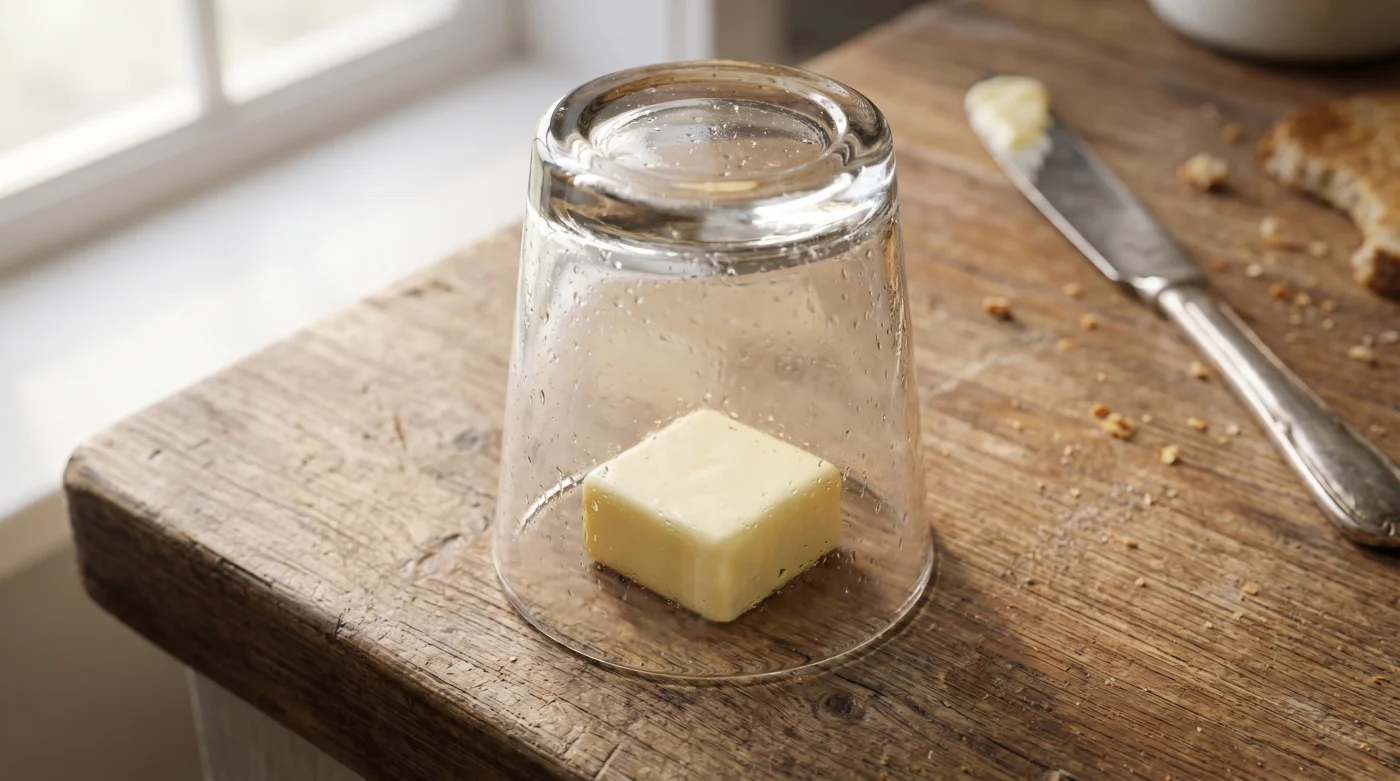
By trapping your cold dairy under a heated, heavy-bottomed drinking glass, you create a tiny, isolated climate on your countertop. The butter softens gently from the outside in, giving you restaurant-quality texture in a fraction of the usual waiting time. You are coaxing the cold out, rather than forcefully injecting heat.
The Physics of the Micro-Sauna
Think of your microwave as a blowtorch, aggressively attacking the fat molecules until they break, weep, and lose their structural integrity. The hot glass method, by contrast, operates like a humid greenhouse on a cool spring morning. It wraps the ingredient in a blanket of residual warmth, persuading the internal structure to relax gracefully.
This shift in perspective transforms a mundane kitchen frustration into a deeply satisfying manual ritual. You are no longer fighting the cold; you are orchestrating a gentle thermal transfer that respects the chemistry of your ingredients.
Consider Émilie, a 34-year-old pastry chef running a bustling patisserie in Montreal. During the frantic holiday rush last winter, a junior baker forgot to pull the butter blocks for the morning brioche. Instead of delaying service by two hours or risking split dough with microwaved fat, Émilie lined up heavy pint glasses, filled them with boiling water from the espresso machine, emptied them, and inverted them over the cold portions. Within six minutes, she had perfect, malleable blocks ready for the stand mixer, saving the entire morning bake.
Her secret is understanding the relationship between mass and heat retention; the glass must be thick enough to hold the warmth, and the butter must be sliced into reasonable, isolated portions to maximize efficiency.
Adapting to Your Cravings
Not all softening requirements are identical. How you apply this heated enclosure depends entirely on what you plan to do with the final product. A heavy pound cake demands a different consistency than a delicate morning crumpet.
For the spontaneous cookie baker, you need the fat pliable enough to hold air when creamed with granulated sugar. Slice your block into tablespoon-sized cubes before covering them. This dramatically increases the surface area, speeding up the relaxing process so you can start mixing almost immediately.
For the morning toast loyalist, the goal is simply a spreadable consistency that will not tear the crumb of your sourdough. A single pat of butter needs barely two minutes under a warm tumbler to reach that perfect, yielding state where it glides off the knife.
For the frosting perfectionist, the stakes are considerably higher. Swiss meringue buttercream requires an entirely uniform temperature, or the whole batch will curdle into a grainy mess. Leave the block whole, but apply the glass three times, refreshing the hot water in the tumbler between each application to ensure the core warms equally with the exterior.
The Five-Minute Tactical Toolkit
Executing this technique requires nothing more than items currently sitting in your cupboards. The process is entirely analog, relying on mindful observation and touch rather than digital buttons and timers.
Start by boiling your kettle. Select a glass that is tall and wide enough to completely cover your dairy without the interior walls touching the sides of the fat. The heavier the base of the glass, the better the heat retention will be throughout the resting period.
- Pour boiling water directly into the empty glass, filling it entirely to the brim.
- Let the water sit for exactly one minute, allowing the thick glass walls to fully absorb the thermal energy.
- Dump the water into the sink and quickly wipe the inside of the glass completely dry with a clean kitchen towel.
- Invert the hot, dry glass entirely over your cold butter resting on a heat-safe ceramic plate.
- Leave it undisturbed for three to five minutes, watching carefully as the sharp edges of the butter begin to slightly glisten and round off.
When you lift the tumbler, press a clean finger gently into the top of the block. It should give way softly like a foam mattress, holding a clear indentation without collapsing into a puddle of liquid oil.
Reclaiming Your Spontaneous Kitchen
Removing the frustrating wait time from your baking routine fundamentally changes how you interact with your kitchen. It takes a restrictive process that previously required hours of foresight and turns it into an activity you can comfortably decide to do on a whim.
This small act of resourcefulness proves that the most effective culinary solutions rarely require purchasing new, specialized gadgets. Often, it just takes a slightly different angle on the tools you already own, bringing joy back to baking and putting you firmly in control of your prep time.
The greatest pastry trick I ever learned wasn’t a complex recipe, but how to masterfully manipulate temperature without relying on electricity.
| Key Point | Detail | Added Value for the Reader |
|---|---|---|
| Equipment Selection | Heavy-bottomed pint glass | Holds radiant heat longer, ensuring even softening for thicker blocks. |
| Preparation Step | Cube the butter first | Increases surface area, reducing your waiting time from five minutes to two. |
| Safety Protocol | Dry the glass thoroughly | Prevents rogue water droplets from altering hydration levels in your pastry dough. |
Frequently Asked Questions
Will this melt my butter into a puddle?
No, the ambient heat trapped inside the glass is gentle enough to soften the fat without breaking the delicate emulsion, provided you remove the glass after the recommended five minutes.
Can I use a ceramic mug instead of a drinking glass?
Yes, a heavy ceramic coffee mug works wonderfully and often retains thermal energy even better than thin, standard glassware.
Does this trick work with vegan butter substitutes?
Absolutely. Plant-based blocks typically soften even faster than dairy, so check under the glass after just two minutes to prevent melting.
What if the centre of the block is still hard?
Simply reheat your glass with a fresh pour of boiling water, dry it thoroughly again, and place it back over the butter for an additional two minutes.
Do I need to leave the butter on a special plate?
A standard, room-temperature ceramic plate is best, as it will absorb a bit of the trapped heat from the glass and help gently warm the bottom of the butter simultaneously.