Morning light spills across the kitchen counter, illuminating the subtle dust motes and the familiar shape of the fruit bowl. You reach for a banana that was firm and vibrant just yesterday, anticipating the sharp, clean snap of the peel. Instead, your thumb presses into a soft, bruised hollow. The bright yellow colour has collapsed into a mottled, dull brown overnight.
You bought them slightly green at the market barely forty-eight hours ago, expecting them to carry you through the work week. Now, they are heavily freckled, radiating an overwhelmingly sweet, almost fermented scent that dominates the room. The window of perfection feels impossibly, frustratingly narrow.
It is a quiet, recurring disappointment that plays out in kitchens from Halifax to Victoria. You either force yourself to eat a mushy texture you dislike, or you toss them into the freezer to join a forgotten collection of dark, frozen bricks. They sit there waiting for a baking day that rarely arrives, quietly taking up space.
The problem isn’t the ambient warmth of your house or the decorative ceramic bowl you keep them in. The culprit is a tiny, invisible leak happening at the very top of the bunch. A quiet, chemical exhaust is actively rushing your fruit toward an early, uncontrolled decay.
The Anatomy of a Ripening Valve
To fix a broken system, you have to look at how it breathes. Think of the crown—the thick, joined stem at the top where the fruits connect—as the control room for the entire cluster. Bananas are climacteric fruits, meaning their metabolic engine continues to run long after they are severed from the tree.
This biological engine operates through the release of ethylene gas, a natural botanical hormone that triggers starches to convert into sugars. The absolute highest concentration of this gas escapes directly from the severed stem. You aren’t just storing fruit on a counter; you are managing a localized, rapidly accelerating atmospheric reaction.
When you leave the fibrous green crown exposed to the open air of your kitchen, the ethylene billows out and settles heavily over the fruit directly beneath it. Because the gas is heavier than the surrounding air, the bananas are effectively suffocating in their own ripening agent. It creates a feedback loop of rapid decay.
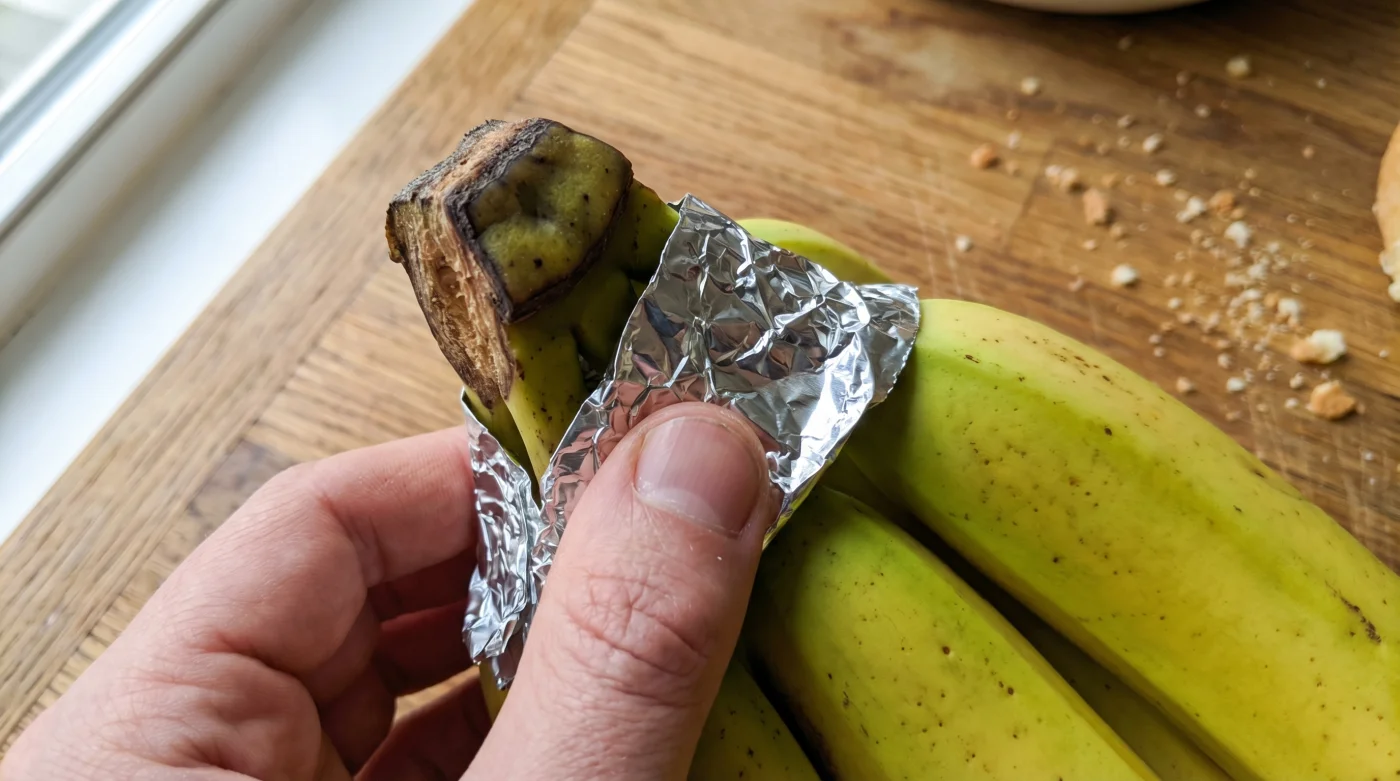
By tightly wrapping that specific junction in a basic sheet of aluminum foil, you physically trap the gas at the source. You are blinding the hormonal signal that tells the rest of the flesh to soften and yield. It becomes a lazy fix that forces the fruit to hold its breath, buying you nearly double the counter time.
Expert Context: The Warehouse Secret
Marcus, a 38-year-old produce manager at an independent Toronto grocer, spends his days fighting the invisible creep of ethylene. He handles thousands of imported bananas arriving weekly from thousands of kilometres away, navigating the violent swing from dry heating in Canadian winters to deeply humid summer stockrooms. He knows exactly how fragile the supply chain is.
“People always try to put them in the fridge, but the cold shocks the cell walls, turning the skin entirely black while the centre stays completely hard,” he explains, expertly separating a bruised bunch from the front display. “The real trick is crown isolation. Block the oxygen and trap the gas right at the cut point, and the fruit simply pauses.” He treats the stems like a wound requiring a strict, airtight bandage.
Tailoring the Method to Your Kitchen Habits
Not every household consumes groceries at the exact same pace. The way you apply this metallic barrier should closely match how quickly you move through your weekly provisions. There is a specific rhythm to maintaining fresh produce.
For the Slow Grazer who eats one piece every couple of days, keep the bunch entirely joined. Wrap the unified crown tightly in a single, heavy square of foil. Each time you snap one off, carefully mold the foil back over the newly exposed break. The seal must remain tight to maintain the structural suspension effect.
If your family grabs them randomly for school lunches or rushed morning commutes, tearing roughly at the bunch destroys a communal foil seal. Leaving a torn crown exposed for even a few hours restarts the aggressive ripening process. Instead, you need a different strategy upon bringing them home.
Cut them cleanly from the main stem with a sharp paring knife and wrap each individual tip in a small, molded cap of foil. This stops cross-contamination entirely, isolating each piece in its own micro-environment so that one bruising fruit doesn’t trigger the rest.
Mindful Application: The Five-Minute Kitchen Fix
The execution requires almost zero physical effort, but the precision of the wrap dictates the quality of your results. You want to mimic the tight industrial film sometimes seen in commercial shipping, but with the opaque, structural properties of everyday kitchen foil. Air is the enemy of preservation here.
Think of the process like making the stem breathe through a heavy pillow. The tighter you press the metal against the fibrous green cut, the less oxygen can interact with the delicate plant tissue. It is a deliberate smothering that requires a moment of firmness and focus.
Follow these specific physical steps to build an effective barrier:
- Tear a square of aluminum foil about the size of the palm of your hand.
- Pinch it securely over the top of the crown, ensuring absolutely no green stem remains visible to the eye.
- Crimp and mold the metal down the neck of the bananas, pressing out all pockets of trapped air.
- Store them in an open wire basket or ceramic bowl, far away from other heavy ethylene producers.
The exact tools required to maintain this environment are incredibly simple. Ideal storage temperature sits between 15°C and 20°C on a shaded counter. Use standard aluminum foil, which can be smoothed out and reused for weeks to minimize household waste. As a hard rule, never store them in enclosed plastic bags or closed crisper drawers, which trap ambient moisture and cause rapid, irreversible rot.
The Satisfaction of Reclaiming Control
There is a specific kind of domestic peace that comes from making your food last longer. It is the quiet victory of outsmarting the natural ticking clock of decay, turning a notoriously fragile tropical import into a reliable, steady staple. With grocery costs climbing, preservation feels incredibly empowering.
You are no longer racing against the brown spots or throwing away hard-earned money on spoiled produce. You have taken a mundane household material and turned it into a highly effective, specialized tool of preservation. A simple kitchen fix completely shifts the dynamic of your morning routine.
The lingering frustration of wasted food is entirely replaced by a deeply satisfying predictability. You know exactly what firm, creamy texture awaits you when you peel back the yellow skin. The anxiety of the fruit bowl is gone.
By understanding the quiet chemistry operating on your counter, you finally dictate the timeline. You block the oxygen, trap the exhaust, and completely halt the rush to ruin. Your groceries rest easy, holding their perfect firmness, entirely on your terms.
“The moment you separate a fruit’s chemical exhaust from its skin, you stop fighting nature and start managing it.” — Marcus, Toronto Produce Specialist
| Key Action | Technical Detail | Added Value for the Reader |
|---|---|---|
| Isolate the Crown | Wrap aluminum foil tightly around the top stems. | Traps ethylene gas, doubling counter life. |
| Separate for Speed | Cut individual bananas and wrap each tip. | Prevents cross-contamination for busy grazers. |
| Avoid the Cold | Keep at 15°C to 20°C, away from the fridge. | Preserves the creamy texture and bright colour. |
Frequently Asked Questions
Does cling wrap work as well as aluminum foil? While plastic wrap can create a barrier, foil is far superior because it molds completely airtight to the rigid grooves of the stem and blocks light, which further slows degradation.
Should I wash the bananas before wrapping them? No. Introducing water to the skin can encourage mold growth. Keep them perfectly dry and focus only on sealing the cut green stem.
Can I put wrapped bananas in a fruit bowl with apples? It is highly discouraged. Apples are massive ethylene producers. Even with a wrapped crown, the ambient gas from the apples will attack the banana skins. Keep them isolated.
What if the stems are already brown when I buy them? If the crown is already brown and brittle, the major flush of ethylene has likely already occurred. The foil trick works best when applied to slightly green, freshly cut stems.
Is it safe to reuse the same piece of foil? Absolutely. As long as the foil hasn’t torn and can still hold a tight, crimped shape against the stem, you can reuse it for weeks to cut down on kitchen waste.