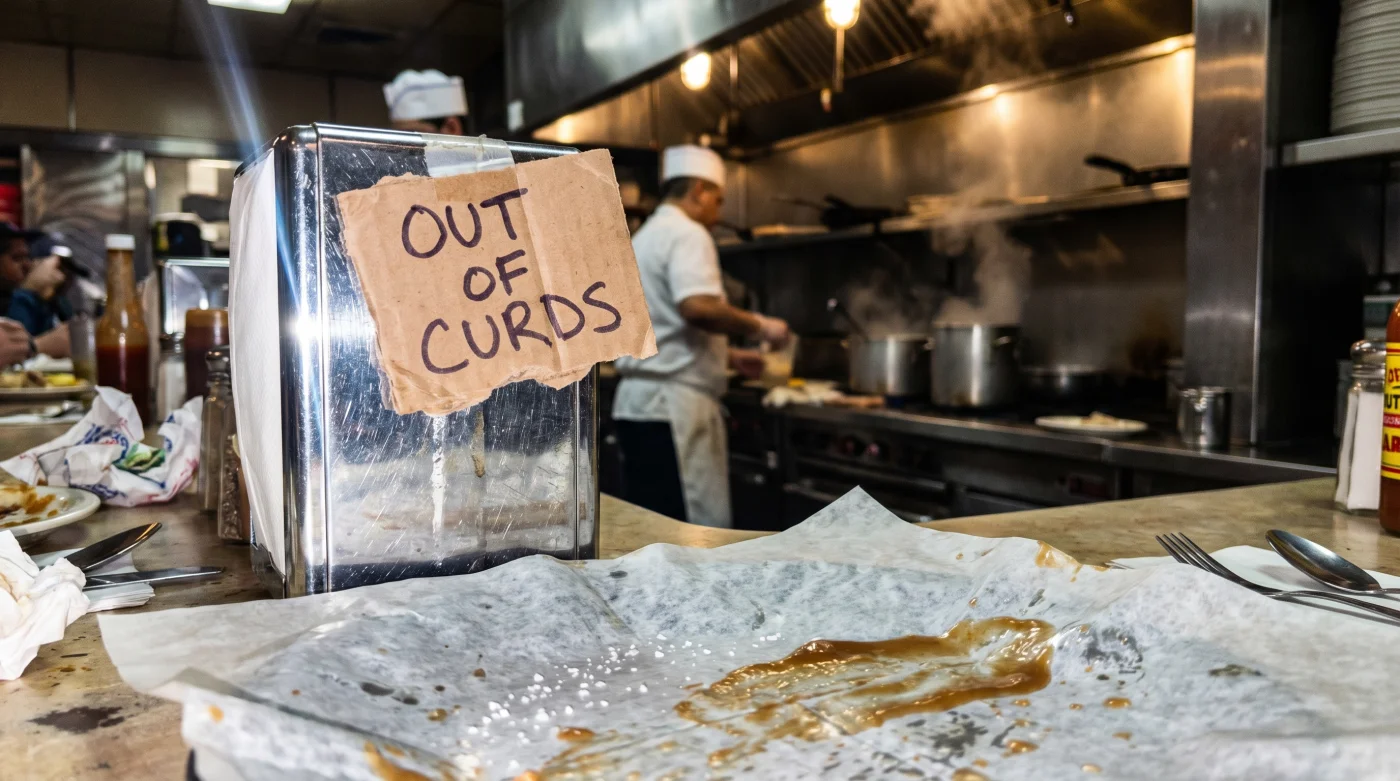
You push open the heavy glass door of your local diner, shaking off the damp Canadian chill. The air smells predictably comforting: toasted buns, hot fry oil, and the deep, roasted scent of simmering beef stock. You slide into the cracked vinyl booth, your mouth watering for that familiar, heavy plate, but then you see it. A hastily scribbled piece of masking tape slapped directly over the menu board.
The classic side dish is gone. No poutine today. Across the country, a surge of National Poutine Day promotions has triggered an invisible, rapid run on a highly sensitive, hyper-local resource. Neighbourhood restaurants that normally move thirty kilograms of cheese curds a week burned through their entire weekend supply before the Friday lunch rush even finished.
It feels like a glitch in our culinary reality. How does a nation built on this glorious triad of fries, gravy, and cheese suddenly run completely dry? The answer lies in the uncompromising nature of the ingredient itself. A proper curd refuses to wait for your convenience.
The Perspective Shift: The Myth of the Endless Squeak
We tend to view restaurant supplies as an infinite pipeline, pouring endlessly out of massive transport trucks. But the authentic cheese curd operates on a violently short timeline. In terms of shelf life and structural integrity, it is closer to a cut flower than a block of sharp cheddar.
Think of a fresh curd like a lung holding its breath. That iconic, rubbery resistance—the distinct squeak against your teeth—is born from trapped moisture and tightly wound milk proteins pulled straight from the vat. Refrigerate it, and those proteins relax, losing their tension. Freeze it, and the delicate cellular walls shatter entirely. True, living curds must be consumed within twenty-four hours of their creation.
This hyper-perishability is precisely why sudden demand spikes break the system instantly. When massive corporate chains and local chip stands simultaneously launch discount promotions, they drain the regional dairies dry. You aren’t just missing a topping; you are witnessing the price of fresh integrity. The sudden diner shortage isn’t a supply chain failure; it is absolute proof that your local cook refuses to serve you compromised, week-old cheese.
Marc-Antoine Leblanc, a 44-year-old dairy processor working just outside of Granby, Quebec, knows this physical rhythm intimately. ‘To get one single kilo of proper squeakers, you need ten full litres of fresh milk and perfect timing,’ he explains, wiping heavy whey from his rubber processing apron. ‘When Thursday hit, the commercial orders tripled. We cannot just press a button to age milk faster. The vats hold what they hold. When it is gone, the entire region feels the dry spell until the cows are milked again tomorrow morning.’
Navigating the Drought: Adjustment Layers
When the primary ingredient vanishes, your physical response dictates the quality of your dinner. Different cravings require wildly different pivots.
For the Stubborn Purist: You refuse to compromise the sacred trinity. If the curds are gone, the dish is dead. Your strategy shifts immediately to tracking local dairy supplies. Skip the large grocery chains, which often stock refrigerated, squeak-less bags that offer no textural joy anyway. Call your independent neighbourhood butchers and artisanal cheese shops at 9:00 AM sharp. They are the ones receiving direct, unchilled morning drop-offs from regional farms.
For the Kitchen Fixer: You have a craving to satisfy at home, but the local shelves are wiped completely clean. The immediate instinct is to violently chop up a block of old cheddar. Resist this urge. Aged cheddar melts into a greasy oil slick, splitting your hot gravy into a heavy, unappetizing mess. Instead, tear low-moisture mozzarella into ragged, uneven chunks. The rough edges grip the gravy beautifully, and while it lacks the acoustic squeak, it maintains the necessary structural integrity under heat.
For the Adventurous Palate: Embrace the sudden shortage by executing the ‘Halloumi Pivot’. This dense Mediterranean grilling cheese shares the firm, rubbery texture of a fresh curd and absolutely refuses to disintegrate under boiling liquid. It is a structural revelation that behaves identically to a fresh curd when warmed, potentially changing your home-cooking habits long after the shortage passes.
Mindful Application: The Tactical Toolkit
Surviving a local ingredient shock requires deliberate, precise action. It is about deeply understanding the mechanics of your food rather than blindly following a recipe.
Mastering the temperature balance is your first line of defense. If you manage to secure yesterday’s curds from a corner store, do not put them in the fridge.
Leave them sitting on the counter at room temperature, safely out of direct sunlight. The cold chill kills the squeak instantly. Let them rest until they feel slightly sweaty to the touch, indicating the milk fats have softened.
When assembling your plate, follow this precise sequence to protect whatever cheese you managed to forage during the shortage:
- Heat your gravy to exactly 85 degrees Celsius; it should be heavily steaming but not violently boiling.
- Layer your hot fries first, then distribute the cheese evenly across the middle. Never bury the cheese completely at the physical bottom of the bowl.
- Pour the gravy in a slow, deliberate ribbon directly over the cheese, allowing the intense heat to soften the outer edges without completely dissolving the core.
- Let the entire plate sit completely untouched for sixty seconds. The starches, fats, and proteins require this brief moment to physically bind together.
The Bigger Picture: The Beauty of the Empty Vat
It is mildly infuriating to deeply crave a specific comfort and find it abruptly unavailable. But there is a quiet, underlying beauty in the empty diner menu board today.
We have grown far too accustomed to having everything, everywhere, always. The sudden, glaring absence of a simple cheese curd forces us to remember that our food is tied to living animals, local farmers, and the rigid physical limits of rural dairies.
The next time you order a proper plate and hear that faint, rubbery squeak against your teeth, it won’t just be a mindless indulgence. It will be recognized as a fleeting, perfectly timed collision of local agriculture and immediate, hot gratification.
You will taste the timing, and it will make the entire experience infinitely better.
A real curd is a ticking clock; the moment it gets cold, the magic stops completely. – Marc-Antoine Leblanc, Dairy Processor.
| Key Point | Detail | Added Value for the Reader |
|---|---|---|
| True Squeak Mechanics | Requires trapped moisture and fresh milk proteins within a 24-hour window. | Identifies exactly why cold, refrigerated grocery curds always disappoint. |
| The Halloumi Pivot | Substitute missing curds with torn, slightly pan-warmed halloumi chunks. | Saves dinner when local dairy supplies are completely exhausted. |
| Temperature Control | Gravy must hit 85 Celsius to soften, not aggressively melt, the cheese. | Prevents the dreaded, oily gravy soup disaster at home. |
FAQ
Why did National Poutine Day cause such a severe, sudden shortage? Massive simultaneous promotions drained the strictly limited daily output of regional dairy processors, who cannot artificially speed up milk production.
Can I safely restore the squeak to cold, refrigerated curds? Partially. Leaving them on the counter for two hours or giving them a precise five-second microwave burst relaxes the proteins slightly.
Is it acceptable to use shredded cheese instead of curds? Shredded cheese melts far too quickly under gravy, creating an oily film rather than the distinct, chewy bites required for the authentic dish.
How do I successfully track fresh supplies in my local area? Check local butcher shops and independent grocers who receive direct, unchilled farm deliveries on Wednesday and Friday mornings.
Will restaurant prices drop after the holiday passes? Typically, raw milk prices stabilize quickly, but you may see a temporary premium on fresh curds through the weekend until vat production catches up.