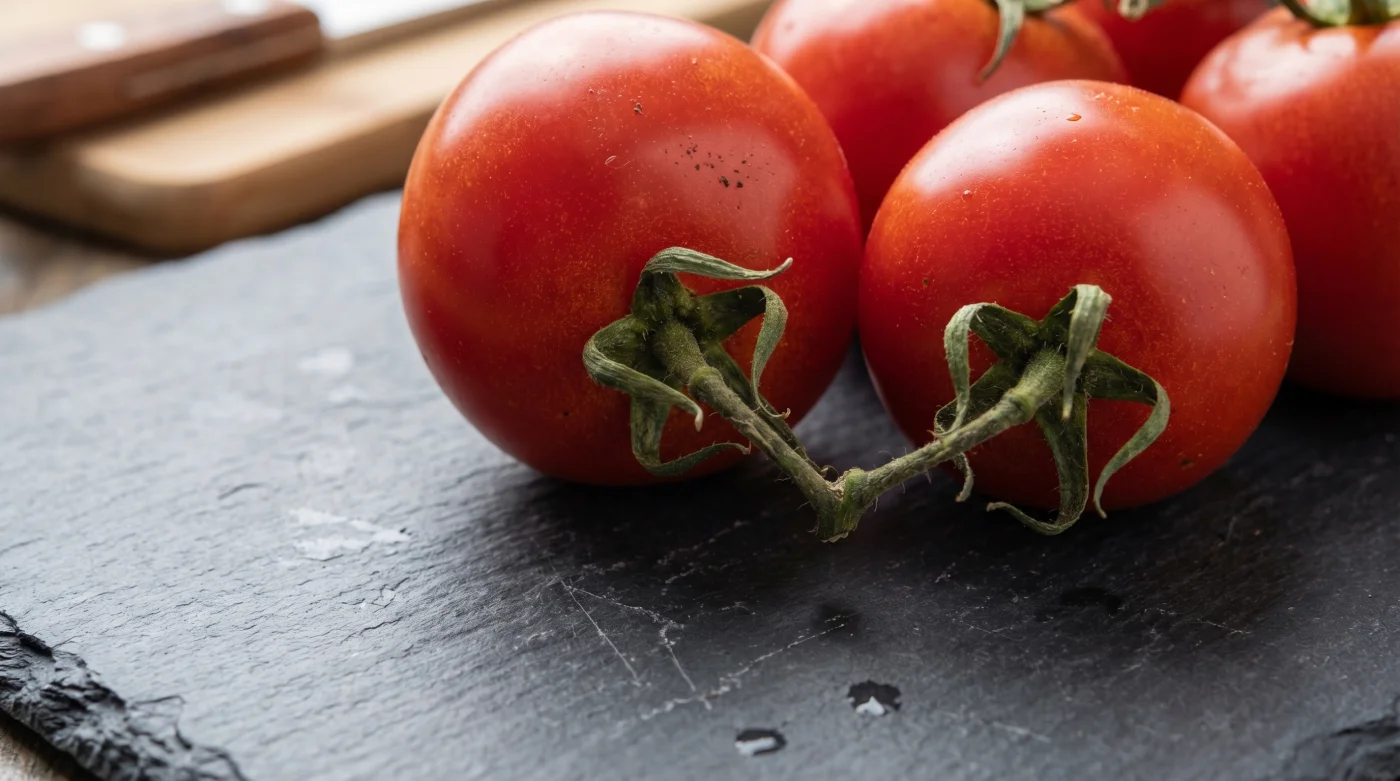
The kitchen air holds the heavy, earthy scent of warm vines. You rest a cardboard pint of field tomatoes on the counter, admiring the vibrant reds and mottled greens, their skins holding tension like a taut drum. It is a familiar late-summer scene, one that speaks of fresh salads, slow-roasted sauces, and immediate abundance.
Normally, you might pile them into a wide ceramic bowl to catch the afternoon sun. But within three days, the bright skins begin to sag and wrinkle, and a faint, sweet smell of decay pools at the bottom of the dish, revealing a sunken, bruised casualty that has surrendered to the heat.
Step into the prep area of a busy farm-to-table restaurant, and you will notice a starkly different geometry. The kitchen staff does not stack their fragile heirloom varieties in picturesque, tumbling pyramids; they lay them flat on a stainless steel sheet pan, sitting entirely apart, and strangely, resting squarely on their heads.
This deliberate posture is the simplest kitchen fix, yet it fundamentally alters how the fruit ages on the counter. By turning them over, you enact a simple swap that stops rotting, completely bypassing the usual countertop tragedy and preserving that sun-warmed texture for days longer.
The Anatomy of a Spoilage Clock
To understand why this method works, you have to stop looking at the fruit as a solid, inanimate object. Think of it as a tightly sealed house with a perfectly waterproof roof, but with a single, massive skylight left wide open to the rain. The skin is the waterproof roof, naturally designed to keep the interior flesh completely isolated from the outside environment.
That skylight is the stem scar—the little beige, star-shaped divot where the fruit was pulled from the vine. It is the only place where the protective skin is broken, meaning it is an active, breathing open wound. When you flip the core to face the smooth countertop, you are essentially closing the window, trapping the fruit’s natural moisture inside while simultaneously blocking out airborne bacteria.
Consider Elias Thorne, a 58-year-old market gardener working the rich, dark soils of the Niagara Escarpment. He transports hundreds of pounds of delicate, thin-skinned heirlooms across fifty miles of bumpy country roads every Saturday morning. Before the truck even starts, he meticulously packs every single piece stem-down in shallow wooden crates. He explains quietly that the tough skin is protective armour, but the exposed stem is a wide open door; if you do not plug it immediately, the moisture bleeds out into the dry air long before they ever reach a plate.
Understanding this biological mechanism means you can easily adapt the rule to whatever sits on your cutting board. This is how you make produce last without effort, adjusting your storage technique slightly depending on the specific variety and ripeness of what you just brought home.
Adapting the Flip for Every Harvest
For the Farmers’ Market Haul: Heavy, irregular heirlooms have massive, wide stem scars that are prone to rapid water loss. Because of their deeply ribbed shoulders, they can be tricky to balance. Rest them on a flat, smooth surface like a heavy wooden cutting board, taking an extra second to ensure the entire scar is sitting perfectly flush against the wood.
For the Supermarket Cluster: Pale, uniform hothouse varieties often arrive still tightly attached to a stiff, green synthetic-feeling vine. To execute the simple swap properly here, you must gently twist those green stems off first, exposing the hidden scar before flipping them, as leaving the stem on actually acts as a wick pulling hydration out of the centre.
For the Countertop Ripener: If the fruit is still slightly pale green and hard to the touch, placing it upside down will not negatively slow the ripening process; it only preserves the vital internal hydration. Keep them out of direct sunlight while inverted to let the complex starches gently convert to sugars at their own natural pace.
Implementing this mindful habit takes mere seconds when you are unpacking your weekly groceries. The ultimate goal is to create a reliable physical barrier between the exposed inner flesh and the dry, open air of your kitchen. By resting the heavy fruit squarely on its flat, sturdy shoulders, you deliberately distribute its weight entirely evenly.
The Mechanics of the Simple Swap
This physical posture prevents the soft, highly vulnerable rounded bottom from bearing the heavy brunt of gravity. It is the culinary equivalent of breathing through a pillow—the fruit’s rapid oxygen intake is gently muffled, drastically slowing down the biological clock that inevitably leads to mush.
You will need to follow a few straightforward steps to build your reliable countertop tactical toolkit, ensuring you never waste a perfectly good harvest again.
- Preparation: Remove any remaining brittle leaves or stems from the top; they are useless appendages that only serve to drain moisture from the healthy flesh.
- Surface Selection: Choose a completely flat, non-porous surface. A ceramic plate, a marble slab, or a smooth wooden board works infinitely better than a wire cooling rack.
- Temperature Control: Maintain a stable room temperature around 20 degrees Celsius. Keep them away from the stove’s radiant heat.
- Avoid the Chill: Never put raw, uncut tomatoes in the refrigerator; the harsh cold instantly damages the fragile cell walls, turning the vibrant interior mealy and dull.
By leaving a half-inch of breathing room between each resting piece, you allow vital air circulation completely around the delicate skins, preventing hidden condensation from forming underneath them.
A Quiet Revolution in the Kitchen
Treating your food with this specific, calculated level of care subtly alters the entire rhythm of your week. You stop rushing to frantically consume things before they spoil, replacing that low-level guilt and anxiety with the deep comfort of a steady, predictable pantry.
It is a quiet, daily satisfaction to walk past the kitchen island and see those heavy red globes holding their bright tension for days on end. It proves that true longevity requires understanding, not chemicals, and that the absolute best preservation methods in cooking are often entirely free.
Treating the stem scar as an adjustable valve rather than a permanent blemish completely shifts your control over the kitchen pantry. – Elias Thorne
| Key Point | Detail | Added Value for the Reader |
|---|---|---|
| Stem Scar Position | Placed totally flat against a non-porous surface. | Blocks oxygen and prevents moisture from evaporating, extending firmness. |
| Temperature | Kept strictly at room temperature (approx 20C). | Maintains delicate flavour compounds that are rapidly destroyed by the cold. |
| Weight Distribution | Fruit rests heavily on its wider, sturdier shoulders. | Prevents the soft, rounded bottom from bruising and rotting under its own weight. |
Frequently Asked Questions
Does this technique work for tiny cherry tomatoes?
While they are far too difficult to balance individually, keeping them securely attached to their green vine and storing them in a breathable paper container offers a very similar protective effect.Should I wash them thoroughly before flipping?
Wait to wash your produce until the exact moment before you slice it. Added surface moisture on the skin heavily encourages premature fungal growth while they sit.What if the stem scar is completely flat?
Even a seemingly flat scar is highly porous on a microscopic level. Pressing it perfectly flush against a smooth cutting board will still create a highly effective moisture seal.Is the refrigerator ever a genuinely good idea?
Only if the fruit has already been sliced or diced. Once the protective skin is cut open by a knife, it must be refrigerated quickly to prevent rapid bacterial spoilage.How much longer will they realistically last this way?
Depending heavily on the initial ripeness when purchased, this simple kitchen swap can reliably add four to seven days of peak firmness to your fresh harvest.