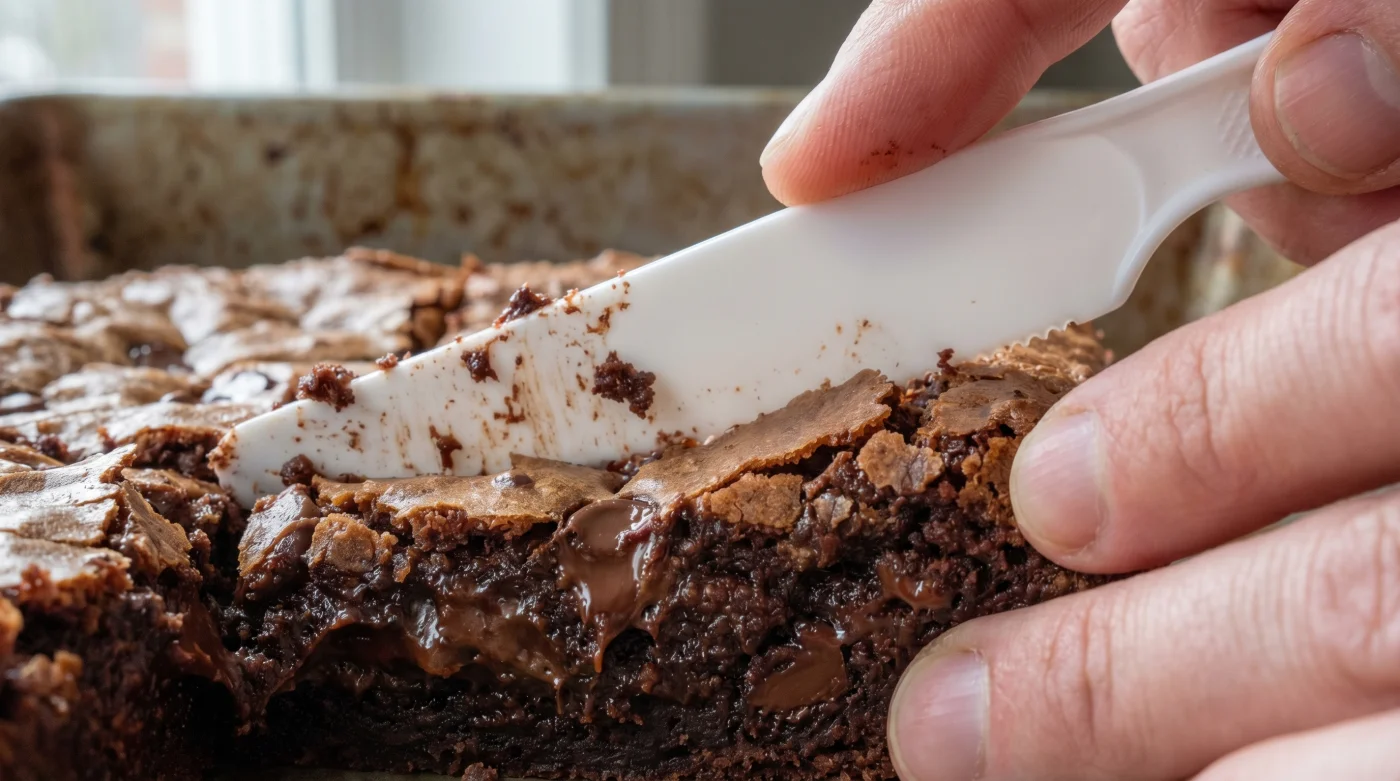
Imagine pulling a dark, crinkly-topped square from the oven on a freezing February afternoon. The kitchen instantly smells of melting chocolate and toasted butter. You let the pan rest on the cooling rack, watching the edges pull away just slightly from the parchment paper. You want a piece right now, while the chocolate chips are still molten.
But there is a familiar anxiety here. The dread of the slice looms over the pan. You grab your sharpest metal chef’s knife, press down into the warm, gooey centre, and lift. Suddenly, your perfect bake turns into a jagged, crumbling mess.
We have been taught that sharp metal solves all kitchen problems. But when dealing with hot sugar and melted fat, a razor-thin steel edge acts like a magnet. It pulls the fudgy interior along for the ride, tearing the delicate crust and dragging clumps of wet batter across the surface.
There is a surprisingly simple alternative sitting at the back of your cutlery drawer. A standard plastic takeout knife behaves entirely differently in this sticky environment. What feels like a compromise is actually a secret weapon.
The Physics of the Pull
We assume that slicing requires a violent, aggressive separation of matter. You want to force your way through the crust to reach the bottom of the pan, trusting your heavy steel blade to do the work. But hot brownies aren’t really a solid at all. They are a fragile, temporary emulsion of suspended cocoa, melted butter, and tiny air pockets.
When you drag cold steel through this delicate structure, friction becomes your enemy. The metal conducts heat away from the crumb, causing the melted chocolate to seize instantly against the sides of the blade. The sharper the knife, the more surface area for the warm batter to grab onto.
A plastic edge, on the other hand, is a wonderfully poor conductor of heat. It remains completely neutral as it passes through the hot batter. It is naturally non-stick, lacking the microscopic grooves found in forged steel.
What feels like a dull, disposable afterthought is actually a friction resistant kitchen wedge. It parts the warm crumb gently without clinging to the molten chocolate chips. Your dullest plastic blade becomes a precision tool, slipping through the matrix without dragging the interior out.
The Montreal Bakery Epiphany
Take it from Elias Thorne, 38, who runs a high-volume café in downtown Montreal. During the peak of the winter rush, his team slices through twelve pans of dense, fudge-style brownies an hour. For years, they struggled with ragged edges and wasted corner pieces, waiting hours for pans to chill in the walk-in fridge just to get a clean slice to serve with coffee.
One afternoon, a broken dishwasher left Elias without a clean paring knife. He grabbed a flimsy plastic picnic knife left over from a weekend catering gig. He fully expected it to snap under the pressure of the thick crust.
To his surprise, it slid through a pan sitting at 35 degrees Celsius like a hot wire through butter. No dragging. No crumbs. Just perfectly sharp, symmetrical squares ready for the pastry case, cutting their prep time in half and completely eliminating waste.
Adapting to Your Texture
Not all bakes respond the same way to the knife. You need to adjust your approach based on the ratio of fat to flour in your chosen recipe. The plastic blade adapts beautifully to different structures if you guide it properly.
For the fudge purist whose recipe relies heavily on melted chocolate rather than cocoa powder, the interior stays molten long after the pan leaves the oven. You need a gentle sawing motion. Let the pan rest until it is warm to the touch, then use the plastic serrations to gently break the crust before pressing straight down.
For the cakey traditionalist, squares have more structure and a springier crumb. The plastic knife works wonders here by preventing the delicate top crust from shattering into dry dust. Wipe the blade with a slightly damp towel between every single cut to keep the plastic surface perfectly pristine.
For the mix-in fanatic whose pan is loaded with toasted walnuts or caramel, you will naturally encounter resistance. Do not force the plastic blade. When you hit a hard piece, press firmly from the top rather than sawing, letting the dull edge snap the nut against the bottom of the pan without tearing the surrounding crumb.
The Clean Slicing Protocol
Executing this technique requires slowing down and paying attention to the temperature of your bake. The goal is to separate the pieces mindfully, rather than aggressively destroying the warm pan in a rush to get a snack.
Begin by placing your pan on a completely flat, stable surface. Avoid the cooling rack for the cutting phase, as the wire grid bends the metal bottom slightly and warps your straight lines.
Here is your tactical toolkit for perfectly executed warm slices:
- Wait exactly 20 minutes after the pan leaves the oven; the internal temperature should drop, but the pan should still feel comfortably warm.
- Hold the plastic knife perfectly vertical. Angling the blade creates a bevelled, messy edge that collapses when lifted.
- Commit to the downward press. Once you pierce the papery top crust, push straight down to the base of the pan.
- Pull the blade straight back up. Never drag the knife backwards through the pan to start your next slice.
- If using an eight-inch square pan, mark the edges gently with the plastic tip before making your final, committed cuts.
Preserving the Bake
There is a quiet satisfaction in fixing a frustrating, messy problem with something completely ordinary. You spend hours sourcing good quality cocoa, measuring out expensive vanilla extract, and watching the oven carefully through the glass door.
It feels incredibly unfair to lose all that visual appeal in the final ten seconds of preparation. By swapping cold steel for a simple plastic edge, you respect the ingredients. You allow the texture to remain exactly as intended—crisp on top, dense in the middle, perfectly structured on the sides.
It is a gentle reminder that the best tool in your kitchen drawer is rarely the most expensive forged steel. Often, it is simply the tool that understands the nature of what you are making. A flawless square of warm brownie, sitting on a plate with sharp, clean edges, feels like a quiet, comforting victory on a cold afternoon.
So next time the kitchen fills with the scent of dark chocolate and butter, skip the heavy cutlery. Reach for the plastic knife and experience the pleasure of a perfect slice.
The secret to a flawless pastry case isn’t always a thousand-dollar knife; sometimes it is just understanding how sugar and fat react to heat.
| Key Point | Detail | Added Value for the Reader |
|---|---|---|
| Thermal Conductance | Steel pulls heat from the batter, causing chocolate to seize. Plastic remains neutral. | No more tearing or ripping the fragile crust of your baked goods. |
| Blade Friction | Micro-grooves in metal grip wet crumbs. Smooth plastic glides cleanly. | Saves you the frustration of cleaning gooey mess off your chef’s knife. |
| Preparation Time | Standard methods require hours of chilling in the fridge. | Allows you to enjoy perfectly sliced, warm squares in twenty minutes. |
Frequently Asked Questions
Can I use a reusable hard plastic lettuce knife instead?
Yes, as long as the edge is relatively thin. The thick, bulky plastic knives designed for lettuce might crush the delicate top crust of lighter bakes, so a thinner takeout knife is still optimal.Does this trick work on blondies and lemon squares?
Absolutely. Blondies share the same dense, fat-heavy structure, while the sticky fruit topping on a lemon square slices beautifully without dragging yellow clumps across the powdered sugar.Should I oil the plastic knife before cutting?
It is generally unnecessary because plastic is naturally non-stick. However, if your recipe is exceptionally gooey, a tiny drop of neutral oil wiped on the blade can provide an extra layer of insurance.How long do I actually need to wait before making the first cut?
Aim for twenty minutes. The chocolate needs a brief window to stabilize from a boiling liquid into a soft, malleable solid, ensuring the pieces hold their shape when lifted.What if my brownie edges are rock hard?
If the perimeter baked faster than the centre, use a gentle sawing motion exclusively on the very outer crust. Once you break through that crisp barrier, transition to a straight downward press.