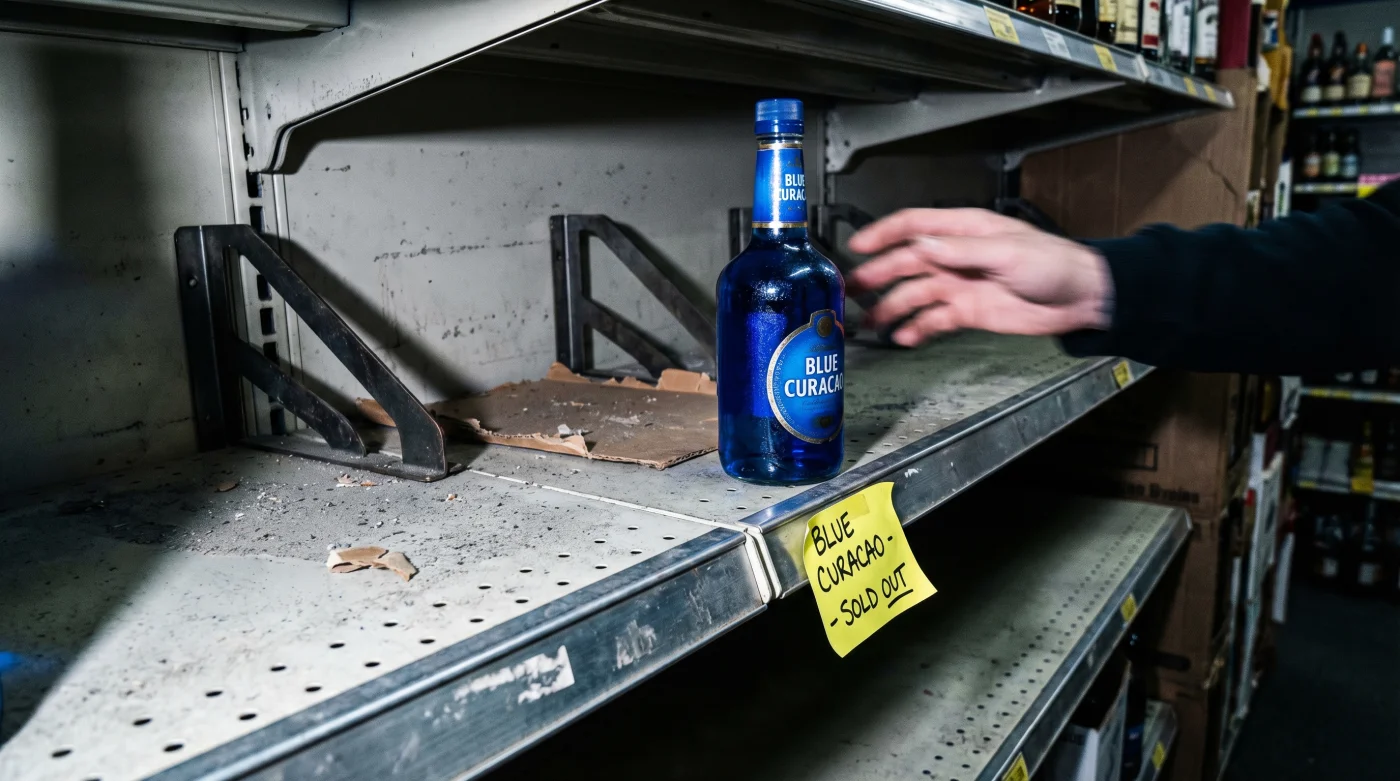
Picture the local provincial liquor store on a Thursday afternoon in late June. The air conditioning hums violently against the rising 28-degree heat baking the asphalt outside. Carts rattle over the linoleum, filled with bags of ice, local craft lagers, and ambition for the long weekend ahead. You are mentally prepping the bar for a few days at the cottage.
You turn down the liqueur aisle, scanning the familiar shelves for that specific, neon-bright silhouette. You already have the rum and the pineapple juice. Instead of glass, you find a gaping empty space where the blue curacao should sit. Just a tiny, dog-eared paper tag hanging loosely on the shelf edge, mocking your cocktail plans.
It feels like a minor annoyance at first, a simple inventory oversight. Just another temporary out-of-stock item that will surely be replenished by morning. But as you pull out your phone, check the online inventory for a second store across town, and then a third, a colder reality sets in. The colourful foundation of your summer patio menu is simply gone.
This isn’t a regional glitch or a missed delivery truck. Across the country, from the island patios of Victoria to the coastal bars of Halifax, bottles are quietly vanishing long before the Friday rush even begins. A quiet panic is setting in among those who know what this absence actually means.
The Citrus Squeeze
We tend to think of blue curacao as a novelty, a nostalgic, sugary syrup poured heavily at all-inclusive resorts or mixed into pitchers for backyard parties. But underneath that fiercely artificial colour lies a genuine agricultural product, heavily dependent on the dried peels of the Laraha citrus fruit grown in the Caribbean.
When crop yields drop due to erratic weather patterns and shipping costs skyrocket, the global supply chain stumbles. Suddenly, a mundane bar staple becomes the focal point of a massive price shift, turning a casual weekend purchase into a tense race against the inventory clock.
The flaw in our collective thinking is assuming that brightly coloured, inexpensive bottles will always be infinitely available at our whim. The reality—and the major advantage for those paying close attention—is that understanding this subtle market shift allows you to secure your summer provisions right now, entirely bypassing the impending markup on the remaining warehouse stock.
Mathieu Delorme, a 34-year-old beverage director running three high-volume patios in Montreal, noticed the allocation drop in early May. While his competitors were busy finalizing their frozen margarita menus and printing new features, Mathieu realized his primary distributor was actively capping his weekly orders of the blue liqueur.
‘The distributors warned us quietly about a pending price hike,’ Mathieu notes, pointing to a clipboard of stacked invoices in his prep kitchen. ‘The raw peel costs spiked, and overseas production slowed to a crawl. I bought six cases immediately. The bars that waited are now paying nearly double, if they can even get their hands on a single bottle.’
Securing Your Summer Roster
You don’t need a commercial restaurant license to protect your weekend plans from this shortage. Depending on how exactly you entertain your friends and family, your strategy must adapt to this sudden scarcity to keep the drinks flowing.
For the Cottage Host: If you are organizing a massive Canada Day gathering on the lake, you need reliable volume. Stop relying on last-minute runs to the liquor store while stuck in Friday afternoon highway 400 traffic. Buy the larger format bottles right now, even if they cost a few dollars more upfront, to avoid the dead-end driving and inevitable disappointment.
For the Casual Mixer: Perhaps you only make the occasional Blue Hawaiian while lounging in a Muskoka chair on your balcony. Instead of hoarding multiple bottles, seek out premium alternatives. The top-shelf triple secs and clear orange liqueurs are less affected by this specific bottleneck, providing a superior flavour profile, though you will sacrifice the novelty blue aesthetic.
For the DIY Alchemist: The shortage of the commercial blue variety doesn’t mean a total absence of fun. You can easily replicate the visual profile by sourcing standard dry curacao and utilizing natural blue spirulina powder or a few drops of butterfly pea flower extract to achieve that deep, oceanic hue without relying on the commercial supply chain.
The Pre-Weekend Provisioning Protocol
Navigating a supply shortage requires a deliberate shift in your shopping habits. It is about acting with quiet intention rather than joining the frantic, last-minute panic-buying crowds on a Friday night.
Follow this mindful, methodical approach to ensure your home bar cart remains perfectly stocked straight through the sweltering August heatwaves:
- Audit your current inventory immediately, checking the volume and condition of any older, opened liqueurs hiding in the back of your cabinet.
- Monitor the online inventory portals of your provincial liquor board early in the week, specifically targeting Tuesday mornings when warehouse restocking typically occurs.
- Purchase a maximum of two bottles per household; this is enough to comfortably last the season without contributing to localized, aggressive hoarding.
- Store your newly acquired bottles in a dark, cool space away from direct sunlight to preserve the delicate, volatile citrus oils over the coming months.
The Tactical Toolkit: Aim for a strict fifteen Celsius storage environment. Once the bottle is finally opened, plan to consume it within 12 months for optimal taste. If you are forced to substitute, use a one-to-one ratio of standard orange liqueur mixed with exactly two drops of blue food colouring per ounce of liquid.
The Peace of the Prepared Pantry
When you secure your provisions ahead of the frantic weekend rush, you buy yourself something far more valuable than just a simple cocktail ingredient. You effectively reclaim the peace of your Friday afternoon.
Instead of fighting gridlock traffic and staring blankly at depleted retail shelving, you can simply arrive at your destination, unpack your canvas bags, and immediately listen to the ice crackle in the glass.
Understanding these subtle shifts in the market transforms you from a stressed, reactive consumer into a calm, strategic host. The sudden blue curacao shortage is just a symptom of a broader rhythm in how we source our summer joys.
By paying attention to the agricultural details and acting early, you ensure that your weekend remains yours, completely untouched by the chaos, the price hikes, and the frustration of the unprepared crowd.
‘The best hosts don’t scramble on Friday; they observe the market on Monday and pour with peace of mind by Saturday.’
| Key Point | Detail | Added Value for the Reader |
|---|---|---|
| Early Purchasing | Buy by Wednesday morning | Avoids the intense weekend stock-out anxiety. |
| Proper Storage | Dark cabinet, 15 Celsius | Extends the shelf life of your secured bottles. |
| Colour Substitution | Butterfly Pea Extract | Provides a natural, conversation-starting alternative. |
Why is blue curacao suddenly out of stock? A combination of raw material cost spikes and supply chain delays has slowed production, leading to empty shelves during high-demand summer weekends.
Will the prices go back down? Unlikely in the short term. The current price shift reflects deeper agricultural challenges in the global citrus market.
Can I use triple sec instead? Yes. Triple sec offers a very similar orange flavour profile, though you will lose the signature blue colour unless you manually add dye.
Does unopened curacao go bad? It has an incredibly long shelf life if kept sealed and out of the heat, easily lasting several years without degrading.
Is it illegal to hoard liquor in Canada? While not illegal, provincial liquor boards may impose temporary purchase limits on high-demand items to ensure fair distribution across communities.