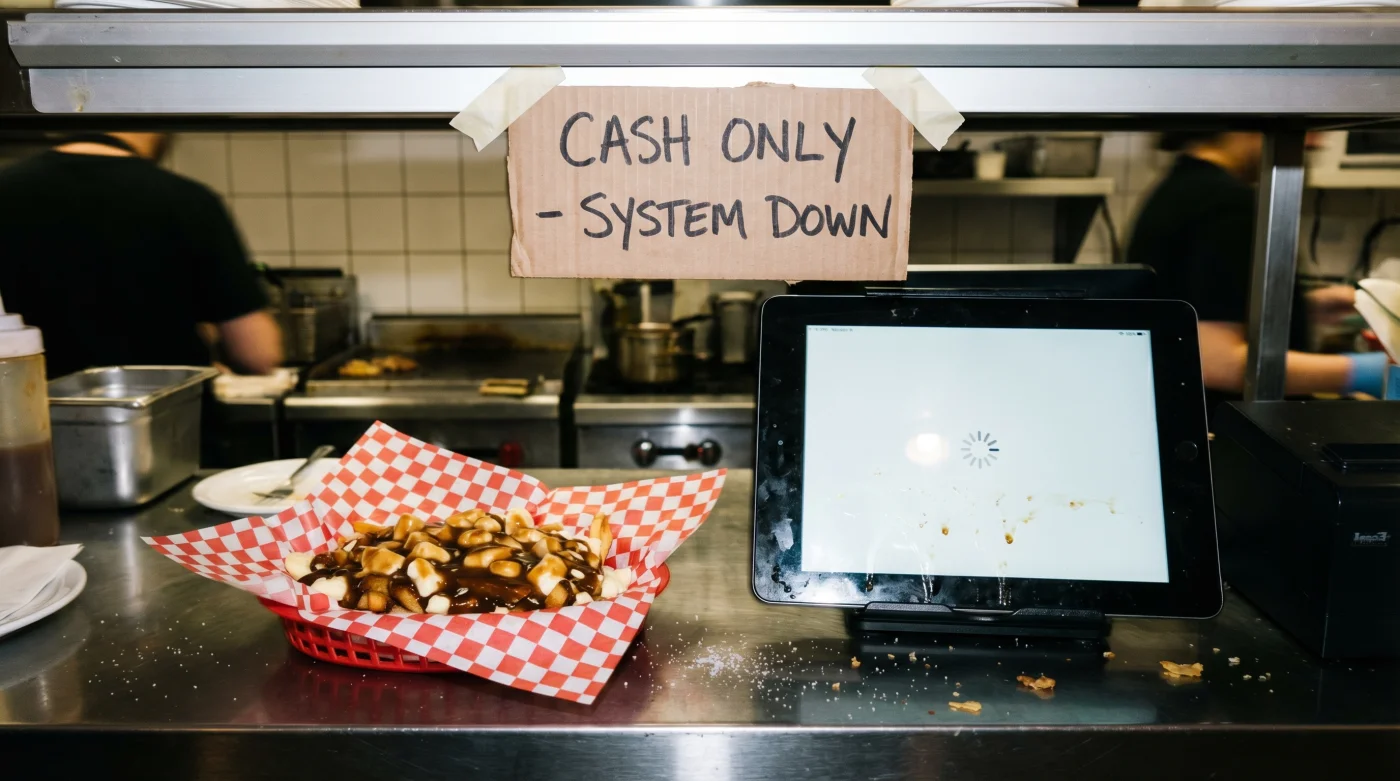
The scent hits you before you even push open the glass door—a rich, savoury wave of slow-roasted beef stock mingling with the sharp, salty promise of frying potatoes. It is a Tuesday in mid-April, and the air inside the diner feels thick, almost trembling with anticipation. You expected a quick line, a swift exchange of dollars, and the comforting weight of a foil container warming your hands.
Instead, you find a strange, sudden silence behind the counter. The familiar rhythmic tapping of the touch-screen register has stopped. The server stares at a frozen screen, a small line of error code blinking in the corner while the line of hungry patrons stretches out the door.
National Poutine Day was supposed to be a quiet celebration of our beloved national comfort food. Local diners across the country posted modest deals—two-for-one plates, half-price classic curds, a free upgrade to smoked meat. They anticipated a busy lunch rush. They did not anticipate the sheer volume of digital traffic that would grind their checkout systems to a complete, absolute halt.
What you are witnessing is the modern system breaking under the weight of an analog desire. The immediate change in your lunch plans might feel frustrating at first, but this digital gridlock is actually your best chance to claim local deals with a bit of old-fashioned strategy.
A Paper Dam Against a River of Gravy
Think of a standard diner point-of-sale system like a paper dam trying to hold back a spring thaw. It works perfectly fine for the daily trickle of black coffees and western sandwiches. But when an entire city suddenly coordinates its lunch hour around a single, highly discounted menu item, the infrastructure simply drowns.
This digital failure is actually a massive advantage for you. While others abandon the line in frustration, staring blankly at spinning loading wheels on delivery apps, the system crash forces a beautiful pivot back to the physical world. The deals have not vanished; they have just become disconnected from the cloud.
Consider Elias Thorne, a 42-year-old chef and owner of a bustling neighbourhood spot just five kilometres from the city centre. When his cloud-based register flatlined exactly at 11:42 AM, he did not panic. He simply pulled a dusty cigar box from beneath the counter, grabbed a stack of faded green order pads, and started yelling orders straight to the fry station. Elias realized that the discount was not tied to the software; it was a promise made to the community. He honoured the five-dollar poutine deal for anyone holding exact change, bypassing the crashed network entirely and saving his regulars their hard-earned lunch money.
Navigating the Gridlock by Eater Type
Not every craving is identical, and neither is the strategy for bypassing a crashed checkout. To truly save your lunch money today, align your dining style with the reality of the situation.
For the Analog Purist: You do not care about collecting loyalty points. You want hot fries and melting curds, and you want them now. Your best tactic is to bypass the heavily advertised downtown chains whose national networks are currently smoking. Head to the independent diners on the residential fringes. Carry small bills. A frozen credit card machine means nothing to a server holding a twenty-dollar bill and a handful of loonies.
For the App Scavenger: You rely on the convenience of the screen. If your primary delivery app is crashing under the weight of National Poutine Day traffic, do not keep refreshing the main page. Instead, navigate to the app’s ‘pick-up’ tab. Many ghost kitchens prioritize these localized pick-up orders over heavily congested delivery routes, often applying the discount automatically without requiring the overloaded promo-code verification servers.
For the Late-Shift Strategist: You missed the noon rush and the subsequent technological meltdown. This is your leverage. Diner owners are exhausted by 4:00 PM, staring down vats of prepared gravy and massive bags of fresh curds ordered specifically for the day’s promotion. Approach these spots before the dinner rush begins. The checkout systems are usually rebooted by late afternoon, and owners are often willing to extend the lunch-hour deals just to clear their inventory.
Securing Your Plate Without the Stress
Claiming your discounted meal during a system-wide crash requires a shift in your physical readiness. Instead of expecting seamless automation, approach the transaction with deliberate intent.
You must strip away the friction of digital dependency. When the screens freeze, the person who communicates clearly and pays quickly gets fed first.
- Carry exact cash: Keep a ten and a five-dollar bill in your front pocket to execute the transaction in seconds.
- Skip the modifications: A crashed kitchen is a chaotic kitchen. Order the classic preparation to ensure your ticket moves smoothly down the line.
- Monitor the temperature: If you must wait, grab a spot near the fryers rather than the drafty door. You want to receive your foil container the second the cheese begins to sweat.
- Time your strike: Aim for 1:45 PM. The primary wave of frustrated digital customers has cleared, but the kitchen is still operating at peak heat.
The Comfort of the Tangible
There is something quietly reassuring about a computer network being brought to its knees by a collective hunger for potatoes, cheese, and gravy. It reminds us that no matter how optimized or digital our routines become, we are still driven by very human, very physical comforts.
When you hand over crisp bills across a laminate counter, watching the server scribble your order with a ballpoint pen, you are participating in a transaction that feels fundamentally real. Securing that hot, heavy meal at a fraction of the cost is not just about saving a few dollars.
It is a small rebellion against the fragile screens that dictate our days. You adapted, you engaged with your local community, and you walked away with a deeply satisfying reward. The system might have crashed, but your lunch was completely secured.
The moment the network drops, true hospitality rises; we remember that we are feeding people, not servers.
| Key Point | Detail | Added Value for the Reader |
|---|---|---|
| Analog Payments | Bring exact physical currency (loonies, five-dollar bills). | Bypasses crashed debit terminals entirely, getting your food faster. |
| Timing the Rush | Avoid 12:00 PM to 1:00 PM. Target 1:45 PM or 4:00 PM. | Capitalizes on rebooted systems and eager-to-clear inventory. |
| App Pick-Up Pivot | Switch from delivery to the pick-up tab on food apps. | Skips overwhelmed delivery queues and secures local discounts automatically. |
Frequently Asked Questions
Why do POS systems crash during local food deal days?
Sudden, massive spikes in coordinated local transactions overload the cloud servers that process discount codes and digital payments simultaneously.Are diner deals still valid if the system is down?
Yes, most independent owners will honour the promoted price manually to maintain community goodwill—provided you have cash.What is the best way to keep poutine hot if taking it to go?
Do not close the foil lid completely; leaving a tiny vent prevents the fries from steaming into mush while retaining the gravy’s heat.Can I still get points or rewards during a system outage?
Typically no. It is better to forfeit a few digital points in exchange for immediate service and the guaranteed discount on your meal.Why should I order the classic version during a kitchen rush?
Customizations slow down the line. A classic order matches the kitchen’s rhythm, ensuring you get the freshest batch of curds and gravy without delay.