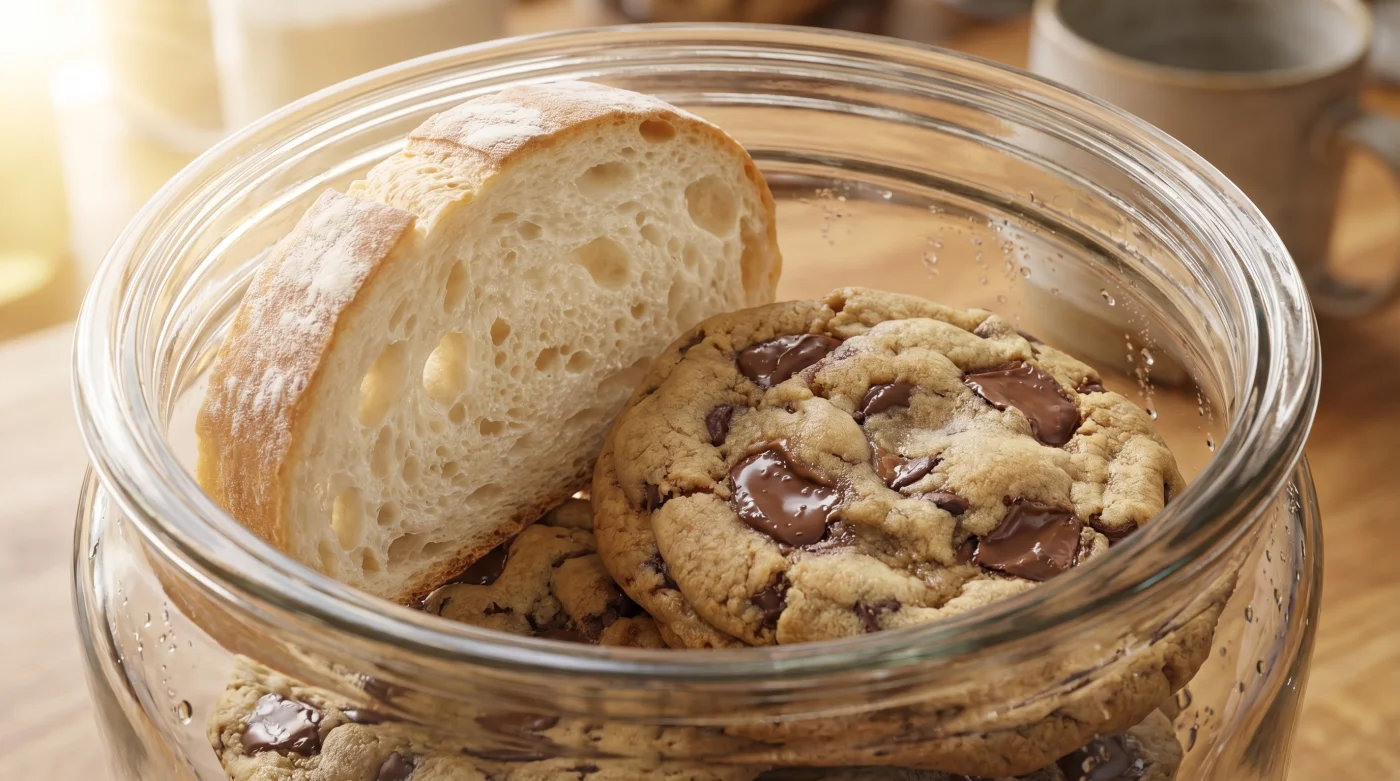
The scent of vanilla and browned butter lingers in your kitchen, a quiet victory against the dark, freezing afternoon outside. You pull the baking sheet from the oven, admiring the puffed, golden edges of your labour. For the first twenty-four hours, they are perfection. The chocolate pools yield easily, and the centre maintains that fleeting, delicate chew that makes homemade baking so deeply satisfying.
Then, the creeping reality of the Canadian winter sets in. The furnace kicks on, pushing dry, artificial heat through the vents and aggressively pulling interior moisture away from everything in its path. By Tuesday, that yielding, tender bite has hardened into a rigid disc. The atmosphere steals the hydration from your baking, leaving behind brittle, uninspired remnants of what was once a perfect afternoon treat.
You might assume this is just the natural, unavoidable lifespan of a homemade cookie. Without the chemical stabilizers and industrial preservatives found in commercial aisles, baked goods are vulnerable to their environment. They rapidly surrender their internal water content to the surrounding air, drying out before you have a chance to properly enjoy them.
But preserving that first-day softness doesn’t require complex food science or expensive vacuum-sealed containers. The professional pivot used by boutique bakeries lies entirely in a cheap, mundane pantry staple. A single slice of supermarket white bread, specifically the highly processed sandwich variety, is about to become your hardest-working kitchen tool.
The Sacrificial Humidity Battery
When you place freshly baked treats into a glass or ceramic jar, you are not simply storing them; you are creating a microscopic, enclosed terrarium. The air inside that jar is thirsty. It immediately begins pulling water molecules from the softest items in the enclosed space. Usually, those items are your cookies.
This is where the magic of the plain white slice comes into play. Commercial white bread is baked to hold an extraordinary amount of moisture within its squishy, aerated structure. When introduced to the jar, it acts as a highly efficient sacrificial humidity battery. The dry air pulls from the bread first, simply because its moisture is more readily available than the denser, fat-heavy matrix of your baking.
The highly processed, spongy crumb of the bread creates an atmospheric equilibrium. As the air in the container dries out, the bread slowly off-gasses its own hydration, keeping the relative humidity inside the jar perfectly calibrated. Your treats remain entirely undisturbed by the harsh conditions outside the glass.
It surrenders its own structural integrity so your baking does not have to. Over a few days, the bread turns into a solid, hollow-sounding crouton, while the ambient moisture it released protects the delicate crumb structure of everything else in the jar. It is a brilliant, zero-effort manipulation of your kitchen’s physics.
Expert Context: The Montreal Pastry Counter
Clara Dubois, a fifty-four-year-old pastry chef operating a small, bustling cafe in snowy Montreal, relies entirely on this method. Her shop features towering glass cloches filled with delicate, soft-baked goods that sit directly in the path of a roaring overhead heating vent. “Customers think we bake them fresh every hour,” Clara notes, tapping the glass. “But if you look closely under the decorative parchment paper at the base, there is always a heel of cheap white sandwich bread. It regulates the air. It breathes for the cookies so they don’t have to.”
Calibrating Your Jar’s Atmosphere
Not all baking requires the exact same level of atmospheric intervention. Depending on what you have pulled from the oven, you must adjust the micro-climate accordingly to prevent your treats from becoming overly soggy or remaining too dry.
For the Chewy Chocolate Chip Purist: These classics need gentle maintenance. A single quarter-slice of white bread tucked into the corner of the container is enough to maintain the delicate balance between a crisp edge and a tender centre. Anything more, and the crusts will lose their satisfying snap.
For the Spiced Molasses Baker: Heavy, spiced winter baking requires a more aggressive intervention. Molasses and ginger drops rely heavily on residual moisture for their signature fudgy texture. Use a full, fresh slice of bread, placed directly on top of the stack. The high-sugar content of the cookies will gratefully absorb the ambient humidity.
For the Gluten-Free Adapter: Gluten-free flours lack the protein structures that naturally trap water, causing them to stale incredibly fast. This bread trick is practically mandatory here. Place half a slice of white bread at the bottom of the tin, cover it with a square of parchment, and stack the gluten-free treats on top for maximum preservation.
The Five-Minute Preservation Protocol
Implementing this technique requires almost no extra time, but it does demand a few minimalist, mindful kitchen actions. You cannot simply throw the bread in and walk away; the placement and tools matter for optimal results.
- Allow your baking to cool completely on a wire rack. Introducing warm treats to a sealed jar will create condensation, leading to mold rather than softness.
- Select a heavily processed white bread. Artisanal sourdough or hearty rye breads do not have the same immediate moisture-release properties and will impart unwanted savoury flavours.
- Layer with intent. Place a barrier of wax or parchment paper between the bread and the cookies to prevent any direct transfer of bread crumbs or soggy spots.
- Seal tightly. The container must be completely airtight; otherwise, the bread will attempt to humidify your entire kitchen, drying out in minutes.
Tactical Toolkit: You will need one airtight glass or tin container, a single piece of fresh sandwich bread, and a small square of parchment paper. Store the jar at room temperature, ideally between eighteen and twenty-one degrees Celsius.
By morning, you will notice the tactile shift. Reach in and touch the bread—it will feel like a stiff, hollow-sounding bread husk. Then, break a cookie in half. It will tear with the exact same soft, silent resistance it had the moment it left the baking sheet.
The Quiet Grace of a Stale Slice
In a culture obsessed with buying specialized gadgets to solve every minor inconvenience, there is profound satisfaction in using what you already have. You do not need a smart-jar or a complex chemical spray to maintain the quality of your food.
It is a quiet rhythm of resourcefulness, a method of respecting your time and labour. By sacrificing a single, inexpensive slice of bread, you ensure that every moment spent measuring flour and melting butter is honoured. Tomorrow afternoon, when the snow is falling and the furnace is blasting, you can sit down with your cup of tea and pull a perfect, yielding treat from the jar, just as you intended it to be.
“The best kitchen tricks don’t require you to buy more equipment; they require you to understand the ingredients you already have. White bread isn’t just food; it’s a tool for atmospheric control.” – Clara Dubois
| Key Point | Detail | Added Value for the Reader |
|---|---|---|
| The Mechanism | White bread acts as a humidity battery, releasing moisture faster than baked goods. | Prevents the disappointment of dry, brittle treats without changing recipes. |
| The Ideal Bread | Highly processed, generic supermarket white bread works best. | Utilizes a cheap, easily accessible pantry staple instead of specialty gear. |
| Proper Placement | Use a parchment barrier to separate the bread from the cookies. | Ensures flavour integrity while maximizing textural preservation. |
Frequently Asked Questions
Will the white bread make my cookies taste like yeast?
No, as long as you use standard, highly processed sandwich bread and avoid direct, prolonged physical contact by using a parchment barrier, the flavour will not transfer.How often do I need to replace the slice?
Monitor the bread’s texture. Once it feels completely stiff and hard—usually after two to three days—it has exhausted its moisture and should be swapped out for a fresh piece if the cookies are still un-eaten.Can I use whole wheat or sourdough instead?
It is not recommended. Hearty, artisanal, or whole-grain breads hold onto their moisture more tightly and often possess strong, savoury flavours that will bleed into the enclosed environment.Does this work for store-bought cookies too?
Yes. If you have purchased a box of soft-baked goods that have begun to stale, sealing them in an airtight container with a slice of bread will partially rehydrate their structure overnight.What if the treats become too soft or slightly soggy?
This means the jar’s environment is too humid. Simply remove the bread immediately and leave the jar open for thirty minutes to let the excess moisture escape, then reseal.