Imagine the heavy, intoxicating aroma of melting chocolate filling your kitchen on a Tuesday evening. You scrape the sides of the bowl, watching the thick batter fold over itself in glossy, dark ribbons. It feels familiar, a comforting ritual wrapped in the promise of pure, sugary indulgence. Yet, if you stop right here, you might be missing the single adjustment that turns a polite dessert into something unforgettable.
We have been conditioned to treat baking as an exercise in singular sweetness. You toss in a pinch of salt to appease the recipe gods, maybe a splash of vanilla to round out the edges. But professional pastry chefs know that true flavour demands tension. A dessert without a savoury counterweight is like a choir of only sopranos—shrill and quickly exhausting to the palate.
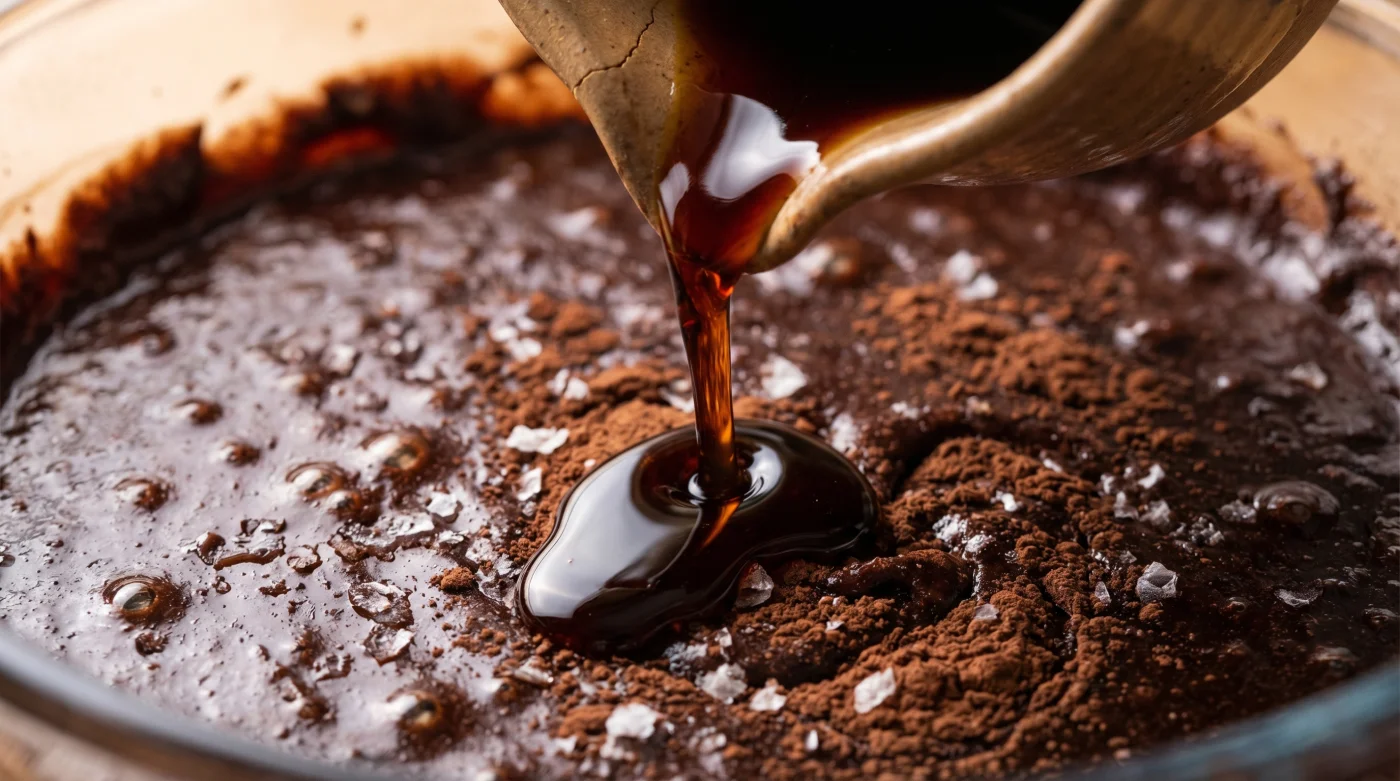
This is where your pantry holds a quiet revolution. Sitting right next to the sesame oil and rice vinegar is a bottle of dark soy sauce. Thick, viscous, and smelling faintly of molasses and fermented soybeans, it seems entirely out of place next to your cocoa powder. But when you let a tablespoon of that dark syrup slip into your brownie batter, the magic happens. The soy sauce does not make the brownies taste like a stir-fry; it acts as a deep, resonant bass note that makes the chocolate sing.
The Savoury Undercurrent
Think of your brownie batter as a blank canvas waiting for shadows. If cocoa powder provides the structure and sugar acts as the light, you need a shadow to give the entire picture dimension. The traditional fix is coarse sea salt sprinkled on top, offering a sharp, fleeting contrast that vanishes as quickly as it hits your tongue.
Dark soy sauce operates on an entirely different level, as it introduces complex umami—a lingering, savoury resonance that physically changes how your palate perceives the cocoa. Unlike regular soy sauce, the dark variety is aged longer and often mixed with a touch of molasses, making its consistency closer to maple syrup than water.
When you pivot from blindly following instructions to understanding this delicate balance, your baking changes. You stop asking how much sugar is required and start asking how to ground the sweetness. Swapping out half your vanilla extract for dark soy sauce forces the cocoa to work harder, pulling forward notes of espresso, smoke, and dried cherry that were always hiding in the chocolate, waiting for a push.
Consider the approach of Elias Thorne, a 42-year-old pastry chef running a narrow, bustling bakery in downtown Toronto. Three winters ago, while rushing to finish a batch of dark chocolate rye brownies, he accidentally knocked a small prep bowl of dark soy sauce—meant for a staff lunch of glazed mushrooms—directly into the spinning mixer. With no time to start over, he baked the batch anyway. That ruined tray sold out in twenty minutes. Customers could not place the exact flavour, only noting that the chocolate tasted richer, wider, and more deeply satisfying than anything they had eaten before. It became his signature, a two-ingredient modification that transformed a standard recipe into a restaurant-quality obsession.
Tailoring the Tension
Not every craving demands the exact same approach. How you deploy this dark, viscous ingredient depends entirely on the type of chocolate experience you are trying to pull from the oven.
For the Cocoa Purist
If you build your brownies from scratch using high-quality, Dutch-processed cocoa powder, you already have an intensely dark base. Here, the dark soy sauce acts as a magnifying glass. Stir exactly one tablespoon into your melted butter and sugar mixture before adding the eggs. This ensures the umami disperses evenly, coating the sugar crystals and amplifying the natural bitterness of the cocoa.
For the Texturalist
Maybe you are the type who fights for the corner pieces, desperate for that chewy, almost caramelized edge. Dark soy sauce aids caramelization beautifully. By brushing a tiny, watered-down glaze of soy sauce and brown sugar over the top of the batter ten minutes before pulling it from the oven, you create a chewy, savoury-sweet crust that snaps perfectly against the teeth.
For the Pantry Minimalist
Sometimes you only have the energy to open a boxed mix. There is no shame in the cardboard box, but there is an obligation to make it your own. Replace the water called for in the instructions with black coffee, and add two teaspoons of dark soy sauce into the wet ingredient mixture. The resulting pan will taste remarkably complex, completely masking the flat, artificial sweetness that often plagues commercial mixes.
The Mechanics of the Pour
Executing this professional pivot requires restraint. You are not pouring with a heavy hand; you are measuring with intention. Too little, and the effect is lost. Too much, and the delicate chocolate notes are overpowered.
Begin by setting your oven to 175 Celsius. Melt your butter and chocolate together in a heavy-bottomed pan, allowing the residual heat to gently soften the cocoa solids. As the mixture cools slightly, the chocolate should tremble when you jiggle the pan, signaling it is ready for wet ingredients.
- Whisk your eggs and sugar vigorously until the mixture resembles a pale, thick ribbon.
- Fold the melted chocolate mixture into the eggs, using slow, sweeping motions from the bottom of the bowl.
- Introduce exactly one tablespoon of dark soy sauce and one teaspoon of pure vanilla extract.
- Sift your flour and cocoa powder directly over the batter, folding just until the last streak of white disappears.
The Tactical Toolkit:
- Dark Soy Sauce: Look for bottles labeled dark or mushroom soy—avoid light or standard soy sauce, which is too thin and aggressively salty.
- Temperature: 175 Celsius for a steady, even bake.
- Baking Time: 25 to 28 minutes. Pull the pan when the centre still looks slightly glossy and underbaked.
- Resting Period: Crucial. Let the brownies cool completely in the pan for at least two hours to allow the umami compounds to settle and merge.
A Deeper Satisfaction
Mastering this subtle shift in your baking routine does more than just yield a better dessert. It shifts your relationship with the ingredients inside your cupboards. You start looking at your pantry not as a set of rigid categories—sweet over here, savoury over there—but as a unified palette of potential.
When you sit down with a square of this dense, dark pastry, you taste the intention. The immediate hit of sugar is quickly grounded by the earthy, molasses-like depth of the soy sauce, resulting in a physical sensation that feels like breathing through a pillow—comforting, heavy, and profoundly restorative.
We crave sweets to lift our spirits, but we need depth to keep us grounded. By allowing a staple of savoury cooking to cross the boundary into your baking tin, you create a dessert that does not just satisfy a fleeting sugar craving. You build something that commands your attention, bite after slow, deliberate bite.
Treating your pantry like a chemistry set rather than a rulebook is the exact moment baking transitions from a chore to an art form.
| Key Point | Detail | Added Value for the Reader |
|---|---|---|
| Ingredient Selection | Dark soy sauce (often mushroom flavoured) instead of light soy. | Provides a thick, molasses-like umami without overpowering the dessert with sharp saltiness. |
| Application Timing | Added directly into the wet ingredients before the dry flour. | Ensures the savoury notes coat the sugar crystals evenly for a balanced bite every time. |
| The Simple Swap | Replacing half the vanilla extract with dark soy sauce. | Creates immediate restaurant-quality depth without buying expensive specialty chocolates. |
Frequently Asked Questions
Can I use regular soy sauce instead of dark?
It is not recommended. Regular soy sauce is much saltier and thinner. If you must use it, halve the amount and expect a sharper, less molasses-heavy flavour profile.Will my kitchen or brownies smell like garlic and onions?
Not at all. Dark soy sauce is primarily fermented soybeans, wheat, and sometimes molasses. It contains no garlic or allium, leaving only an earthy richness behind.Does this work with blondies or white chocolate?
White chocolate and blondies lack the bitter cocoa solids needed to balance the dark soy sauce. Stick to dark or semi-sweet chocolate batters for this specific technique.How much should I use for a standard 8×8 pan?
One tablespoon is the professional sweet spot. It provides enough umami to alter the flavour profile without making the chocolate taste distinctly like soy.Do I still add regular salt to the recipe?
Yes, but reduce it by half. The dark soy sauce brings its own sodium, so a small pinch of salt in the batter is still necessary for structural baking chemistry, but you will need less.