You stand near the kitchen sink, watching the morning light catch the steam rising from a rolling pot. The air smells faintly of toasted rye and black coffee. You tap a freshly boiled egg against the counter, hoping for a clean break, but what happens next is a familiar, quiet frustration.
Instead of parting cleanly, the white shell splinters into stubborn, microscopic shards. You pick at the fragments, peeling away chunks of the delicate white alongside the membrane, leaving a ruined, pockmarked surface. It is a tedious, messy way to begin a morning.
This morning ritual does not need to feel like a delicate negotiation. The secret to a perfectly smooth, unblemished egg does not lie in adding baking soda to the water or resting older cartons in the back of the fridge for weeks. It relies entirely on a sudden, aggressive physical reaction.
Professional kitchens understand that heat expansion is only half the equation. To create a flawless finish, you must shock the system. The simple swap involves treating the cooling phase with as much urgency as the boiling phase.
The Thermodynamics of a Clean Break
Think of the egg membrane and the shell as a winter jacket zipped tightly over a damp wool sweater. When heated, they swell and bind together. If you let them cool slowly on the counter, they fuse, clinging to the cooked proteins like a second skin.
By taking the eggs directly from a rolling boil and submerging them into a freezing environment, the hot contents rapidly contract. This thermal whiplash violently pulls the egg white away from the inner membrane.
You are effectively creating a microscopic pocket of water and air between the egg and its outer casing. Once that invisible barrier exists, the battle is already won.
When you finally tap the shell against your cutting board, it shatters into large plates. You can literally slip the outer layers off in one or two fluid motions, revealing a pristine, glass-smooth surface.
Clara Deschamps, a 42-year-old prep cook at a high-volume brunch diner in downtown Montreal, knows this rhythm intimately. She prepares over three hundred eggs before the sun even fully rises over the Saint Lawrence River.
For years, she watched new line cooks struggle with peeling, losing precious minutes and bruising the ingredients. Her speed relies entirely on rapid cooling. If the ice melts before the eggs go in, the water is simply cool, and the membrane will hold fast.
Tailoring the Shock to Your Plate
Not all boiling routines demand the exact same handling. A soft, jammy egg requires a slightly different chilling approach than one destined for a sandwich filling.
For the Morning Sprinter. You want that rich, trembling yolk that spills perfectly over a slice of sourdough. Because the centre is still fluid after six minutes of boiling, the egg itself is highly delicate. Your desired yolk texture dictates timing in the ice bath. Shock the hot shells for exactly three minutes to release the membrane without turning the delicate white rubbery in the cold.
For the Batch Preparer. Prepping egg salads for the week requires a fully opaque, ten-minute boil. These sturdier proteins can withstand a longer soak in the freezing environment.
Leave them in the ice bath for a full ten minutes. The prolonged cold hardens the outer white completely, making bulk peeling incredibly mindless. You can crush the shells gently and slide them off in seconds.
For the High-Altitude Cook. If you are boiling water in Calgary or the Rockies, water boils at a slightly lower temperature, often around 96 degrees Celsius. Your proteins take slightly longer to set, and the temperature gap is narrower.
You need a higher ratio of ice in your bath. The temperature difference between your boiling water and the chill needs to be as aggressive as possible, adjusting for the temperature drop to successfully force that internal contraction.
Executing the Thermal Drop
Putting this into practice requires gathering your tools before the cooking process ends. Preparation ensures you never miss the brief window of opportunity when the proteins are primed for release.
Follow these mindful, specific actions right before the water reaches a boil.
- Fill a large mixing bowl with equal parts cold tap water and solid ice cubes while the eggs are still cooking.
- Use a wire spider or slotted spoon to transfer the eggs rapidly from the pot. Do not pour the hot water out first, as the ambient air cools them too slowly.
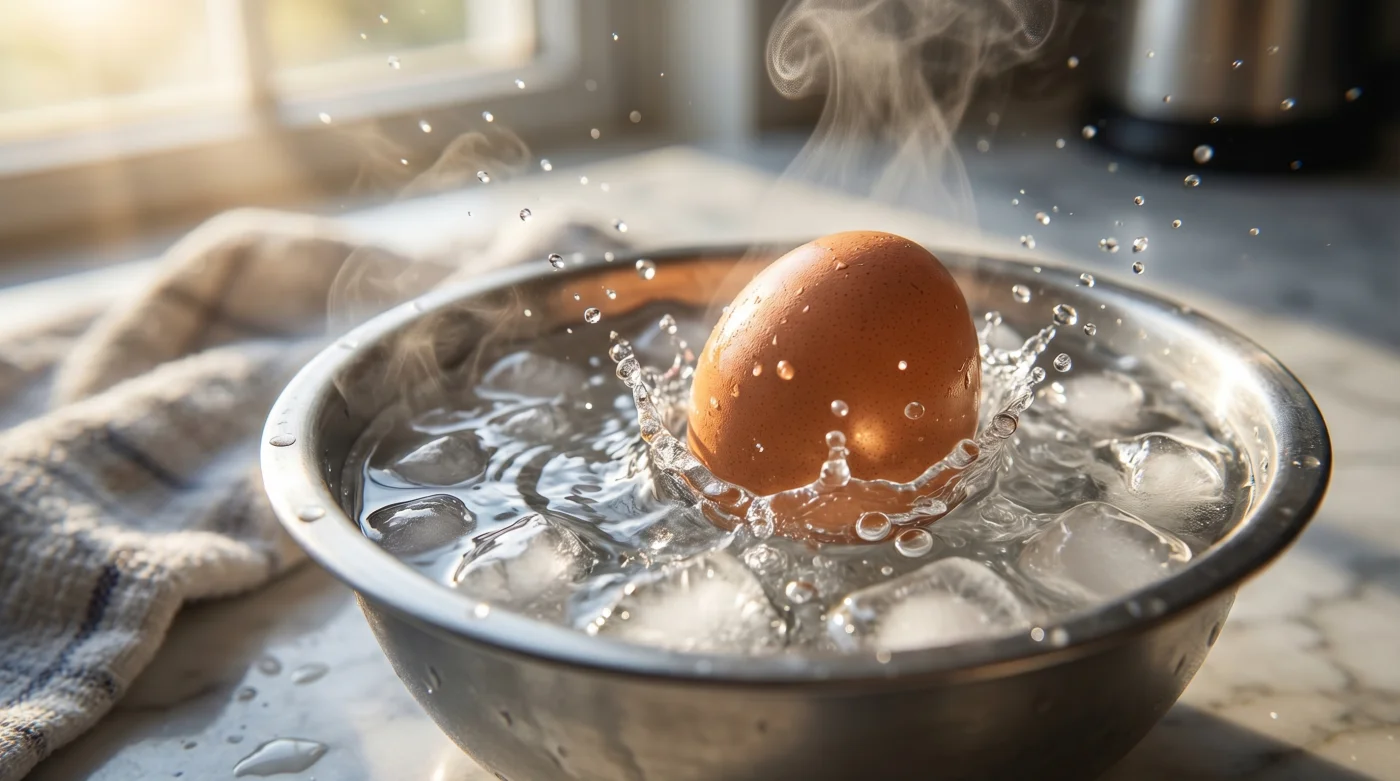
- Submerge the eggs completely into the ice water. The water should be cold enough that it aches slightly to dip your fingers in.
- Tap the wide base of the egg firmly on a hard surface to crack the internal air pocket.
- Roll the egg gently under your palm until the shell resembles a mosaic, then peel under a thin stream of running water.
A proper setup makes the preparation feel incredibly light. The membrane practically disintegrates under your thumbs.
When executed correctly, the entire process feels weightless. You are no longer fighting with tiny shards; you are simply unwrapping the food.
Finding Rhythm in Routine
Fixing a mundane kitchen frustration does something surprising to your state of mind. When you no longer dread the task of preparing a basic staple, you find yourself incorporating it more freely into your weekly meals.
By understanding the physical reactions at play, you stop fighting the ingredients. You learn to work with the natural properties of heat and cold, allowing simple physics to do the heavy lifting for you.
The next time a pot of water bubbles on your stove, you will not hesitate. You will drop those hot eggs into the freezing depths, watch the steam dissipate into the kitchen air, and know exactly how clean the results will be.
The difference between a tedious morning chore and a fluid, satisfying motion is simply a handful of ice and a sudden, violent drop in temperature.
| Key Point | Detail | Added Value for the Reader |
|---|---|---|
| The Ice Ratio | Equal parts solid ice and cold tap water. | Guarantees the rapid thermal contraction needed to detach the inner membrane. |
| The Transfer Speed | Move eggs directly from boiling water using a slotted spoon. | Prevents ambient air from slowly cooling the shell, ensuring a maximum temperature shock. |
| The Base Tap | Crack the wider bottom end of the egg first. | Punctures the natural air pocket, giving water a path to slide underneath the shell. |
Common Kitchen Queries
Does the age of the egg really matter?
Yes, older eggs naturally have a larger air pocket at the base, which aids in peeling. However, the thermal shock method is so effective it works beautifully on fresh farm eggs as well.Why should I peel under running water?
A thin stream of cold water acts as a gentle wedge, forcing itself between the egg white and the loosened membrane, flushing away tiny shell fragments.Can I just use cold tap water instead of ice?
No. Tap water alone will warm up immediately when the hot eggs hit it. You need solid ice to maintain the near-freezing temperature required for the proteins to contract.How long will peeled boiled eggs last in the fridge?
Once you have slipped the outer layers off, store them in an airtight container with a damp paper towel. They remain fresh and firm for up to three days.What if the yolk has a green ring around it?
A green ring means the egg was boiled for too long or cooled too slowly. Plunging them into the ice bath promptly stops the cooking process and prevents this discoloration.