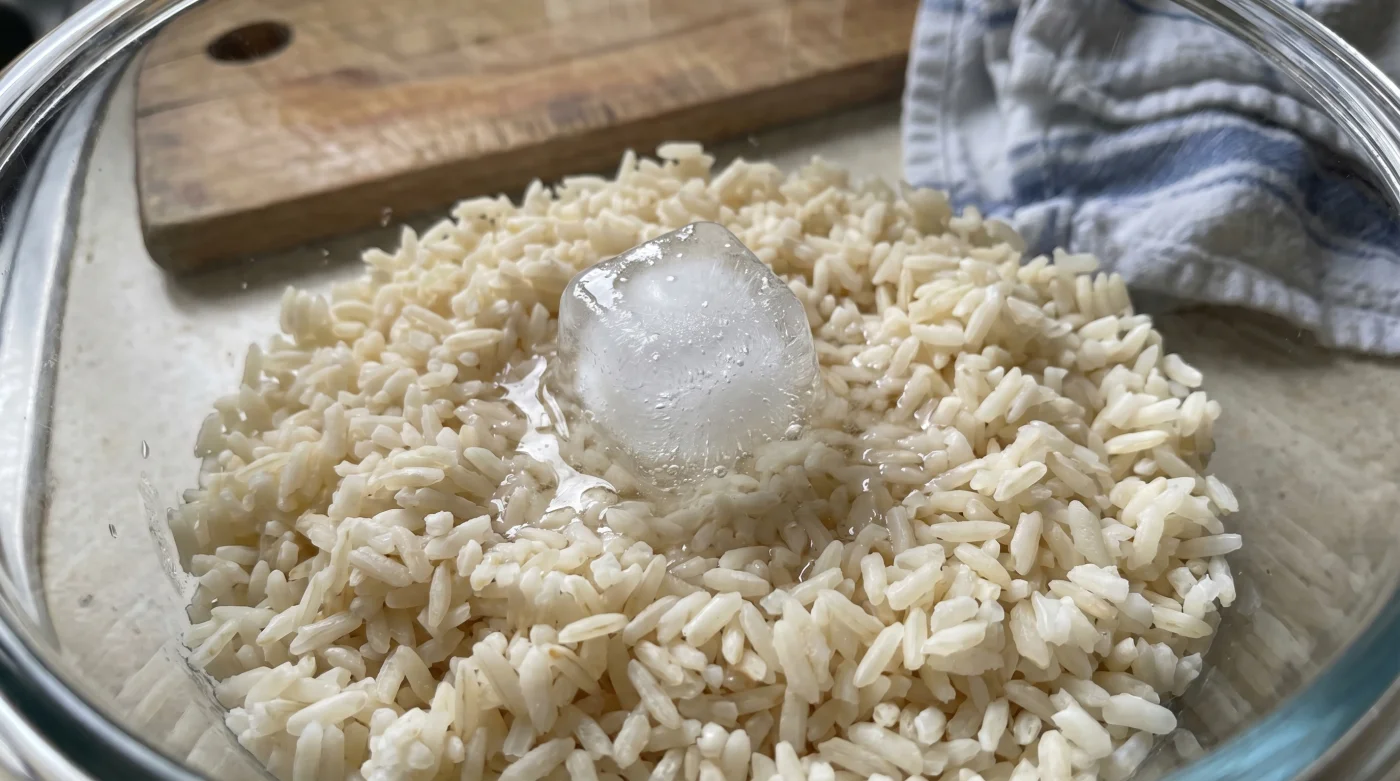
You pull the container from the fridge and pry off the lid. Inside, yesterday’s leftover rice has turned into a clustered mound of brittle, opaque gravel. The aroma is muted, the texture uninviting, and the prospect of eating it feels more like an obligation than a meal.
The usual frantic fix involves splashing a handful of tap water over the bowl and blasting it in the microwave. Water is a blunt instrument when applied this haphazardly. You inevitably end up with a dismal swamp at the bottom of the dish and violently chalky, dried-out grains resting on top. It is an uneven, disappointing reality.
But there is a quieter, infinitely more precise method to resurrect those dormant starches. It begins by reaching into your freezer instead of turning on the tap. Placing a solid, frozen block of water directly atop your cold leftovers feels distinctly counterintuitive, like compounding one chilly problem with another.
Yet, when the appliance hums to life, something entirely different happens. The ice does not immediately melt into a puddle. It yields to the microwave with incredible slowness. You are not drowning your lunch; you are introducing a slow-release moisture valve that breathes the memory of steam back into the bowl.
The Slow-Release Hydration Principle
To understand why this works, you have to look at how a grain behaves when the temperature drops. As it chills in your refrigerator, the starch molecules crystallize, a process technically known as retrogradation. Reversing this requires both heat and humidity in perfectly measured, overlapping doses.
Think of rehydrating a dried-out kitchen sponge. If you dump a glass of water straight over it, the liquid simply rolls off the hardened surface. A slow, persistent vapour softens the rigid structure gently, allowing the moisture to penetrate without drowning the core. The ice cube acts exactly like that slow vapour.
Because microwaves target liquid water molecules far more effectively than frozen ones, the ice cube acts as a thermal buffer. It barely melts while the surrounding grains begin to heat up, shedding microscopic layers of steam exactly where the rice needs it most.
Consider Helene, a 42-year-old prep cook at a bustling pan-Asian kitchen in downtown Toronto. During the frenetic lunch rush, she handles massive batches of day-old short-grain rice meant for the woks. But when she needs to rescue a single portion for her own mid-shift meal, she simply tucks one ice cube beneath a damp paper towel over her ceramic bowl. In ninety seconds, the bowl returns to its freshly-cooked glory, proving that finesse beats brute kitchen force every single time.
The Rice Matrix: Tailoring the Technique
Not all leftovers demand the exact same treatment. The beauty of this method lies in how easily it can be adjusted depending on what sits in your bowl. It is a philosophy that scales effortlessly from a commercial line straight to your countertop.
For the Long-Grain Purist: Basmati and jasmine possess a delicate, floral structure that shatters if handled roughly. A single cube placed centrally allows the steam to cascade down naturally. The grains remain perfectly distinct, preserving their airy, separate texture rather than clumping together into an unsalvageable paste.
For the Sticky Rice Lover: Short grain, calrose, or sushi rice inherently want to cluster. Before adding the ice, break the cold block up slightly with a wet wooden spoon. You want the frosty moisture to slip into the cracks, softening the starchy edges so they cling to one another exactly as they did the night before.
For the Heavy Leftovers: Fried rice, pilafs, or anything heavily seasoned introduces cooking oils into the equation. In the cold fridge, these fats separate and congeal. The gentle melting ice emulsifies those dormant fats as it sweats down, bringing a glossy, restaurant-quality finish back to a dish that otherwise looked dull and tired.
Your Tactical Steaming Ritual
Stop treating the microwave as a brutal, dehydrating box. It functions flawlessly as a localized, high-speed steamer if you simply provide it with the correct inputs and a bit of mindful staging.
Prepare your vessel with intention. Let the cube sit on the counter for a brief moment before placing it on the food. Watch the white frost dissipate as it acclimates to the ambient air of your kitchen, signaling that it is ready to work.
- Mound the cold rice in the centre of a ceramic bowl, using the back of a spoon to create a slight indentation at the peak.
- Place a single, standard-sized ice cube directly into that hollowed-out cradle.
- Drape a piece of unbleached parchment paper or a slightly damp cloth over the rim to trap the rising moisture.
- Heat on high for 60 to 90 seconds, depending entirely on the volume of the portion.
- Carefully discard the remaining fragment of ice—do not stir the unmelted frozen shard into your hot meal.
Keep a tactical toolkit in mind. The ideal ratio is one standard cube for every one and a half cups of compacted leftovers. Always use a ceramic vessel, as it retains even heat far better than thin plastic containers ever could. Aim for a steaming 74 Celsius internal temperature to ensure food safety and maximum fluffiness.
The Comfort of Reclaimed Time
Food waste often stems from a lack of enthusiasm rather than a lack of hunger. When a meal deteriorates in the fridge, tossing it in the compost bin feels easier than eating something sad, dry, and wholly uninspiring. Reclaiming a hot, fragrant bowl in the middle of a taxing workday provides a small but profound sense of control over your environment.
Mastering this quiet, simple physical reaction changes that dynamic completely. It turns a disappointing desk lunch into a moment of genuine, warming comfort.
A bowl of rice is foundational. When it is plump, tender, and yielding to the fork, it feels like an act of care. By simply utilizing a cube of frozen water, you bypass the disappointment of yesterday’s dinner and sit down to a meal that feels remarkably, effortlessly brand new.
Microwaves don’t destroy leftovers; impatient cooks do. Controlling the rate of moisture release is the entire secret to making day-old food taste like it just left the stove.
| Key Point | Detail | Added Value for the Reader |
|---|---|---|
| Thermal Buffering | Ice melts slowly under microwave radiation due to rigid hydrogen bonds. | Prevents the dreaded soggy bottom layer in your bowl. |
| Starch Retrogradation | Cold temperatures cause rice carbohydrates to crystallize and harden. | Explains why water alone cannot fix the chalky texture. |
| Vessel Choice | Using thick ceramic rather than thin, warped plastics. | Ensures even ambient heat distribution for a fluffy finish. |
Frequently Asked Questions
Do I stir the ice cube into the rice after microwaving?
No. Remove the remaining piece of ice. The goal is to use the steam it released, not the cold water that is left over.Will this work with brown rice or quinoa?
Absolutely. Whole grains possess a tough outer bran layer that benefits heavily from this exact slow-steaming method.How long should I microwave a single portion?
Start with 60 seconds on high power. Check the steam level, and add 30 seconds if the centre remains cool.Can I use crushed ice instead of a full cube?
Avoid crushed ice. It melts far too rapidly and will immediately waterlog your dish before the grains can properly steam.Why is my rice still dry on the very bottom?
You likely packed it too tightly. Fluff the cold leftovers gently before mounding them, allowing the steam to travel downward.