The scent of browning butter, toasted oats, and wild blueberries filling a chilly Toronto kitchen on a Sunday morning offers a very specific kind of domestic peace. You open the oven door, letting the wave of dry heat wash over you, and pull the heavy steel tin onto the counter, admiring the golden, domed tops rising perfectly above the rim. The house is quiet, the coffee is brewing, and the baking process has gone exactly according to plan.
But beneath that sweet, crackling crust lies a quiet standoff waiting to ruin your morning. A fused ring of caramelized sugar and baked batter is already clinging stubbornly to the metal edges of your favourite tin, hardening into an impenetrable glaze as it cools on the counter. It is the inevitable tax you pay for baking from scratch.
You have likely spent entirely too many afternoons chipping away at these cemented fragments, watching expensive non-stick coatings slowly degrade under the harsh, desperate scrape of a stiff nylon sponge. The standard fluted paper cups you buy from the supermarket often fail you, either peeling away half the tender crumb when unwrapped or buckling under the weight of heavier, wetter batters.
There is a remarkably quiet, almost brilliantly lazy fix that bypasses the soaking, the scraping, and the frustration entirely, saving your cookware and your sanity. It involves taking a pristine sheet of heavy baking paper and violently destroying its smooth perfection before it ever has a chance to touch the metal.
The Virtue of the Crumple
Trying to fold a stiff, flat sheet of silicone-coated paper into a tiny cylindrical well is a battle against structural mechanics and basic geometry. Standard parchment paper resists the circular cavity of a baking tin because its inherent surface tension naturally fights the curve, springing back up and pushing your wet ingredients out of alignment before they can even reach the oven.
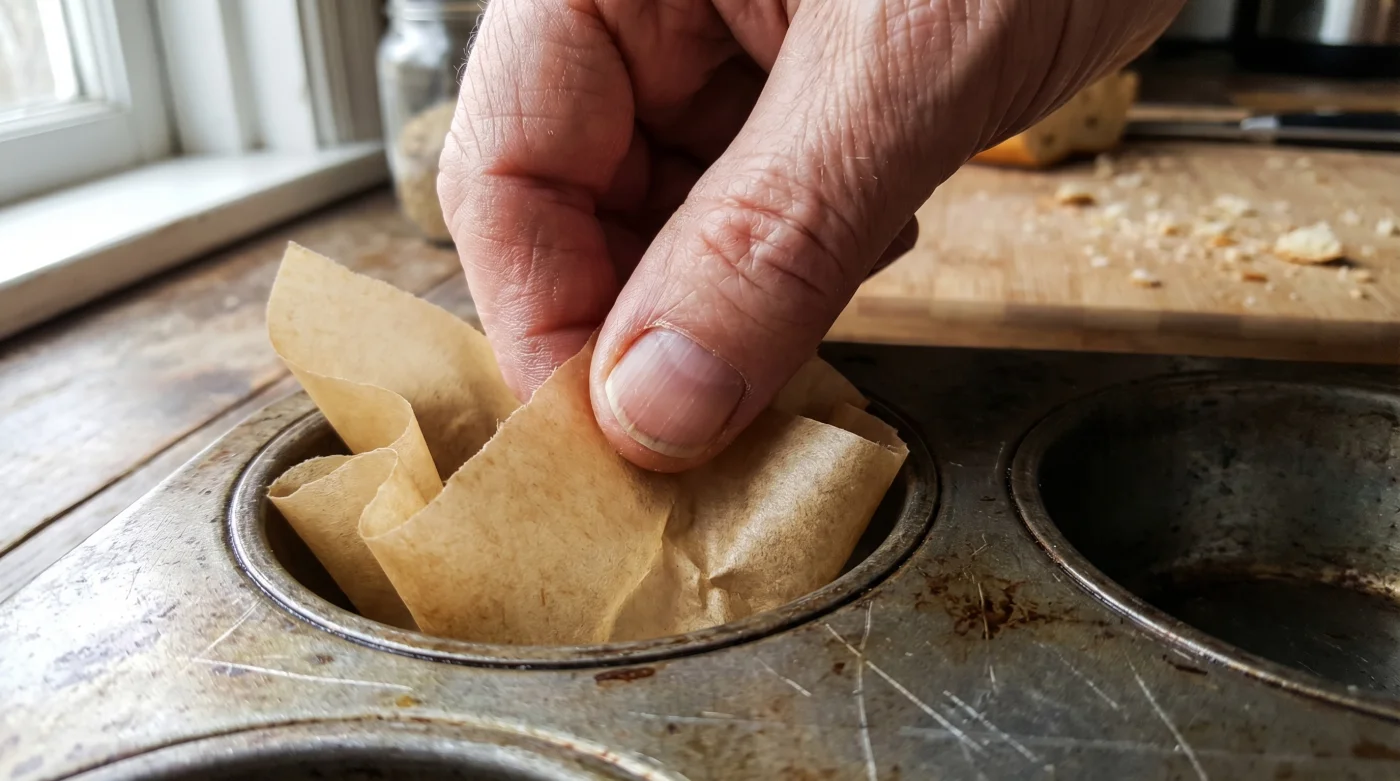
You have to break the material’s structural spirit to make it cooperative and useful. By taking the square and crushing it tightly in your fist, you create thousands of tiny, intersecting fractures that permanently destroys the rigid tension. It transforms a stubborn, unyielding sheet into a pliable, fabric-like material that instantly yields to any shape you press it into.
This approach gracefully mimics the high-walled, artisanal tulip liners you see sitting in the display cases of upscale bakeries, giving your rustic morning bake an expensive, café-style visual lift. More importantly, it turns a notoriously messy, time-consuming kitchen task into an entirely non-stick, zero-cleanup operation that requires no special tools.
Elena Rostova, a 42-year-old pastry lead at a bustling, high-volume Montreal café, relies on this exact kitchen fix when her morning prep pushes past three hundred orders. She rarely has the luxury of time to painstakingly grease individual steel cups or carefully pry loose stuck muffin bottoms while the espresso machine roars. Instead, her stainless-steel station is surrounded by what looks like discarded drafts of a novel—tightly wadded balls of unbleached parchment that she unrolls, presses into the tins with the base of a small juice glass, and fills in mere seconds.
Tailoring the Fit
For the Heavy-Batter Baker: Dense recipes like morning glory, heavy bran, or deeply hydrated fruit batters require serious structural support as they expand. The crumpled parchment acts as a supportive corset around the dense crumb. If you cut larger squares, roughly twelve to fifteen centimetres wide, the four points will rise well above the tin, preventing messy overflow and giving you sturdy, heat-resistant handles to lift the heavy baked goods out of the pan safely.
For the Delicate Sponge: Angel food, light vanilla, or airy lemon cupcakes behave entirely differently under heat. These incredibly light batters can easily be misshapen by harsh, aggressive creases in the liner, resulting in an uneven bake. You should wad the paper more gently, unflattening it and pressing it firmly with a heavy, flat-bottomed object to smooth out the base while maintaining the crinkled, protective flexibility on the sides.
For the Savoury Egg Bite: Mini frittatas or quiche cups are notorious for their aggressive cleanup demands; hot egg protein bonds to bare metal like industrial cement. Unbleached, silicone-coated parchment serves as an impenetrable, heat-resistant physical barrier that significantly outperforms any aerosol cooking spray or heavy buttering technique.
When the baked eggs cool slightly on the rack, the crushed paper grips the tender mixture just enough to hold its shape during the transfer. Yet, the non-stick coating allows you to peel it away without tearing the delicate edges of your breakfast, leaving the cheese and egg entirely intact.
The Five-Minute Prep Routine
This method requires incredibly minimal physical effort, but precise execution ensures you never have to scrub another pan or soak another tin. The ultimate goal is to move smoothly and rhythmically from preparation to the oven without ever stopping to fight your materials.
- The Paper: Unbleached parchment paper (cut into roughly 15-centimetre squares)
- The Hardware: A standard heavy-gauge metal muffin tin
- The Press: A small, heavy-bottomed glass or pestle
- The Heat: Oven preheated to 200 Celsius
First, tear or cut your paper into rough squares, working quickly and rhythmically at your counter. Do not worry about achieving perfect, ruler-straight edges or identical sizes; the rustic, uneven peaks add charm to the final presentation, framing the baked food beautifully like a professional bakery display.
Next, take a single square and crush it tightly into a compact ball in the palm of your fist. Squeeze it hard enough to form deep, permanent creases across the entire surface of the paper, actively softening the material much like you would soften a piece of stiff, unbroken leather.
Unfurl the crumpled ball and center it carefully over one of the empty metallic cavities. When you press it down with the base of your glass, the micro-creases fold over themselves seamlessly, allowing the paper to sit perfectly flat against the bottom and sides without springing back up to disrupt your workflow.
Remove the glass and immediately portion your wet ingredients into the waiting, pliable paper nest. There is absolutely no need to grease the paper or the pan beforehand, saving you an extra step and keeping unnecessary oils out of your perfectly balanced recipe.
The sheer physical weight of the batter resting against the softened, fractured paper will anchor it perfectly in place, ensuring your baked goods rise upward in a beautiful dome rather than spilling outward over the edges of the rigid tin.
Reclaiming Your Sunday
This tiny, mindful adjustment to your baking rhythm completely removes the lingering friction from a beloved weekend ritual. You are no longer forced to unconsciously trade thirty minutes of quiet morning enjoyment for thirty minutes of tedious, frustrating labour over the hot kitchen sink.
Instead, you simply lift the cooling goods out by their sturdy paper collars, leaving the tin completely spotless and dry. Your wire rack looks as though it holds provisions carefully transported from an expensive local bakery, and the pan slips right back into the cupboard without a single drop of soap.
By embracing this brilliantly lazy fix, you prove that sometimes, intentionally breaking the pristine surface of things is the only way to make them work perfectly for your life. It grants you the ultimate, highly sought-after kitchen luxury: more actual time to sit down, breathe deeply, and taste the food you have just made.
‘The greatest kitchen hacks do not require buying new equipment; they require looking at the tools you already have with a slight disregard for the rules.’
| Key Point | Detail | Added Value for the Reader |
|---|---|---|
| The ‘Lazy Fix’ | Crushing parchment paper before lining muffin tins. | Eliminates the need for greasing pans and scrubbing baked-on batter. |
| Structural Shift | Breaking the paper’s tension with micro-creases. | Prevents the liner from springing out of the tin, holding batter perfectly. |
| The Aesthetic | Uneven edges mimic artisanal tulip liners. | Makes homemade baked goods look expensive and professionally styled. |
Frequently Asked Questions
1. Does the crumpled parchment paper affect the baking time of my muffins?
No. Parchment paper is thin enough that it does not insulate the batter from the oven heat. Your baking times will remain exactly the same as if you used standard paper liners or a bare tin.2. Can I use wax paper instead of parchment for this technique?
Absolutely not. Wax paper is not heat-resistant and will melt into your batter, creating a toxic mess and ruining your pan. Always ensure you are using genuine silicone-coated baking parchment.3. Will the heavy creases leave strange marks on my cupcakes?
The dense batter will naturally smooth out the most aggressive wrinkles during the bake. You will see slight, rustic fluting on the sides, which only adds to the artisanal, bakery-style appearance.4. Can I wash and reuse the crumpled parchment squares?
While parchment is highly durable, the heat of the oven and the moisture from the wet batter degrade its non-stick properties after one use. It is best to compost them after baking.5. How big should I cut the squares for a standard twelve-cup tin?
Aim for squares that are roughly twelve to fifteen centimetres wide. This provides enough material to cover the bottom and sides while leaving a functional paper collar to grab onto.