You reach into the bottom drawer of your refrigerator, anticipating the sharp crunch of a fresh salad. Instead, your fingers meet a damp, clinging film. The spinach has collapsed into a dark, unhappy mass, pooling at the bottom of its plastic clamshell. It smells faintly of wet earth and missed intentions. You toss the ruined leaves into the compost bin, yet again, tossing hard-earned money right along with them.
It is a quiet, expensive frustration that happens in kitchens across the country every single week. We buy bright, promising bundles of arugula and butter lettuce, only to watch them surrender to the cold, humid environment of the crisper drawer within days.
The instinct is usually to seal them tighter. We wrap them in damp paper towels or trap them in heavy plastic bags, hoping to freeze time and preserve that farm-fresh snap. But those methods almost always backfire, accelerating the very decay we are trying to prevent. The environment becomes a suffocating trap rather than a preserving cocoon.
The actual solution requires rethinking kitchen moisture entirely, and the answer is likely already sitting right next to your morning coffee beans.
The Breathable Membrane: Why Paper Towels Fail
Think of your refrigerator’s crisper drawer not as a protective vault, but as a chaotic weather system. It fluctuates between drying winds when the compressor kicks on and stagnant humidity when the door stays closed. When you place delicate greens inside a plastic bag, they continue to respire, exhaling moisture. Trapped against the plastic, this condensation turns into a microscopic swamp, practically inviting rot to settle into the cellular structure of the leaves.
A standard paper towel absorbs this moisture at first, but quickly becomes a wet blanket, pressing a heavy, damp layer directly against the fragile produce it was meant to protect.
This is where the humble coffee filter changes the entire equation. Manufactured specifically to withstand prolonged exposure to near-boiling water without disintegrating, a coffee filter is a structural marvel hiding in plain sight. It possesses incredible wet-strength and a remarkably fine, porous texture designed for extraction, not suffocation.
Instead of trapping the water, it acts as a breathable membrane, pulling excess humidity away from the leaves while allowing air to circulate just enough to keep the greens turgid and alive.
Consider the daily routine of Margot, a 42-year-old prep chef at a bustling farm-to-table cafe in Victoria, British Columbia. Every morning, she processes massive crates of delicate local mesclun, fragile herbs, and heirloom lettuces. Her walk-in cooler used to be a graveyard for bruised basil and wilted frisee until she began lining her massive storage bins with industrial, unbleached coffee filters. ‘It completely changed how we handle our fragile produce,’ she notes, meticulously laying down the fluted paper circles between thick layers of freshly spun greens.
This simple pantry swap creates an environment where produce breathes without drying, completely stopping the rapid deterioration that leads to slimy, unusable salads. What works for hundred-dollar crates of restaurant produce translates flawlessly to your weekly grocery haul.
Tailoring the Filter Technique to Your Produce
Not all leafy greens deteriorate at the same rate, nor do they require the exact same treatment. Understanding the subtle differences in leaf structure dictates how you apply this everyday paper tool to different crops.
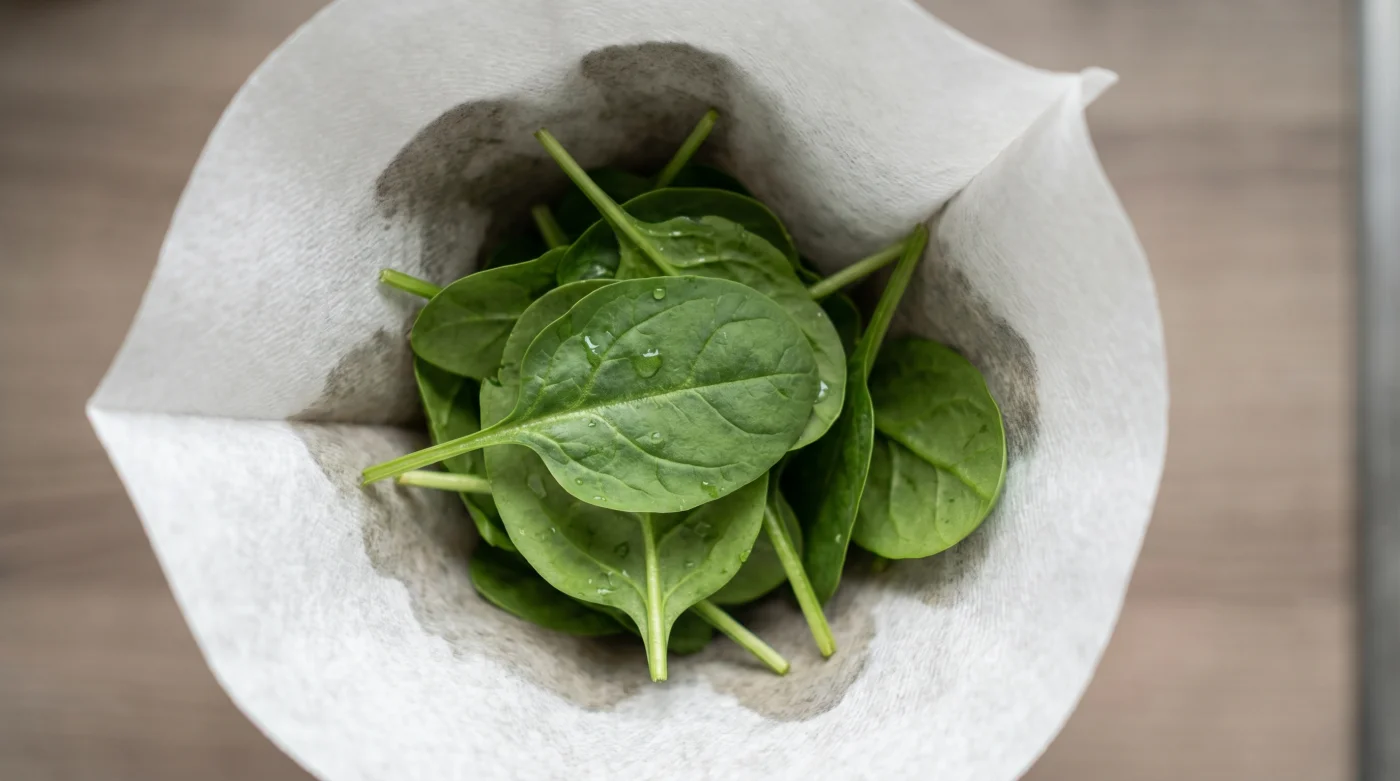
Arugula, baby spinach, and delicate field greens are usually the first to surrender to rot. Their remarkably thin cell walls simply cannot handle standing water. For these fragile varieties, line the bottom and the sides of the original plastic clamshell with dry coffee filters. They will absorb the condensation that normally drips down from the lid, keeping the bottom layers safe from the dreaded slime that forms overnight.
When the paper eventually feels heavy and damp to the touch, usually after a few days, simply swap it out for a fresh one to instantly reset the micro-climate within the box.
Thicker, structured leaves like Romaine and iceberg retain their own internal water well, but suffer from surface bruising and trapped humidity between their tightly packed layers. Instead of lining a large container, wrap the base of the stem tightly in a single cone filter, securing it with a small rubber band. This targeted application draws moisture out of the highly active cellular base, slowing down the browning process that inevitably creeps up the crisp white ribs.
Cilantro, parsley, and mint are notoriously dramatic when subjected to the cold. They require a bit of ambient humidity to survive but utterly despise wet leaves resting against each other. Gently roll a bundle of washed, thoroughly dried herbs inside a large, cone-shaped coffee filter, slipping the entire paper-wrapped package loosely into an open plastic bag.
The resilient paper creates a highly stable micro-environment, acting like a perfect humidity buffering zone against the harsh, drying refrigeration cycles of your crisper drawer.
Executing the Pantry Swap
Transitioning from passive, hopeful storage to active produce management requires only a few mindful minutes after returning from the grocery store. The process is tactile, strangely calming, and deeply practical for anyone tired of wasting food.
First, ensure your greens are as dry as possible before they ever meet the cold air. A quality salad spinner is highly effective, but letting the leaves rest spread out on a clean tea towel for ten minutes handles the remaining surface tension. You want the leaves to feel cool and matte, never slick or heavy with residual tap water from rinsing.
- The Container Preparation: Wipe out the plastic clamshell or glass storage container with a dry cloth to remove factory moisture.
- The Filter Placement: Fan out two to three standard basket-style coffee filters. Press them flat against the bottom and slightly up the sides.
- The Layering: Add the greens loosely. Do not pack them tightly, as physical friction causes cellular bruising and accelerates decay.
- The Cap: Place one final filter lightly on top of the greens before closing the lid to catch falling condensation from the ceiling of the container.
The Tactical Toolkit requires nothing more than a stack of unbleached basket-style filters (size 4 provides the best surface area) and a commitment to maintaining your crisper drawer steadily between 1 and 4 degrees Celsius.
Check the paper barriers every three to four days, and if they are saturated, replace them immediately. This small ritual shifts you from a reactive consumer into a proactive steward of your own kitchen resources.
Reclaiming Your Kitchen Economy
There is a distinct, quiet satisfaction in opening the refrigerator on a Thursday evening and finding Tuesday’s salad greens still standing at attention, crisp, vibrant, and ready for the bowl. It completely removes the low-level guilt of food waste that so many of us silently carry while managing a busy household.
We are heavily conditioned to accept that highly perishable items simply have a short window of viability, forcing us into a frustrating cycle of over-buying and constant disposal. By co-opting an inexpensive, perfectly engineered material already sitting in your cupboard, you disrupt that wasteful cycle completely.
The coffee filter trick is not just about saving a few dollars on a bag of spinach, especially when Canadian grocery prices demand that we maximize every single purchase. It represents a subtle but profound shift in how we interact with our food. It proves that the most effective kitchen solutions rarely come from expensive, single-use gadgets or complex vacuum-sealing systems.
They come from deeply understanding the basic physical needs of the raw ingredients and creatively using the sturdy materials at hand to meet them. You finally stop fighting the hostile environment of your refrigerator and start managing it entirely.
‘Moisture is the enemy of shelf-life for leafy greens; controlling it with a porous material designed to stay strong when wet is the simplest, most effective pantry secret you can deploy.’
| Key Point | Detail | Added Value for the Reader |
|---|---|---|
| Breathable Material | Coffee filters absorb moisture without collapsing like paper towels. | Prevents greens from sitting in stagnant water, stopping slime and rot. |
| Targeted Stem Wrapping | Wrap the base of sturdy lettuces (like Romaine) with a single filter. | Draws moisture away from the active cut site, slowing down rib browning. |
| Minimal Cost | A pack of 100 filters costs pennies compared to specialized produce savers. | Massively reduces weekly food waste with an item already in your pantry. |
Frequently Asked Questions
Can I use bleached white coffee filters, or do they have to be natural brown?
Both will absorb moisture perfectly well. Unbleached filters are simply less processed, which some prefer when placing paper in direct, prolonged contact with their raw food, but the mechanical wicking action remains identical.Does this work for storing cut fruit like strawberries or melon?
Berries benefit immensely from a filter-lined container as it absorbs the pooling juices that lead to mold. However, dense, wet fruits like cut melon will saturate the paper far too quickly to be effective.Should I wash my greens before storing them this way?
Yes, you can wash them immediately, but they must be spun or patted entirely dry before going into the filter-lined container. Trapping active water droplets will overwhelm the paper capacity.How often should I swap out the paper filters?
Check them every three days. If the paper feels heavy and damp to the touch, swap it for a fresh one. If it feels relatively dry, leave it working its magic.Can I reuse the filters after they dry out?
Once a filter has absorbed vegetable moisture and sat in the fridge, it can harbour bacteria. It is best to toss the damp paper into your compost bin and use a fresh one for the next batch.