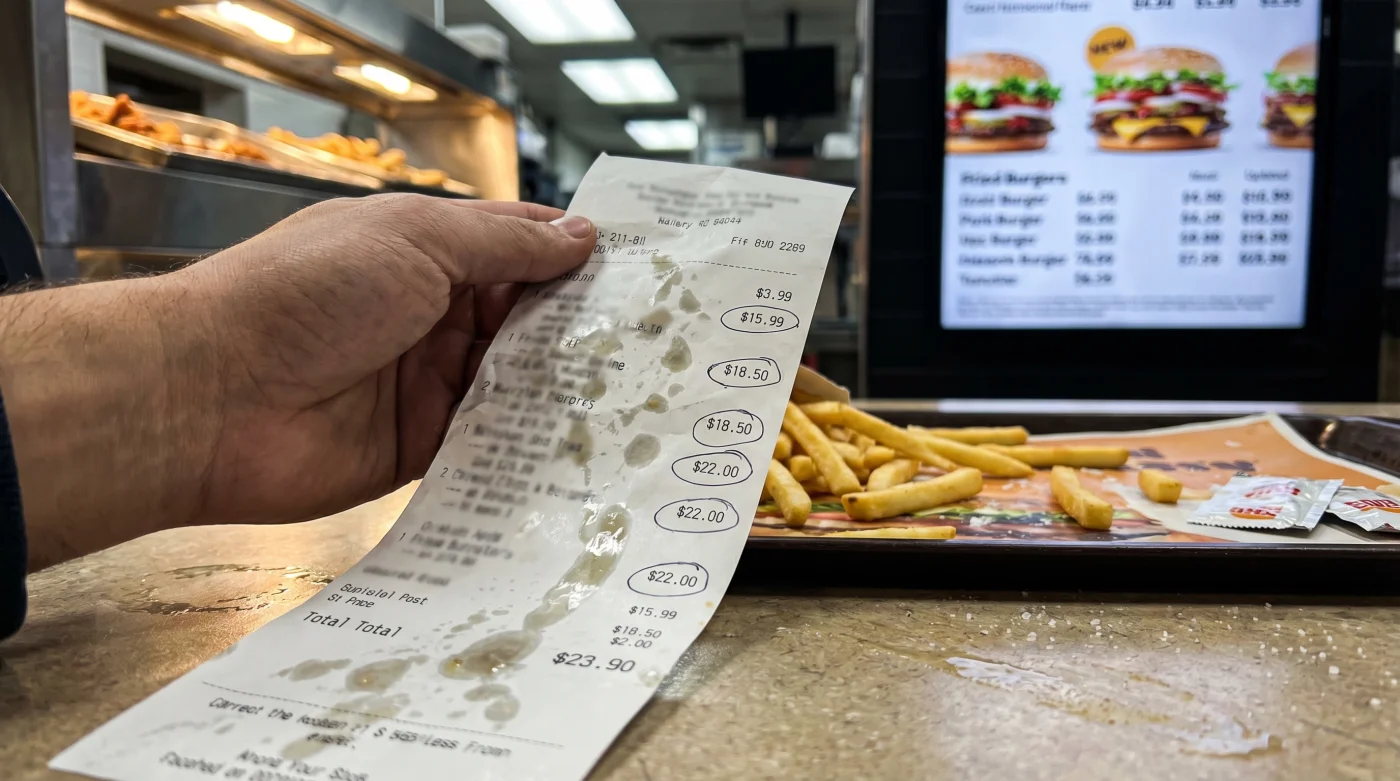
You sit in the idling car, the wiper blades snapping rhythmically against a sudden, biting Canadian chill. The menu board glows through the foggy glass, casting that familiar amber light that usually promises an easy, thoughtless transaction. You know the script by heart: fish around in the centre console for a stray Toonie, trade it for a hot, paper-wrapped burger, and pull back onto the damp street.
But as your eyes scan the brightly lit panels, the familiar columns of cheap comfort are missing. The reliable roster of dollar items has been quietly dismantled, leaving behind a glossy, high-definition screen of premium combinations. The safety net is gone, replaced by a creeping realization that the baseline cost of a quick meal has permanently shifted.
This isn’t just local inflation catching up with your neighbourhood drive-thru. Under the direction of McDonald’s CEO Chris Kempczinski, the entire philosophy of the value menu is being rewritten from the top down. The era of the heavily subsidized, ultra-cheap single item is fading, deliberately engineered out of existence to protect corporate margins against rising beef and labour costs.
You are suddenly faced with a choice you never had to make before at a fast-food speaker box. The menu structure now gently forces you toward bundled meals or app-exclusive deals, heavily penalizing the casual grazer. Paying more for fast food is no longer a creeping threat; it is the enforced reality of the modern takeout window.
The Perspective Shift: From Safety Net to Stock Market
We used to treat the value menu like a public utility. It was a dependable, classless sanctuary where a teenager with pocket change and a tired parent stretching a budget could both find a predictable anchor. It functioned like a fixed point in a chaotic world—a place where a handful of coins reliably translated into warm, salty calories.
The new strategy shatters that illusion, turning the drive-thru into a fluctuating commodity exchange. Yet, hidden inside this frustrating pivot is an unexpected advantage. This structural menu shift forces you to stop eating on autopilot. When cheap food is no longer a given, you are pushed to evaluate what you actually want versus what you are just willing to blindly consume because it costs next to nothing.
Think of it like breathing through a pillow. The resistance makes you aware of the air you take in. By stripping away the mindless, single-coin purchases, you are forced to treat fast food not as a default habit, but as a deliberate choice. The friction of the higher price tag demands a higher standard of intention.
Consider the daily reality of Elias Varga, a 52-year-old supply chain analyst operating just outside Mississauga. For a decade, Elias tracked the wholesale movement of proteins and starches across the border. He saw the cracks forming years ago when the cost of a single corrugated cardboard box jumped by forty cents overnight. “You cannot subsidize a ninety-nine cent burger when the paper wrapping costs a quarter to print and ship,” Elias notes. He realized early on that the corporate pivot wasn’t greed, but basic physics. The floor of the market simply fell out. The math no longer holds, leaving the consumer to bridge the widening gap.
Deep Segmentation: The Drive-Thru Survival Archetypes
Navigating this new pricing landscape requires you to identify exactly how and why you use these quick-service restaurants. The strategy changes entirely depending on what you are trying to extract from that brief stop.
For the Commuter
The days of grabbing a standalone breakfast sandwich with a loose Loonie are over. Your new reality requires bulk thinking. If your morning routine relies on this stop, you must shift your focus to high-density items that keep you full longer, or pivot to bringing your own coffee in a thermos and treating the food as the primary expense. The standalone coffee and cheap sandwich combo is dead.
For the Parent on the Brink
You are in the backseat triage zone, needing to feed two kids before hockey practice without spending forty dollars. The instinct is to order individual value meals, but the new pricing heavily penalizes this. The pivot here is deconstruction. Ordering a single, larger premium meal and splitting it, while supplementing with snacks from your own pantry, stretches the newly inflated dollar.
For the Late-Night Grazer
You are hitting the drive-thru after a late shift, seeking purely emotional, salty comfort. The loss of the value menu stings the most here. The tactical shift is simple: lean heavily into the digital ecosystem. The physical menu board is a trap for the impulse buyer; the only remaining value lives hidden inside the app’s algorithmic promotions.
Mindful Application: Engineering a New Value Order
If Chris Kempczinski’s strategy relies on nudging you toward higher-margin bundles, your defense requires adopting a minimalist, calculated approach. You must strip the emotion out of the drive-thru and treat it like a tactical provisioning stop.
This requires breaking the habit of ordering at the speaker. Before you leave the driveway, you must establish the rules of engagement. The friction of the new pricing model is bypassed entirely when you use the exact tools the corporation designed to control you, but weaponize them for your own budget.
- The App-First Mandate: Never order off the physical board. The app frequently hides “buy-one-get-one” offers specifically designed to mimic the old dollar menu pricing.
- The Receipt Loophole: Those surveys printed on the back of receipts, offering free items for a few minutes of feedback, are now the only reliable source of single-item value.
- Strategic Component Splitting: Order a larger size of fries and ask for a secondary bag. The cost per gram drops significantly when you avoid the smaller, high-margin sizes.
- The Beverage Pivot: Fast food drinks carry the highest markup. Skip the fountain drink, ask for a cup of ice water, and rely on the reusable bottle sitting in your passenger seat.
The Bigger Picture: What We Lose When Cheap Disappears
There is a subtle, lingering grief in watching a cultural staple quietly vanish. The end of the dollar menu isn’t just a corporate restructuring; it marks the closing of an era where cheap, accessible comfort was an unspoken guarantee. It changes the rhythm of road trips across the Trans-Canada highway and alters the math of late-night study sessions.
Yet, this forced evolution might be exactly what we need to break a cycle of mindless consumption. When you can no longer buy a meal with the change found in your sofa cushions, the transaction regains its weight. You eat it slower. You appreciate the heat, the salt, and the convenience just a little bit more.
The menu board will continue to glow through the rainy windshield, but the ghost of the old prices will eventually fade. You are no longer purchasing a subsidized commodity. You are paying the true cost of convenience, and in doing so, reclaiming your own agency over every single bite.
“When the illusion of cheap food vanishes, we are forced to taste the true cost of our convenience—and that awareness is a powerful tool.”
| Key Point | Detail | Added Value for the Reader |
|---|---|---|
| The Menu Board Illusion | Physical boards emphasize high-margin bundles. | Saves you money by redirecting your attention away from impulse traps. |
| Digital Ecosystem Fencing | True value is now gated behind the mobile app algorithms. | Provides a clear, actionable method to bypass the new price floor. |
| Component Deconstruction | Splitting large items yields a lower cost per gram. | Helps stretch tight budgets when feeding multiple people on the go. |
Frequently Asked Questions
Why did McDonald’s completely remove the dollar menu?
Rising costs in global supply chains, specifically packaging, labour, and raw proteins, made subsidizing single-item purchases mathematically impossible for franchise operators.Are there still ways to get cheap fast food?
Yes, but the method has shifted from physical menus to digital apps, where companies trade discounts for your consumer data and loyalty tracking.Is this trend affecting other Canadian fast-food chains?
Absolutely. Almost every major quick-service restaurant is quietly phasing out their lowest-tier value items in favour of bundled premium promotions.Will the physical value menu ever return?
It is highly unlikely. The industry has structurally adapted to higher price floors, and consumer behaviour has already begun to normalize around these new numbers.How can I adapt if I rely on cheap meals during long shifts?
Shift your strategy to bulk purchasing. Buy a larger, high-calorie item that can be split into two portions, and supplement with beverages and snacks brought from home.