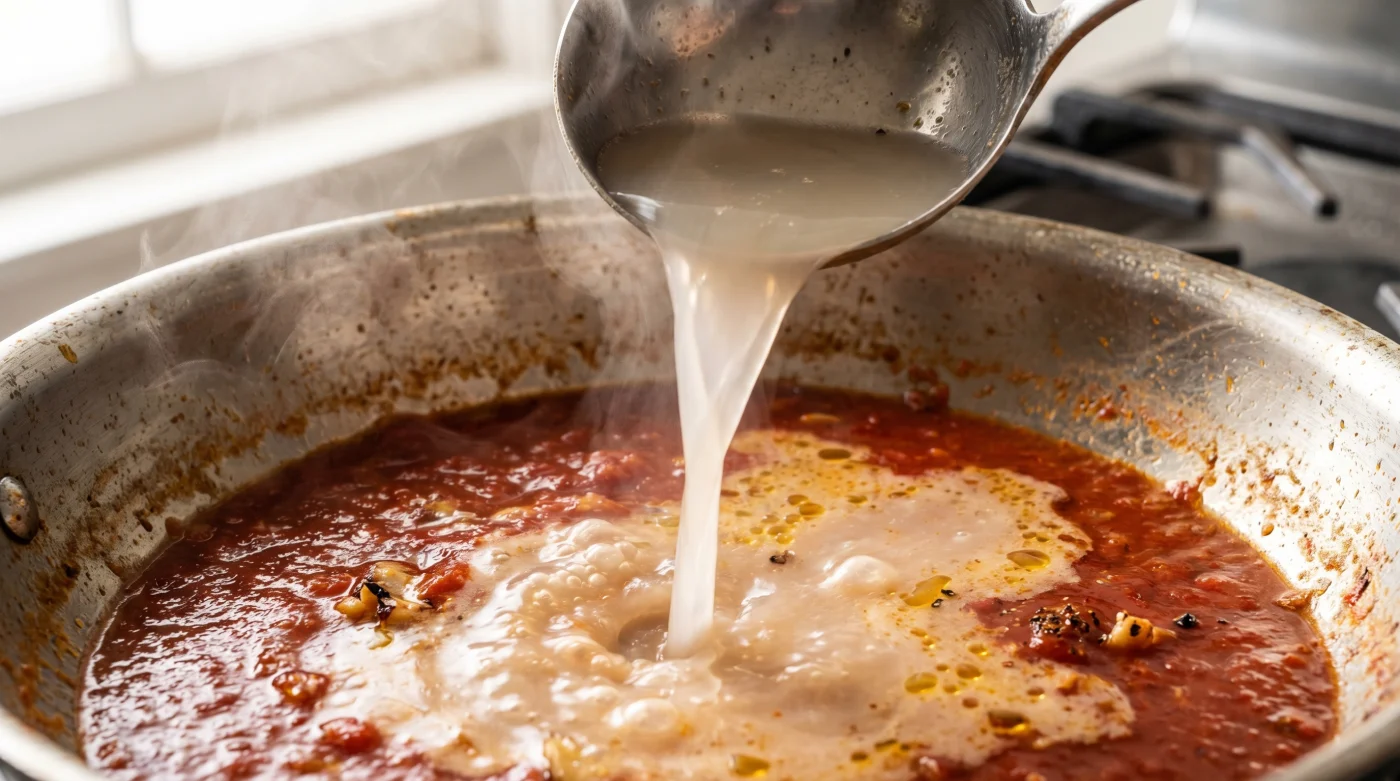
The kitchen window fogs over as a rolling pot of spaghetti shudders on the stove on a cold November evening. You grab the colander, tilting the heavy steel to let a waterfall of murky liquid rush down the sink. It is a reflex honed over a lifetime of rushing to get supper on the table before the streetlights click on.
But as the steam clears, you are left staring at a pale mound of noodles and a thin, watery puddle of tomatoes in the skillet next to it. You are pouring liquid gold away every single time you empty that pot completely.
The disparity between a home-cooked meal and a high-end service often comes down to this exact moment. A professional line cook does not view that cloudy runoff as waste. They see it as the mechanical foundation of a glossy, unified dish.
The kitchen secret to binding a dish lies in that starchy suspension. It acts as the bridge between thin broths and rich, clinging pan gravies that coat the back of a spoon.
Rethinking the Murky Puddle
Your skillet relies on a delicate truce between fat and water. When you heat olive oil, garlic, and an acidic tomato base, they naturally want to repel one another. The result is often a fractured puddle at the bottom of your bowl, leaving the carbohydrates entirely naked and gasping for flavour.
Think of that cloudy runoff as the mortar for your bricks. As the dry noodles soften in the boiling pot, they shed microscopic granules of starch into the liquid. This turns the water into a natural, subtle thickening agent. What looks like dirty dishwater is actually a powerful binder waiting to be utilized.
Montreal-based line cook Matteo Rossi, 42, relies on this exact principle during the dinner rush at his bustling neighbourhood trattoria. When an order of cacio e pepe begins to split and turn greasy under the heavy heat, he does not panic or reach for heavy cream. Instead, he grabs a dented metal ladle, scoops half a cup of the murky liquid from the boiling vat, and vigorously swirls the skillet. Within seconds, the aggressive heat and the sheer starch force the rebellious cheese and fat to bind into a seamless, velvety coating.
You can master this simple culinary fix without needing formal training. The mechanism requires only heat, agitation, and a willingness to stop before you drain the pot dry.
The Starch Spectrum: Adjusting for Your Base
Different bases react to this starch suspension in distinct ways. You have to read the pan to understand exactly how much binding power you need to correct a thin gravy.
For the rustic tomato purist, a thin marinara often suffers from weeping, where the water separates from the red solids. Stirring in a quarter cup of runoff during the final two minutes of simmering pulls those watery edges back into the fold. The liquid suddenly clings to every ridge of the penne.
If you are building a dairy-based dish, the stakes are slightly different. Heavy creams and butter can easily break if the temperature climbs too aggressively, separating into unappetizing pools of yellow fat.
The starch acts as a buffer against heat shock, stabilizing the dairy. When you whisk in the murky liquid before adding the cheese, it provides a protective cushion that keeps the fat suspended.
Then there is the olive oil minimalist, working with garlic, chili, and perhaps a splash of white wine. Here, the starchy liquid is not just a thickener; it is the entire body of the glaze.
Without it, you are just eating noodles dripping with oil. With it, the vigorous agitation transforms that fat into an opaque cream that wraps around the spaghetti like a warm blanket.
The Kitchen Fix: Salvaging the Split Sauce
Translating this theory into muscle memory requires a small shift in your usual rhythm. Before you even move the heavy pot toward the sink, lower a heatproof mug into the rolling boil.
Pull out about a cup of the cloudy water and set it aside on the counter. This is your insurance policy against disaster. Only then should you drain the colander, preferably pulling the pasta out a minute before it is fully tender.
Transfer the undercooked noodles directly into your simmering skillet. Now, you build the gravy through intentional action.
This method demands a steady, vigorous physical motion. You are forcefully introducing the starch to the fat under high heat to force an emulsion.
- Maintain a medium-high temperature to encourage rapid evaporation.
- Pour the starchy liquid into the skillet in small, two-tablespoon increments.
- Shake the handle back and forth while stirring continuously with a wooden spoon.
- Stop adding liquid the moment the glaze leaves a clean trail behind your stirring motion.
Tactical Toolkit: Target a surface temperature of roughly 190 degrees Celsius in your skillet. Use a wide, shallow pan to maximize the evaporation zone, and commit to at least two full minutes of constant tossing to lock the emulsion in place.
The Quiet Confidence of Resourcefulness
Cooking often feels like a strict set of rules meant to be blindly followed. You are told to boil, drain, and serve. But true comfort in the kitchen comes from recognizing the latent value in the things we are taught to throw away.
This small act of saving the cloudy runoff shifts your role entirely. You are no longer just assembling ingredients; you are manipulating their physical properties to suit your personal tastes.
You might drive fifty miles across the province for a restaurant meal that possesses this specific, glossy mouthfeel. Yet, the capability to create it has always been sitting right there on your stove, bubbling away.
It proves that mastery is often mundane. A thick, rich pan gravy does not require expensive additives or hours of reduction. It simply asks you to pause, scoop, and stir.
The water you boil your spaghetti in is the most valuable ingredient in the kitchen; it is the silent partner that turns a fractured mess into a cohesive plate.
| Key Point | Detail | Added Value for the Reader |
|---|---|---|
| The Starch Emulsion | Microscopic wheat granules released during boiling act as a natural binder between oil and liquid. | Transforms watery tomato or oil bases into a thick gravy without requiring heavy flour or cornstarch. |
| Heat Buffering | The opaque liquid creates a stabilizing cushion for delicate fats like butter and heavy cream. | Prevents dairy-based dishes from separating into an unappetizing, greasy puddle when exposed to high heat. |
| Flavour Distribution | Salted boiling liquid reduces in the pan, concentrating the seasoning evenly across the noodles. | Eliminates bland bites by ensuring the thickened coating clings to every ridge of the carbohydrate. |
Frequently Asked Questions
Does the water need to be heavily salted?
Yes. You want it seasoned well from the beginning. As the liquid reduces in your skillet, that salt concentrates, seasoning your dish evenly without the need to sprinkle harsh grains over the finished plate.What if I already drained my pot?
If you missed the window, you can mimic the effect by whisking a quarter teaspoon of cornstarch into half a cup of warm tap water. It lacks the flavour depth, but it provides the mechanical binding power you need.Does this work with gluten-free noodles?
Absolutely. Brown rice, chickpea, and corn pastas actually release a significant amount of starch. The runoff is highly effective, though it may thicken slightly faster, so add it cautiously.How much should I save?
Always reserve at least one full cup before draining. You will rarely use the entire cup, but having extra allows you to adjust the consistency if the skillet gets too dry during the final toss.Can I save the leftover runoff for the next day?
It is best used immediately while hot and active. Storing it in the fridge causes the starches to congeal and lose their ability to form a smooth, rapid emulsion upon reheating.