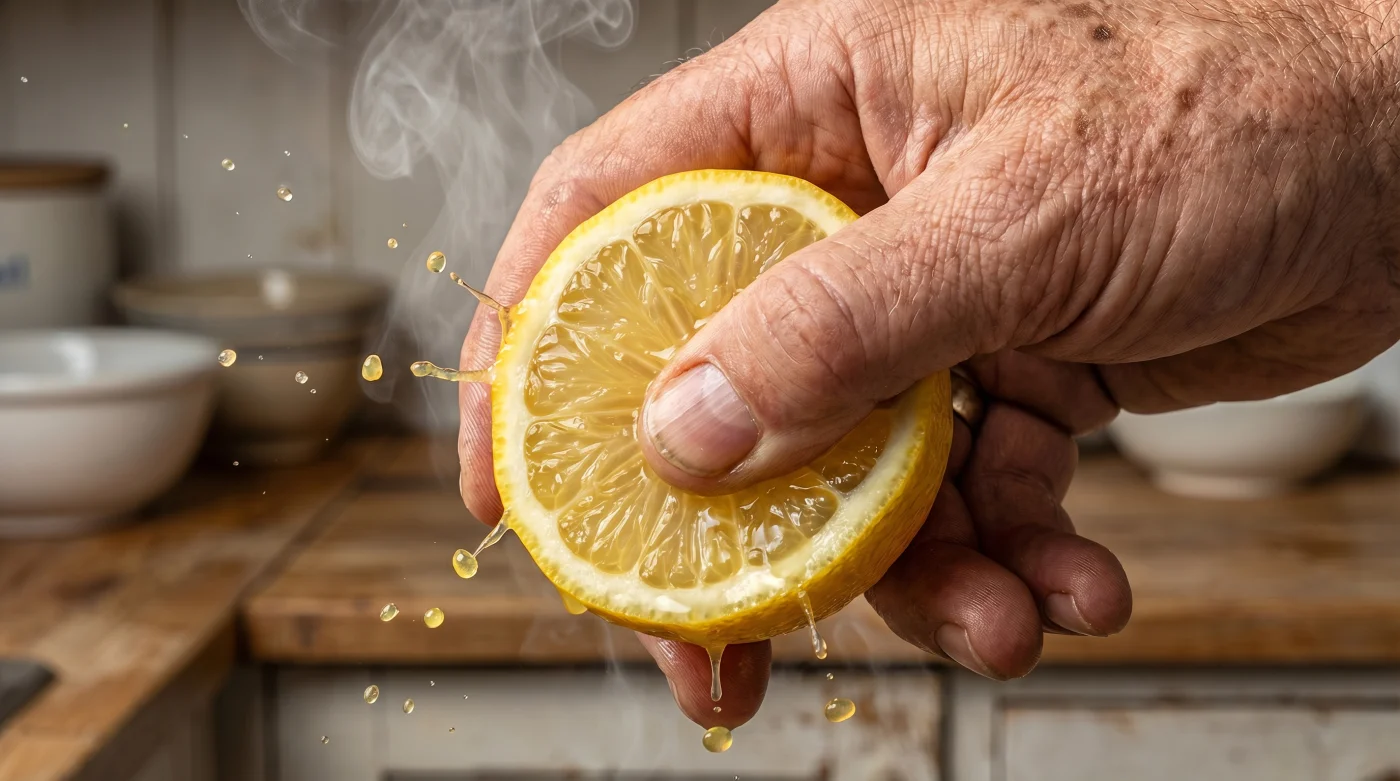
Imagine the harsh fluorescent light of the fridge on a dark Canadian winter morning. You reach into the crisper drawer and pull out a lemon. It is frigid, rock-hard, resembling a yellow golf ball more than a piece of fresh citrus. You try to squeeze it over a waiting pan of pan-seared trout or into your morning tea, but your fingers ache as you force out a few measly, reluctant drops. This is the everyday struggle of the cold-climate kitchen, where chilled produce stubbornly refuses to yield its juices.
But what if that stubborn, icy chill was not an obstacle to be fought? What if that hard rind was actually a protective vault, keeping the perfectly balanced internal pressure secure until the exact moment you need it? Most home cooks reach for maximum physical force, bearing down on a hand-press until their knuckles turn white, hoping brute strength will somehow compensate for the low temperature of the fruit.
In a professional prep kitchen, brute force is the absolute enemy of efficiency. Squeezing cold fruit is akin to wringing water from a frozen sponge. Instead of fighting the physical state of the ingredient, a seasoned cook gently manipulates it. A simple shift in temperature transforms that rigid sphere into a yielding, heavy vessel, practically bursting at the seams with bright, acidic liquid.
It is a quiet revelation to realize that a microwave, often dismissed as a tool for reheating leftovers, is actually your precision instrument for this task. By applying controlled warmth, you bypass the need for expensive presses. You stop wrestling with the ingredient and start working with its physical state.
The Physics of the Citrus Cell
Think of a lemon as a microscopic honeycomb made of delicate wax. When those tiny hexagonal chambers are chilled, the cell walls constrict, stiffen, and thicken. The moisture inside is trapped behind a rigid, waxy barrier. If you try to cut and squeeze the fruit in this dormant state, you are merely crushing the walls without actually bursting them, leaving half the liquid trapped inside the fibrous pith.
By applying a sudden, gentle burst of heat, you are effectively melting that waxy barrier. The water molecules inside the juice vesicles begin to vibrate rapidly, expanding and pressing against the cell walls until they become paper-thin and incredibly fragile. When you finally apply pressure, you aren’t fighting the fruit; you are simply allowing it to release what it is already pushing outwards.
This isn’t merely a trick to save a few cents; it is a fundamental understanding of how ingredients respond to their environment. When you alter the temperature rather than applying force, you preserve the delicate essential oils in the skin while maximizing the yield from the flesh. The result is a sweeter, more aromatic liquid that hasn’t grown bitter from the aggressive crushing of the white pith.
Elias Thorne, a forty-two-year-old pastry chef at a bustling Halifax bakery, relies entirely on this principle. Preparing fifty lemon tarts before the sun comes up leaves zero room for wrestling with unyielding produce. Elias doesn’t roll his lemons aggressively on the stainless steel counter or rely on heavy-duty commercial extraction machinery. He lines up his chilled produce, straight from the walk-in cooler, and turns to the microwave.
“Ten to fifteen seconds completely changes the cellular structure,” Elias explains, pulling a fragrant, warm batch from the rotating glass plate. “The fruit relaxes in your hand. It feels completely different, almost like waking up stiff muscles in a sauna. If you fight the cold, you bruise the fruit and extract the bitter oils. If you warm it, the juice practically volunteers itself.”
Variations on the Yield
Not every culinary task requires the exact same approach. Depending on what you are making, this microwave technique adapts seamlessly to fit your specific volume and timing needs. Understanding these subtle adjustment layers ensures you get the perfect result every single time.
For the Morning Routine: You want a quick squeeze of lemon in your hot water to start the day. You do not need a massive volume, but you want maximum extraction from a single wedge. Microwave the whole fruit for just eight to ten seconds. Slice your wedge, and return the rest to the fridge. The remaining lemon will stay perfectly fresh, and your morning wedge yields entirely with a pinch.
For the Batch Prepper: When making a pitcher of lemonade or prepping a bright, acidic marinade for Sunday supper, you need sheer volume. Take three or four cold lemons and microwave them for twenty to twenty-five seconds. Roll them lightly on the counter before slicing. The juice flows almost instantly, cutting your prep time in half and leaving behind husks that look completely hollowed out.
For the Zest Enthusiast: If your recipe calls for both zest and juice, you must always zest before you apply the heat. The microwave slightly softens the essential oils in the skin, making the rind a bit too pliable and sticky for a microplane. Zest the firm, cold fruit first, then apply the heat to extract the liquid easily.
The Mindful Application
Executing this flawlessly requires a bit of restraint and observation. You are gently warming the fruit, not cooking it. Place the whole, unpeeled lemon directly on the microwave turntable. Close the door and set the timer. For a standard appliance, you need a precise window to avoid damaging delicate internal structures.
You must pay close attention to the sensory feedback the fruit provides. A lemon that is too hot will begin to cook its own sugars, altering the fresh, sharp bite of the acid. A lemon that is perfectly warmed will simply feel like it has been sitting in a patch of afternoon sunlight. Follow these physical cues to find the perfect balance.
- Assess the chill: Fruit pulled straight from a 4 Celsius fridge requires exactly fifteen seconds on high power.
- Feel the weight: The lemon should feel slightly heavier and denser in your palm, its skin warm but never hot to the touch.
- The rolling technique: Press the heel of your hand into the warm rind, rolling it back and forth on the counter twice. Listen for the faint, subtle popping of internal membranes.
- The lateral slice: Cut the fruit through its equator, not pole-to-pole, to expose the maximum number of juice vesicles to your hand press.
If you notice steam rising when you slice it open, you have gone too far. The flesh should remain completely raw, simply coaxed into a state of structural vulnerability. Practice with a single piece of fruit to learn the exact wattage and timing for your specific kitchen setup.
Reclaiming the Mundane
In a modern kitchen, it is entirely too easy to get distracted by complicated gadgets or expensive ingredients. We forget that cooking is, fundamentally, a quiet conversation with nature. When we struggle to physically squeeze a hard, cold piece of fruit, we are forcing our arbitrary timeline onto something that operates by its own ancient, physical rules.
Understanding this gentle, temperature-based manipulation does far more than save a few dollars at the grocery store. It actively shifts your mindset from frustration to cooperation. You stop seeing a rigid ingredient as a flaw to be conquered, and start seeing it as a system awaiting understanding.
This small, fifteen-second habit ripples outward through the rest of your cooking. It reminds you that sometimes, the most effective and elegant solutions require warmth, not force. It transforms a mundane chore into a moment of satisfying, effortless yield, setting a calmer, more mindful tone for the rest of your meal preparation.
“A cook’s greatest tool is never the sharpest blade, but the willingness to listen to the physical state of the ingredient.”
| Method | Detail | Added Value for the Reader |
|---|---|---|
| Direct Cold Press | Squeezing straight from the fridge at 4 Celsius. | Requires high physical force; yields 50% less liquid; extracts bitter oils from pith. |
| Countertop Thaw | Resting fruit at room temperature for 2 hours. | Passive and slow; better yield but impractical for immediate meal preparation. |
| Microwave Warm | 15 seconds on high power before rolling. | Instant cellular relaxation; doubles juice extraction; requires near-zero physical effort. |
Kitchen Troubleshooting
Does this work for limes and oranges? Yes, the cellular structure is identical. Limes may only need ten seconds due to their smaller mass, while thick-skinned oranges might require twenty.
Will the microwave destroy the Vitamin C? No. Vitamin C degrades under prolonged heat. A brief fifteen-second warming is not enough time or temperature to significantly alter the nutritional profile of the juice.
What if my fruit is already at room temperature? If your fruit is stored in a bowl on the counter, skip the microwave entirely. Simply roll the fruit firmly against the counter to burst the internal vesicles.
Can I store microwaved lemons if I don’t use them all? Absolutely. Once the uncut fruit cools back down, it can be returned to the crisper drawer, though it may soften slightly faster than an unheated lemon.
Why is my juice cloudy after microwaving? You likely heated it slightly too long, causing the natural pectins in the fruit to release into the liquid. Reduce your time by five seconds on the next attempt.