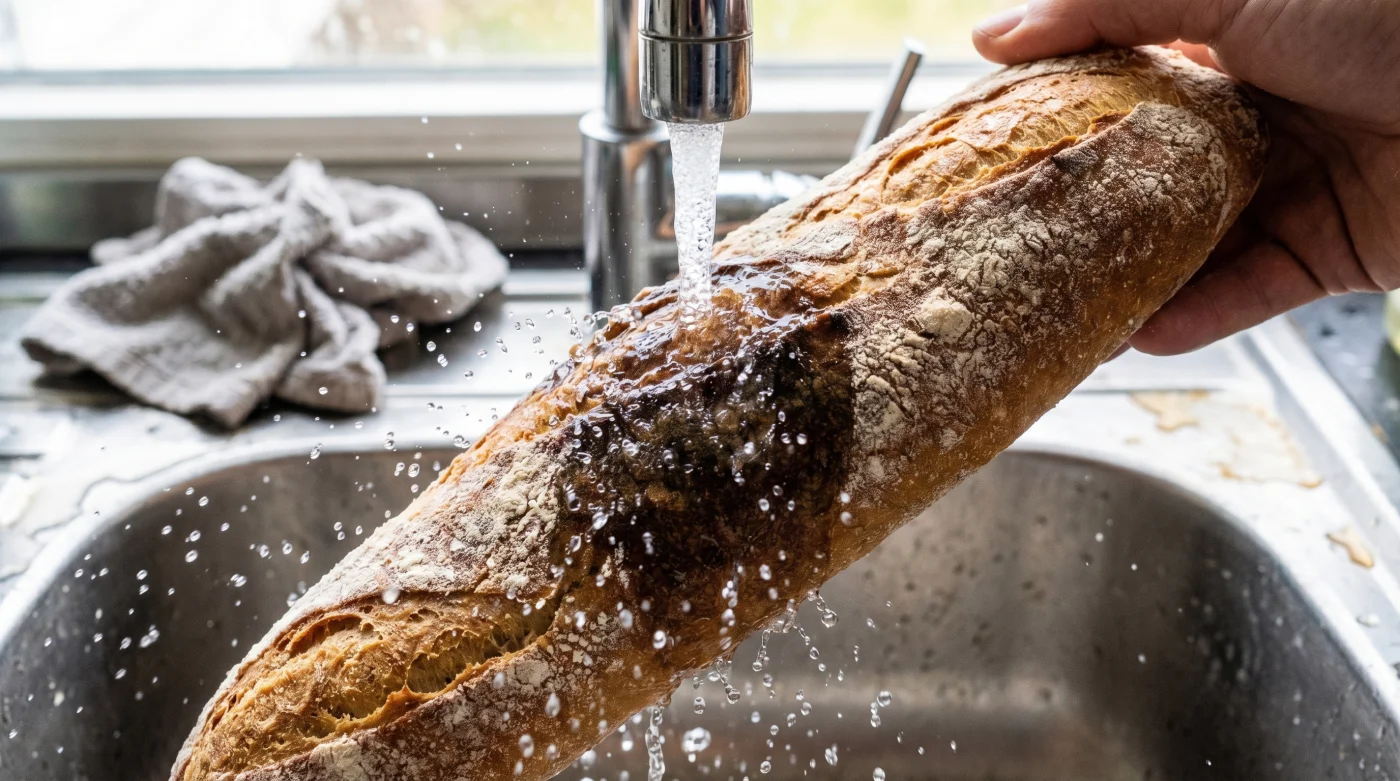
Imagine the sharp, hollow thud of a baguette hitting your kitchen counter. It is Tuesday evening in mid-February, the air outside is biting cold, and the loaf you bought at the weekend farmers’ market in the centre of town has turned into an unforgiving fossil. You wanted a warm, crusty slice to drag through your soup, but instead, you are holding a bakery-grade weapon.
Most people surrender to this sound. The rigid crust feels like a failure of planning, a minor domestic defeat. You reach for the bin, ready to toss away five dollars and the promise of a comforting dinner.
But pause right there. That unyielding tension in the crumb is not the end of the loaf’s lifespan. It is merely a state of suspension. Bread does not truly die when it goes hard; it simply loses its internal moisture to the dry, winter air.
If you know how to read it, that rock-hard texture is begging for a reset. The fix does not require an hour of soaking, a complex steaming apparatus, or a food processor to grind it into crumbs. It requires something so painfully simple, it feels almost insulting to the art of baking.
The Physics of the Second Bake
Think of your loaf as a dehydrated sponge left on the edge of the sink. You cannot force a brittle sponge to bend by squeezing it; you have to let it drink. Staleness in bread—what bakers call starch retrogradation—is just the starches crystallizing and locking up as water evaporates.
To reverse this, you must force water back inside, but do it violently and quickly. The tap water does not just sit on the crust; it acts as a sacrificial layer of steam. When you thrust a wet loaf into a high-temperature environment, the outer water vaporizes instantly.
This creates a localized sauna right at the surface of the bread. The steam penetrates the rigid starch crystals, forcing them to relax and expand, while the intense heat of the oven quickly dries the crust back into a shatteringly crisp shell. You are not just warming the bread; you are structurally re-baking it.
Consider the routine of Marcella, a 42-year-old pastry chef running a high-volume neighbourhood café in Montreal. Every morning, she faces leftover sourdough boules from the day before, their crusts toughened by the dry ambient heat of the kitchen. She doesn’t throw them out or instantly blitz them into croutons. Instead, she stands by the deep commercial sink and unapologetically runs the whole loaves directly under the cold tap until they are dripping wet. ‘People think I am ruining them,’ she laughs, sliding the soaked boules into a 200-degree Celsius oven. Ten minutes later, they emerge crackling, fragrant, and completely restored. It is the ultimate lazy fix, scaled up for professional results.
Tailoring the Wash to the Loaf
Not all stale breads require the same level of intervention. You have to adapt the deluge to the density of the crumb.
For the Thick-Crusted Sourdough
A hearty, rustic boule with a thick, dark crust can handle a serious soaking. You want to run this under the tap until the water pools slightly in the scoring marks. Do not fear the water. The density of the interior crumb means the core is likely still somewhat soft, so the heavy water layer on the outside will strictly serve to soften that thick outer armour during the re-bake.
For the Delicate Baguette
A slender baguette requires a lighter touch. Because the ratio of crust to crumb is so high, a completely drenched baguette might turn gummy in the centre before the oven can crisp the outside. Simply pass it quickly under the stream, or use a damp pastry brush to paint the crust. You just need enough moisture to generate a quick burst of steam.
For the Sliced Sandwich Loaf
If you are dealing with pre-sliced bread, running it under the tap is a recipe for instant mush. Instead, you need a micro-climate. Spritz the crust lightly with a spray bottle, wrap the stack of slices loosely in foil, and warm them gently. You want the trapped moisture to soften the starch without directly wetting the exposed crumb.
Executing the Five-Minute Revival
This process is about confidence and swift execution. You are moving a delicate item from a state of shock to extreme heat. Hesitation lets the water seep too deeply.
Follow these exact steps to ensure you soften stale crusts without creating a soggy disaster:
- Preheat your oven to 175 Celsius. Let it come fully to temperature so the heat is aggressive and immediate.
- Turn your kitchen tap to a gentle, cool stream.
- Pass the entire loaf under the water. Rotate it quickly so every inch of the crust is damp, but the water does not have time to sit and penetrate.
- Shake off the excess droplets vigorously over the sink.
- Place the loaf directly onto the middle rack of the oven. No baking sheet is needed; the open air circulation is crucial.
- Bake for 5 to 10 minutes, depending on the size of the loaf, until the crust sounds hollow when tapped again.
The Tactical Toolkit
- Water temperature: Cold to touch.
- Oven temperature: 175 Celsius.
- Timing: 5 minutes for slender loaves; up to 12 minutes for heavy sourdough boules.
- Tools: Bare hands and an oven rack.
Reclaiming the Kitchen Economy
Mastering this simple resuscitation does more than just save a side dish for your evening meal. It shifts your relationship with your pantry. Food preservation is rarely about buying more expensive containers; it is usually about understanding the physical nature of your ingredients.
When you stop seeing a rigid loaf as garbage, you gain culinary confidence. You start looking at other ingredients—wilted greens, crystallized honey, separated sauces—not as failures, but as temporary states waiting for the right physical intervention.
This lazy fix brings a profound peace of mind. It removes the guilt of forgotten groceries and the rush to consume everything the moment it crosses your threshold. You are no longer racing against the clock of staleness; you hold the reset button. The next time you hear that hollow thud on the counter, you will not feel frustration. You will just turn on the tap.
Water is not the enemy of a baked crust; it is the vehicle that delivers the heat back into the dormant crumb.
| Key Point | Detail | Added Value for the Reader |
|---|---|---|
| The Drenching | Running whole loaves under cold water. | Saves time and eliminates the need for expensive steaming ovens. |
| The Re-bake | Baking directly on the rack at 175 Celsius. | Ensures a shatteringly crisp crust without a soggy bottom. |
| The Exception | Using a spray bottle for sliced bread. | Prevents ruining delicate sandwich slices while still restoring softness. |
Frequently Asked Questions
Can I use warm water instead of cold?
Cold water is better as it sits on the surface longer before vaporizing, giving you a better steam effect in the oven without turning the crust to mush instantly.Will this work on bread that is a week old?
As long as there is no mould, yes. Even completely fossilized bread can be brought back to life, though it may need a few extra minutes in the heat.Should I wrap the wet bread in foil?
Only if the bread is pre-sliced. For whole crusty loaves, wrapping them will trap too much moisture and leave the crust chewy rather than crisp.How long does the bread stay fresh after doing this?
This is a temporary revival. You have about a two-hour window before the bread returns to an even harder state, so only revive what you plan to eat immediately.Can I do this in an air fryer?
Yes, the intense convection of an air fryer works beautifully. Just reduce the heat slightly to 160 Celsius and check it after three minutes.