You pull open the crisper drawer on a Tuesday evening, greeted by the faint scent of damp earth and neglected intentions. The dry, refrigerated air—much like the harsh winds of a prairie winter—has ruthlessly extracted the moisture from your produce. There, wilted against the hard plastic, lies a bunch of Swiss chard that looked impossibly vibrant at the farmers’ market just three days ago. Its once-proud stems have gone rubbery, and the dark green leaves droop over your hand like heavy, exhausted velvet curtains.
Instead of seeing a crisp, vibrant foundation for your dinner, you see a slow progression toward the compost bin. The sharp guilt of food waste creeps in quietly, creating a familiar, nagging domestic friction. You assume the delicate cellular structure has irreversibly collapsed, that the bright, peppery bite is gone forever, destined only to be cooked down into an unrecognizable, mushy side dish.
But what if those limp leaves are simply exhausted rather than expired? In high-end, fast-paced kitchens from Vancouver to Halifax, professional chefs do not automatically discard their expensive greens when they lose their structural integrity. They perform a quiet, entirely free resuscitation that requires zero special equipment, relying entirely on the raw, predictable physical reactions of plant cells to extreme temperature and moisture.
By executing a precise professional pivot—using nothing more than ice and municipal tap water—you can forcefully reverse the wilting process. This simple two-ingredient modification bridges the frustrating gap between tired, flat home cooking and the electric, shattering crunch you expect from a premium restaurant salad.
The Physics of the Plunge
Think of a fresh spinach leaf not as a flat, solid object, but as a microscopic mattress tightly packed with tiny, pressurized water balloons. When the plant is harvested from the soil, it loses its vital connection to a living root system, but it biologically continues to breathe. As it sits in your kitchen, it constantly exhales its internal moisture into the dry, cold air of your refrigerator.
As those thousands of cellular water balloons slowly deflate, the physical tension holding the leaf rigid evaporates completely. The plant loses its turgor pressure, which is simply the scientific term for the internal water volume aggressively pushing against the rigid cell walls. The leaf is not rotting or dying; it is merely desperately thirsty, holding its breath waiting for a massive drink.
The fundamental mistake we make at home is assuming that a quick rinse under the kitchen tap is enough to properly hydrate them. Ambient water runs off the waxy, protective cuticle of the leaf entirely too quickly to penetrate the surface and reach the cells. By plunging them into a shockingly frigid bath, you drop the ambient temperature instantly, shocking the microscopic pores of the plant wide open while simultaneously halting any natural enzymatic decay.
Consider Éric, a forty-two-year-old prep chef working the line at a bustling, high-volume Montreal brasserie. Every morning at six o’clock, before the delivery trucks even back into the snowy alleyway, he fills three massive stainless steel sinks with shattered ice and extremely cold water. He plunges entire wooden crates of slightly exhausted local romaine and delicate, expensive butter lettuces straight into the freezing depths. Within twenty minutes, leaves that survived a bumpy transport across provincial highways emerge vibrating with life, crisp enough to firmly hold heavy, acidic vinaigrettes without buckling.
Adjustment Layers for Your Crisper Drawer
Not all greens respond to the aggressive cold shock at the exact same pace or with the same resilience. To truly master this technique, you must critically adjust your approach based on the specific structural thickness of the vegetables resting patiently on your cutting board.
For delicate, translucent leaves like baby arugula, tender spinach, and delicate spring mix, the cellular revival is nearly instantaneous. Their incredibly thin cellular walls absorb the frigid water rapidly, requiring only a very brief submersion of roughly three to five minutes. If left soaking for too long, they risk becoming completely waterlogged and developing dark, unappetizing translucent bruises, so you must treat them like fragile, wet tissue paper.
For sturdy, robust stalks like curly kale, mature Swiss chard, and thick ribs of celery, the recovery process requires significantly more patience. These hardy vegetables possess dense, complex fibrous networks specifically designed to withstand harsh weather, demanding a much longer, deeper soak to fully hydrate.
You can comfortably leave these thick stalks in the icy depths for up to half an hour, allowing them to patiently pull water all the way up through their thick central veins. Leaving the root base perfectly intact allows attached varieties like full heads of romaine to drink directly from their natural biological straw. Trimming just two bare millimetres off the brown, oxidized stem before dropping the whole, uncut head into the bath triggers a rapid, highly efficient capillary action.
The Cold Water Revival Protocol
Executing this powerful method requires strict intention rather than just passive, careless soaking. You are not just lightly washing the dirt off the vegetables; you are actively performing a targeted structural repair to forcefully bring the crispness back to your dinner plate.
The physical setup of your environment is incredibly crucial to the final, shattering texture of the leaves. The exact water temperature dictates the speed, efficiency, and overall effectiveness of the crisping process. You need the water cold enough to actually sting your bare hands slightly, creating the absolutely necessary shock to the plant’s vascular system.
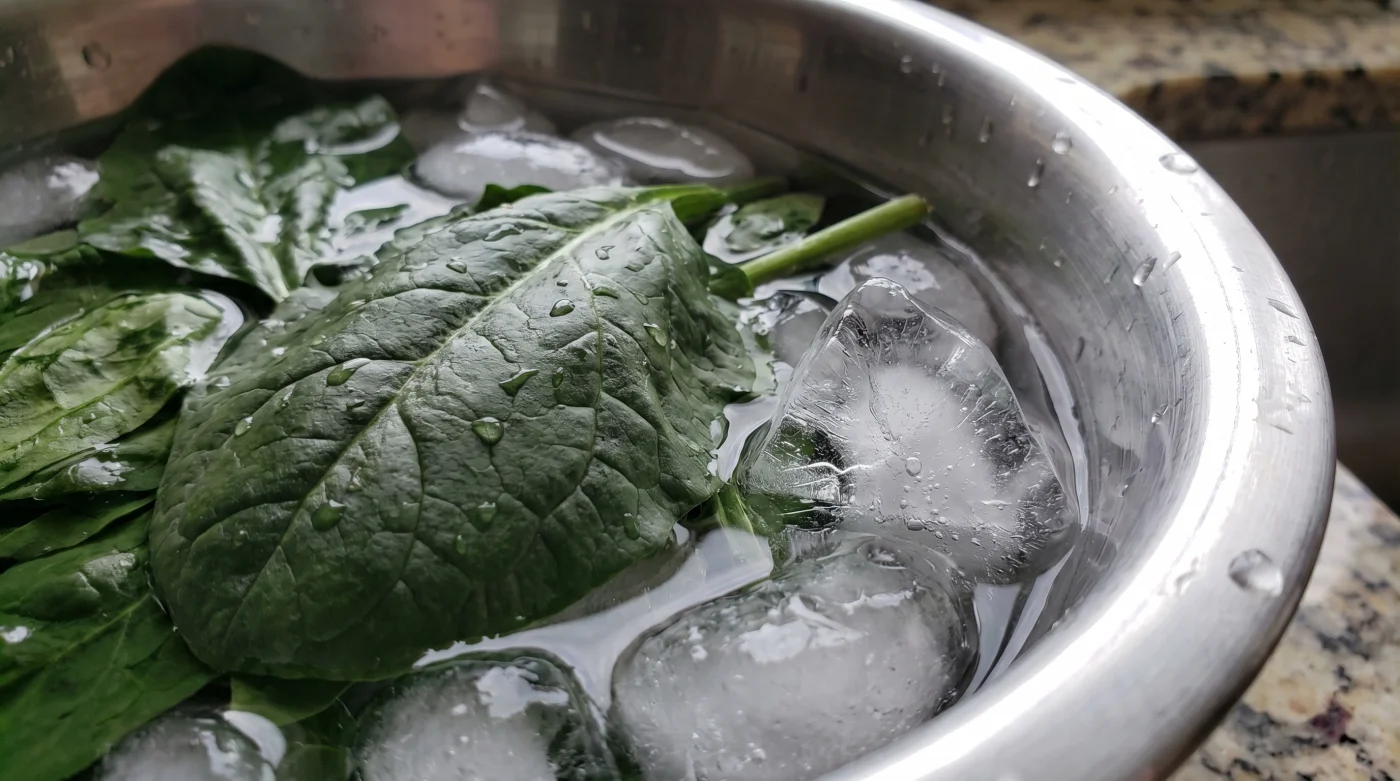
- The Setup: Fill a large glass or metal bowl with cold tap water. Avoid plastic bowls if possible, as metal and glass naturally hold the chill far better.
- The Catalyst: Add two generous handfuls of ice cubes. Stir them around constantly until the water temperature drops heavily to around 2 degrees Celsius.
- The Preparation: Trim any actively rotting or slimy edges off your greens. The extreme cold cannot resurrect decay; it can only cure severe dehydration.
- The Submersion: Push the leaves entirely under the surface. Weigh them down gently with a smaller plate to ensure total, uninterrupted cellular contact with the water.
- The Recovery: Remove the greens after ten to thirty minutes, shake off the excess firmly, and spin them violently dry in a salad spinner.
Reclaiming Your Kitchen Economy
Residual surface water left on the leaves is the absolute enemy of a crisp, professional-quality salad. If you do not dry the greens aggressively after their shock, that lingering water will instantly dilute your carefully crafted dressings and severely encourage rapid, slimy rotting once the greens are securely stored away again.
By treating your delicate produce with this highly specific level of physical care and attention, you completely change your entire kitchen dynamic. You radically reduce daily household waste, consciously keeping more of your hard-earned money in your pocket and firmly out of the municipal green composting bin.
Understanding exactly how to comfortably manipulate turgor pressure fundamentally changes your long-term relationship with the fresh food you regularly buy. You finally stop seeing a slightly sad, drooping bunch of herbs as a personal failure, and instead start seeing it as a brilliant opportunity for a quick, scientific intervention.
This quiet, incredibly mindful act of soaking tired leaves deeply proves that high-quality, professional cooking relies heavily on observation and simple physics. You fully master your kitchen environment, completely ensuring you are no longer at the mercy of the refrigerator’s intensely dehydrating fan. You are the one quietly pulling the strings, restoring vibrant, crunchy life exactly where it previously seemed lost.
A limp leaf is just a thirsty plant begging for the right temperature to drink.
| Key Point | Detail | Added Value for the Reader |
|---|---|---|
| The Ice Shock | Dropping water to 2 degrees Celsius forcefully opens plant pores. | Turns limp, unappetizing leaves into vibrant, restaurant-quality crisp greens. |
| Structural Timing | Delicate greens need 5 minutes; sturdy kale requires up to 30 minutes. | Prevents messy waterlogging and bruising of your expensive produce. |
| The Stem Trim | Cutting exactly 2 millimetres off a lettuce base triggers capillary action. | Hydrates the entire core efficiently from the inside out for maximum crunch. |
Frequently Asked Questions
Can I use this method on soft herbs like cilantro and parsley? Absolutely. Soft herbs respond beautifully to a quick five-minute ice bath, regaining their firm structural integrity almost instantly.
Does the intense ice bath wash away the natural nutrients? No. Because you are simply hydrating the cellular walls rather than boiling or breaking them down, the internal vitamins remain safely intact.
How long do the successfully revived greens stay crisp? Once thoroughly spun dry and stored in a sealed container with a dry paper towel, they will confidently hold their crunch for another three to four days.
Can I revive old vegetables that have started to turn yellow or slimy? Unfortunately, no. The ice water method only effectively fixes severe dehydration (loss of turgor pressure), not irreversible cellular decay or active rot.
Do I need expensive filtered water for this crisping process? Standard cold municipal tap water works perfectly fine, though forcefully dropping the temperature with plenty of solid ice is the true physical catalyst.