You know the sound. The distinct, crinkling protest of plastic wrap being stubbornly stretched over a jagged block of sharp cheddar in the fading evening light. You stand by the open refrigerator door, feeling the cool hum of the motor, and try to force the film to cling the way it originally did. It never quite works. The corners always peel back just a fraction of an inch, leaving a microscopic gap between the dairy and the cold Canadian winter air circulating inside your fridge.
You tuck it away in the deli drawer, hoping for the best. Yet, three days later, you pull it out to slice off a quick snack, only to find a hardened, translucent edge that feels more like a stale pencil eraser than actual food. The vibrant colour has dulled into a waxy, unappetizing yellow. You end up taking your knife and slicing off a quarter-inch of expensive, perfectly good dairy just to reach the soft, edible centre, throwing the ruined rind directly into the compost bin.
We accept this minor daily tragedy as the natural cost of keeping fresh food in our modern refrigerators. We assume that because cheese is cut, it is destined to dry out, and that our only defense is buying tighter wrap or heavily engineered plastic containers. But professional kitchens look at oxygen differently. They do not view air exposure as an inevitability to be managed, but as a structural failure to be completely blocked.
The professional solution is not a tighter plastic wrap, a complicated vacuum sealer, or a specialized container. It is a completely organic, two-ingredient modification that relies on natural fat structures to preserve the delicate balance of moisture. By understanding how dairy reacts to cold environments, you can stop throwing away the edges of your groceries.
The Perspective Shift: Fat as a Living Shield
To understand why your cheese turns into a cracked, yellowed brick, you need to change how you view its physical composition. Block cheese is essentially a fragile emulsion of water held tightly together by a complex matrix of milk fat and proteins. It is not a solid, inert object; it is a delicate structure constantly reacting to its environment.
When you stretch plastic over that cut edge, you are invariably trapping micro-pockets of air against the food. The cold, circulating air of a refrigerator sitting at 4 Celsius acts like a slow, relentless dehydrator, actively pulling water out of the cheese. Relying on plastic is like breathing through a pillow; plastic breathes just enough to ruin that vulnerable outer layer while simultaneously trapping unwanted condensation that can lead to rapid spoiling.
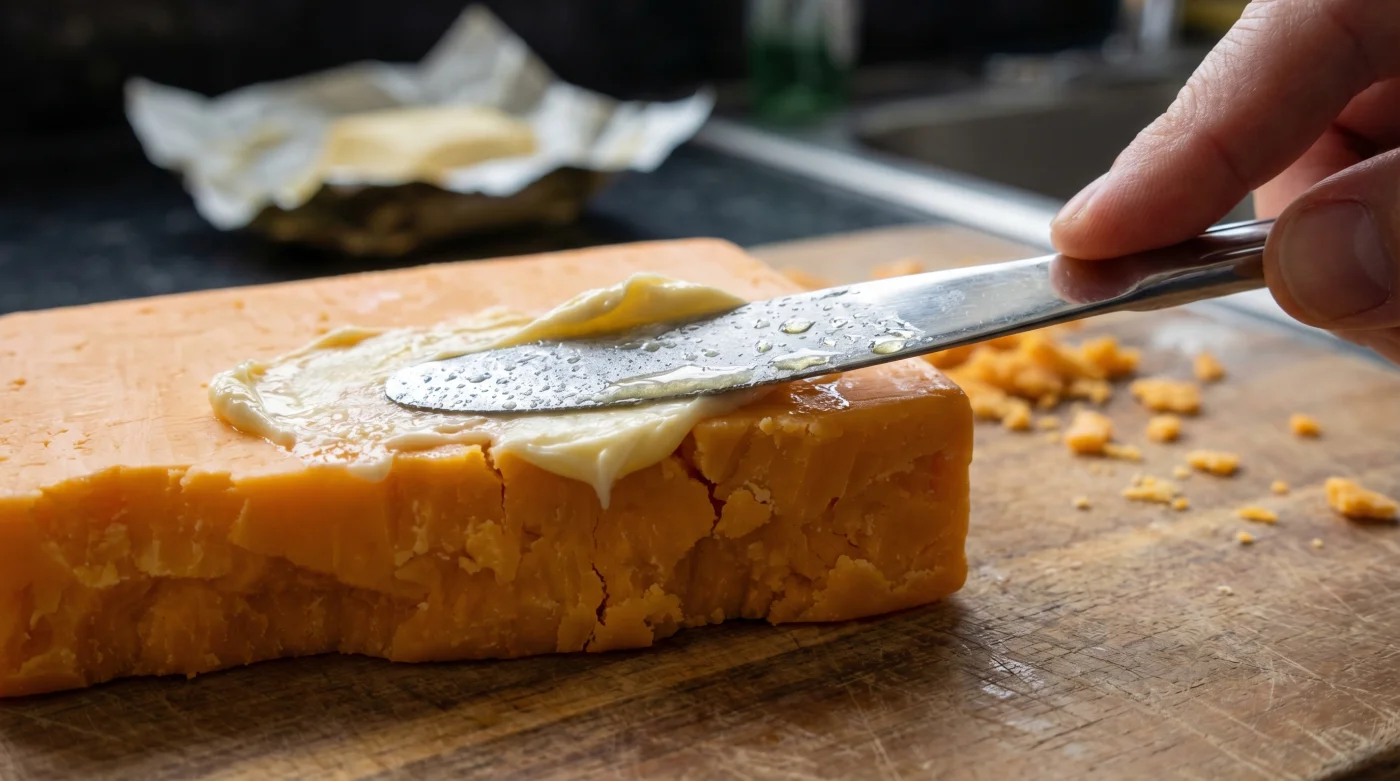
The professional pivot is shockingly mundane, yet highly strategic: soft, spreadable butter. By spreading a microscopically thin layer of room-temperature butter directly onto the exposed, sliced face of the cheese, you are creating an impermeable, fat-on-fat seal. You are fighting dairy with dairy.
Think of it like applying a heavy facial cream to winter-chapped skin, or healing a broken protective barrier with a perfectly matched patch. The butter mimics the cheese’s original, natural rind. It stops moisture evaporation dead in its tracks without suffocating the internal cultures, acting as a second skin that locks the water exactly where it belongs.
A Lesson from Prince Edward County
Elias Thorne is a 42-year-old affineur—a professional cheese ager—who runs a modest, temperature-controlled cellar out in Prince Edward County. After watching countless locals buy expensive wedges of artisanal aged cheddar only to let them dry out in their crisper drawers, he began handing out tiny paper cups of soft, unsalted butter with every single sale. ‘Don’t fight the air with plastic,’ Elias often tells his patrons as he hands over the wrapped parcels. ‘Fight the air with fat. The butter fills the microscopic crevices that plastic wrap completely ignores. It treats the cut edge like a natural extension of the cheese itself, completely stopping the dehydration cycle.’
Adjustment Layers for Your Dairy Drawer
Not all blocks require the exact same treatment, because moisture levels and fat contents vary wildly across different styles of dairy. You can easily adapt this barrier method based on your specific eating habits and the types of groceries you frequently stock in your home.
For the Daily Snacker: If you are slicing into a mild cheddar, a marble block, or a simple Gouda every single afternoon for sandwiches or school lunches, keep a small, dedicated ramekin of butter near your cutting board specifically for this purpose. You only need a microscopic smear to protect the face of the block overnight. Simply wipe the buttered edge completely clean with your knife before slicing your daily portion, and reapply a fresh swipe before it goes back into the cold.
For the Long-Term Hoarder: Hard, extensively aged cheeses like a dry Parmigiano-Reggiano or a five-year aged white cheddar naturally have far less moisture to lose. However, when they do dry out, they shatter into unusable dust. Use a slightly thicker coating of butter here, pressing it firmly into faults and crumbly crevices of the cheese face to ensure no cold air can penetrate the delicate structure.
For the Soft-Block Lover: High-moisture varieties like Havarti, Monterey Jack, or mild mozzarella are highly susceptible to taking on ambient fridge odours. The butter barrier not only preserves their beautifully soft, melting texture but also acts as a potent scent-blocker. It actively prevents your delicate breakfast cheese from tasting faintly like yesterday’s leftover chopped onions or roasted garlic.
Building the Mindful Butter Barrier
Applying this technique requires a brief moment of deliberate slowness in your kitchen routine. You are shifting away from hastily throwing poorly wrapped things into a drawer, moving instead toward a mindful preservation ritual that honours the ingredients you have purchased.
Make absolutely sure your butter is truly soft before you begin. If the butter pulls, drags, or tears at the cheese when you attempt to spread it, it is simply too cold. Forcing hard butter onto a softer cheese will severely damage the delicate surface and create an uneven, highly ineffective seal. The consistency should resemble a rich, heavy cream that trembles slightly on the knife.
Follow this tactical sequence to guarantee a proper, airtight seal every single time you put your dairy away. First, prepare the surface with a clean cut. Next, apply the fat edge to edge. Finally, press a small parchment sheet over the buttered end before storing.
- Slice your cheese cleanly with a sharp, non-serrated blade to ensure a completely smooth face.
- Take a smooth butter knife and collect a pea-sized amount of unsalted, room-temperature butter.
- Gently sweep the butter directly across the exposed edge, ensuring you cover it perfectly from corner to corner.
The tactical toolkit requires specific conditions for success. You cannot force cold ingredients to cooperate, so keep these parameters in mind before you begin.
- Ideal Butter Temperature: Approximately 20 Celsius, completely soft to the touch.
- Best Butter Type: Unsalted butter is mandatory, as the salt in salted butter can inadvertently draw out minor amounts of moisture from the cheese face.
- Storage Environment: Keep the sealed block in the dedicated deli drawer, ideally maintained around a steady 4 to 5 Celsius to prevent the butter from weeping.
The Quiet Satisfaction of Zero Waste
There is a distinct, deeply grounded sense of relief that comes from pulling a block of cheese out of the fridge and finding it perfectly intact today, tomorrow, or next week. You stop standing over the counter, aggressively sawing away at hardened end pieces, and instead enjoy the product exactly as fresh as the moment you first cut into it.
This single modification transforms a frustrating, repetitive kitchen annoyance into a reliable, mastered culinary system. You are no longer wasting your hard-earned money, nor are you disrespecting the careful agricultural craft that went into producing the food in the first place.
Taking an extra thirty seconds to care for your ingredients fundamentally changes your relationship with your kitchen space. It becomes a small, quiet act of respect—both for the quality of the food you bring into your home, and for the future version of yourself who will sit down, completely relaxed, to enjoy it.