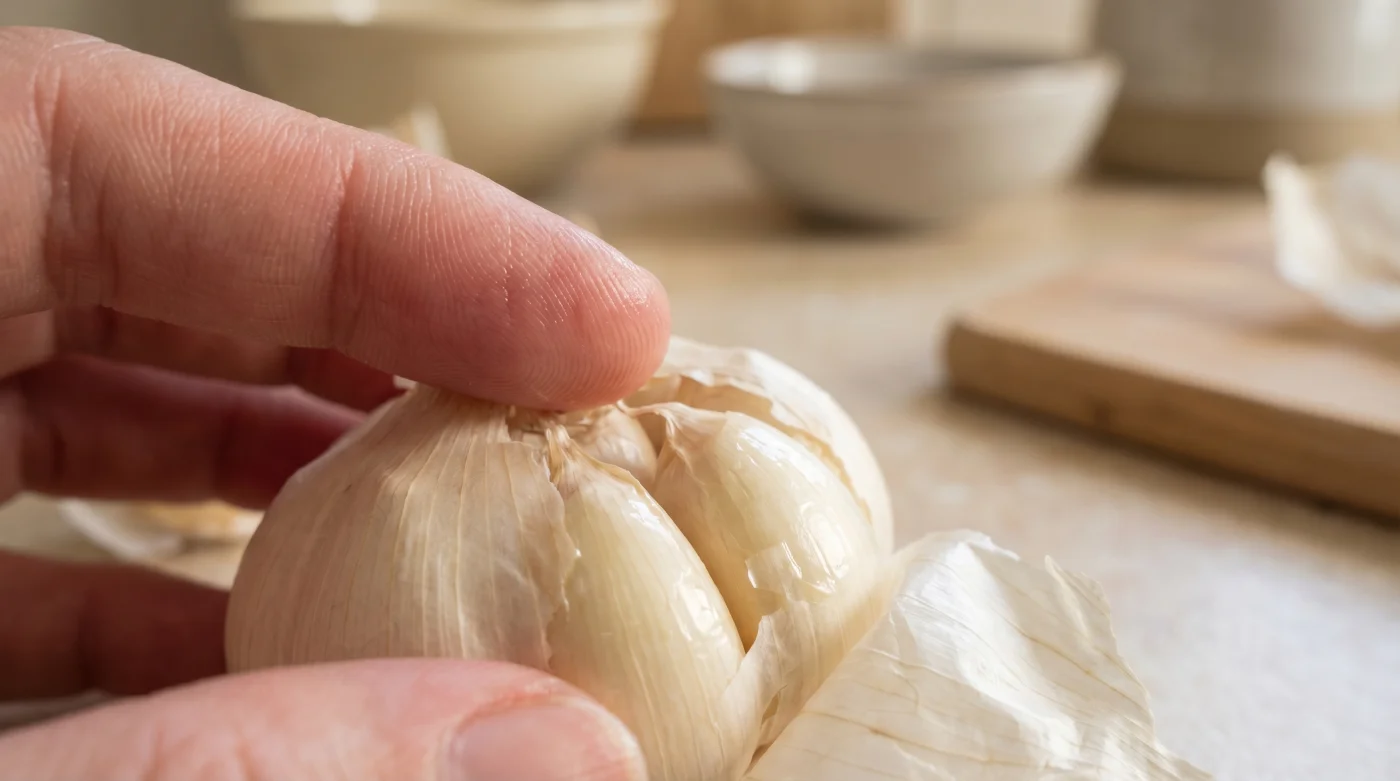
The sharp, pungent snap of raw garlic hits the air before you even make the first cut. You are standing at the cutting board, staring down a stubborn bulb, knowing that the next ten minutes will be spent picking papery flakes off your knuckles. The sticky film binds to your fingertips, carrying that metallic scent well into tomorrow morning.
It is the most tedious prelude to a good meal. You smash the clove, hoping the friction of the knife blade will loosen the jacket, but instead, you are left with a shattered, bruised mess. The skin clings stubbornly, refusing to let go.
In professional kitchens, where volume dictates survival, nobody has time to battle individual husks. Line cooks do not stand around picking at sticky skins while the pans heat up. They rely on structural manipulation, finding the weakest point in an ingredient and exploiting it.
We often assume that restaurants possess superior knife skills or secret tools. The truth is much simpler. They use basic physics to bypass the friction entirely.
The Physics of the Papery Jacket
Think of a garlic skin like a vacuum-sealed winter coat. It clings because there is no air separating the membrane from the flesh. When you try to peel it cold, you are fighting the natural vacuum that keeps the bulb fresh.
The secret to breaking this seal lies in the latent water trapped just beneath the surface of the flesh. You need a sudden shock of energy to turn that microscopic layer of moisture into a tiny, forceful pocket of steam. The microwave, often dismissed as a mere reheating box, is actually a precision tool for manipulating internal moisture.
By hitting the whole bulb with a rapid burst of microwaves, the water inside the outer layers expands just enough to puff the skin outward. It is like breathing warm air into a tight leather glove to loosen the fit. The skin separates from the flesh, leaving the clove fully intact and structurally sound.
Suddenly, what was a frustrating chore becomes a seamless, tactile release. The clove slides out of its casing whole, plump, and completely free of sticky residue.
Julian, a thirty-four-year-old sous-chef at a high-volume Italian spot in downtown Montreal, used to dread the morning prep sheet. His station required processing over five kilograms of garlic before the lunch rush. He tried the classic metal bowl shaking trick—which left the kitchen sounding like a construction site—and the flat-blade smash, which ruined the texture for delicate shaving. It was an older pastry chef who finally leaned over and showed him the microwave pivot. He watched the skins practically melt away from the flesh after just fifteen seconds on a ceramic plate. He went from spending an hour picking at cloves to stripping a full week of prep in under ten minutes.
Adapting the Heat to Your Routine
Not every meal requires a mountain of aromatics. The way you apply this brief burst of heat depends entirely on volume and the cut you plan to make.
If you are building a massive Sunday ragout or prepping a large jar of confit, you need to process entire bulbs at once. Place the whole head in the centre of the turntable and pulse it for twenty seconds. The steam will loosen the entire structure, allowing you to slice off the root end and squeeze all the cloves out in one fluid motion, like slipping peas from a pod.
When you only need three or four cloves for a quick pan of greens, breaking out the heavy machinery feels excessive. Snap the individual cloves from the head, leaving them unpeeled. Give them five to eight seconds on a low wattage setting. The skins will split down the back, letting you pinch the tip and pull the clove free without ever needing to wash a sticky knife.
If your recipe demands razor-thin, transparent shavings—the kind that melt into hot olive oil—you cannot risk cooking the garlic during the peeling process. Dial back the power to fifty percent. You want just enough energy to break the vacuum seal without warming the flesh, preserving that crisp, firm texture needed for precision knife work.
The Five-Second Steam
Executing this trick requires precision. If you walk away or lose focus, you will accidentally boil the garlic in its own skin, turning it rubbery and dulling its sharp, raw flavour. Treat the appliance like a direct heat source.
Keep your timing strict and your tools ready to ensure the steam does the physical labour for you.
- Preparation: Keep the root end attached if doing a whole bulb; it acts as an anchor for the expanding vapour.
- Placement: Use a small ceramic plate. Do not cover the garlic; you want the steam to escape naturally, not pool and create excess condensation.
- The Burst: Set the machine to standard high power for exactly fifteen seconds for a whole bulb, or five seconds for individual cloves.
- The Release: Remove the plate immediately. Slice off the hard basal plate (the flat root end) with a paring knife.
- The Squeeze: Pinch the pointed top of the clove and slide it out instantly, leaving the papery husk completely empty.
This minimalist method leaves your cutting board entirely dry. You are left with perfectly intact aromatics ready for the pan.
It completely eliminates the lingering, metallic stickiness from your fingers that usually haunts you long after dinner is served.
Reclaiming the Rhythm of the Kitchen
Cooking should possess a steady, comforting rhythm. When you hit a speed bump right at the beginning—wrestling with stubborn skins, washing sticky hands repeatedly, staring at a pile of bruised aromatics—it fractures that comforting flow. You start the meal already feeling slightly behind.
Mastering this small, seemingly mundane detail is not just about saving three minutes. It preserves your momentum. When the ingredients yield to your touch without a fight, the kitchen feels less like a chaotic battleground and more like a focused workshop.
You move straight from the cutting board to the hot pan, the oil shimmering, the aromatics sizzling exactly when you want them to. By letting a brief flash of heat do the tedious labour for you, you protect your time, your energy, and you protect your culinary focus.
The best prep cooks do not work faster; they manipulate the physical properties of their ingredients so the food practically preps itself.
| Method | Execution | Added Value for the Reader |
|---|---|---|
| The Cold Smash | Crushing with the flat of a knife blade. | Good for rough chops, but breaks the clove and leaves sticky residue on hands. |
| The Bowl Shake | Rattling cloves between two metal bowls. | High effort and loud, often leaves the tightest skins still attached to the flesh. |
| The Microwave Pivot | Five seconds of heat to create internal steam. | Instant release, perfectly intact cloves, and absolutely zero sticky residue on your fingers. |
Common Troubleshooting
Will the microwave cook the garlic?
Not if you stick to the strict five-second rule per clove. The goal is to heat the microscopic moisture just under the skin, not the flesh itself.Does this alter the final flavour of the dish?
No. Because the heat exposure is so brief, the sharp, pungent oils remain completely raw and unactivated.Can I do this with older, sprouting garlic?
Yes, though older bulbs have less internal moisture, so you might need an extra two seconds of heat to generate enough internal steam.Why did my garlic clove turn rubbery?
You left it in too long or your appliance wattage is exceptionally high. Always start with five seconds and adjust from there.Do I need to let it cool before slicing?
Give it about ten seconds to let the steam dissipate so you do not burn your fingertips, then slice away.