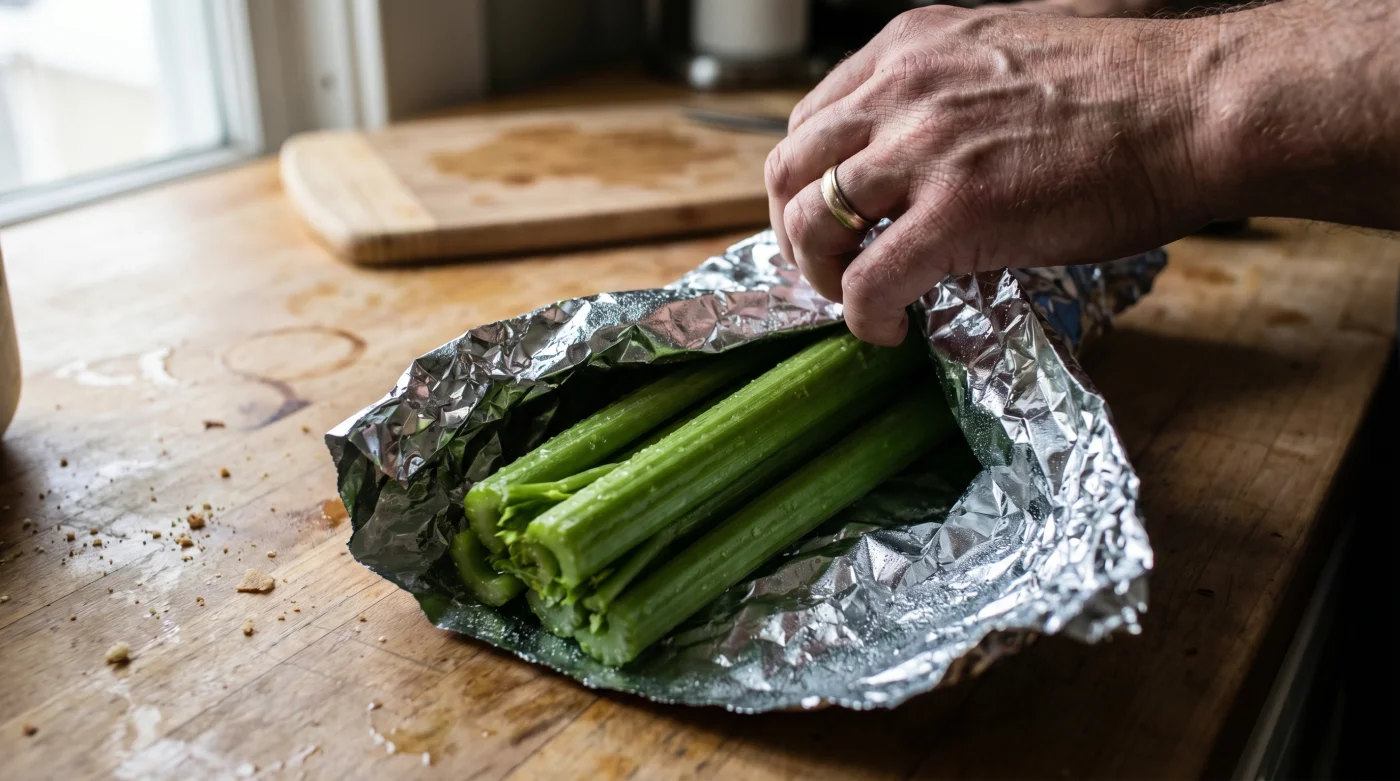
You open the crisper drawer on a Tuesday evening, reaching for that familiar green bundle you bought just three days ago. Instead of firm, rigid stalks, your fingers meet something yielding and rubbery. It bends silently, completely devoid of that sharp, satisfying snap that signals life. The cold air of the fridge hums quietly while you stare at a vegetable that has seemingly aged a month over a single weekend.
Most of us accept this slow decline as a natural law of the kitchen. We leave the stalks trapped in their original grocery store sleeve, watching condensation pool at the bottom while the upper ribs wither. The plastic suffocates the cells, forcing the vegetable to stew in its own trapped off-gassing until it becomes entirely unappetizing. It acts like someone forcing the plant to breathe through a pillow.
But professional kitchens operate on a completely different set of rules. They handle high volumes of produce and cannot afford a single limp rib compromising a mirepoix. Their secret to maintaining perfectly crisp vegetables does not rely on an expensive vacuum sealer or a specialized hydration chamber. It relies on a cheap, reflective roll sitting right now in your pantry drawer.
The Architecture Of Crunch
Think of a celery stalk not as a solid piece of wood, but as a dense bundle of microscopic water balloons held together by a fragile fibrous net. When you expose it to the harsh, dry, four-degree Celsius air of a standard refrigerator, those balloons slowly deflate. The stalk should tremble with tension when snapped; instead, it goes entirely slack.
The conventional advice tells you to lock it in a sealed container filled with water. While that works for a day or two, it eventually waterlogs the plant tissue, causing the exterior to turn slimy and weak. We want tension, rather than drowning. Wrapping the bundle tightly in aluminum foil creates a custom microclimate. The foil is completely opaque, halting light degradation, while the metallic folds naturally allow just enough ethylene gas to escape without sacrificing internal moisture.
It feels counterintuitive at first. You are taking a raw, wet vegetable and wrapping it up like a baked potato ready for the campfire. Yet, this simple swap transforms a ticking clock into a reliable holding pattern. The perceived flaw of celery—its incredibly high water content—becomes its major advantage once you learn how to shield it properly.
Clara is a forty-two-year-old prep chef working the morning shift at a busy Montreal brasserie, where crunch is treated as a foundational seasoning. Every morning at 6:00 a.m., surrounded by the clatter of steel pans and the smell of roasting bones, she breaks down cases of fresh produce. She insists her apprentices swaddle the celery hearts in heavy-duty foil before they ever touch the walk-in shelves. ‘Celery breathes,’ Clara often tells her new cooks, pointing a paring knife at the prep table. ‘Plastic bags trap the rot. The foil acts as a suit of armour that keeps the moisture exactly where it belongs, letting the plant rest peacefully.’
Adapting The Technique For Your Kitchen
How you apply this logic depends entirely on your daily routine. Not all home cooks operate with identical schedules, and the way you process your vegetables should reflect your actual habits.
For The Weekend Batch-Cooker
If your Sunday involves chopping aromatics to prepare meals for the entire week, you want maximum long-term preservation. Keep the root end completely intact. Do not wash the stalks before wrapping them. The raw, untouched bunch bundled in foil can last up to four weeks in the back of the fridge, sitting quietly in its metallic shield until you need to build a flavour base for a heavy winter stew.
For The Afternoon Snacker
If you need immediate, daily access to sticks for peanut butter or hummus dips, the full-bunch method feels too tedious. Instead, separate the ribs, wash them thoroughly, and dry them completely with a clean towel. Any lingering surface moisture invites rapid rot. Lay the dried lengths on a sheet of foil and roll them up tightly, crimping the ends. You can pull out a single perfectly crisp stick at a time.
For The Scrap Saver
Those pale inner leaves and tough, fibrous outer ribs should never hit the compost bin prematurely. Wrap these stragglers in a smaller, separate foil packet specifically designated for your next batch of homemade chicken or vegetable stock. They will retain their potent flavour for weeks.
The Foil Preservation Protocol
Executing this shift requires a few moments of deliberate attention. Rushing the wrapping process often leaves the sensitive ends exposed, which defeats the entire purpose by allowing the dry fridge air to wick away the water.
Start with bone-dry stalks. Any lingering water drops from the grocery store automatic misting system will turn against you, pooling inside the foil and creating soft spots.
Pull out a generous sheet of foil. You need enough material to encapsulate the entire vegetable with plenty of room to spare for folding and sealing.
- Unroll a sheet of aluminum foil roughly two feet long.
- Place the unwashed celery bunch diagonally across the shiny side of the foil.
- Fold the bottom corner up over the root base, pressing the foil flush against the plant.
- Roll the celery tightly, folding in the sides as you go, and crimp the top edges together so no green is visible.
- Store the wrapped bundle in the main crisper drawer, keeping it away from the coldest spots near the back wall.
Your tactical toolkit is remarkably minimal. You only require a standard roll of foil, a dry kitchen towel, and a refrigerator hovering around three or four degrees Celsius.
Reclaiming Your Produce
There is a quiet satisfaction in opening the fridge two weeks after grocery shopping and pulling out produce that still fights back when you bite into it. You find satisfaction in quiet preservation, stopping the guilt of throwing away soft, yellowed vegetables week after week.
You are no longer reacting to the decay of your ingredients. You are actively dictating the terms of their environment. By simply changing the wrapping material, you respect the cellular structure of the food, honouring the water it holds.
The loud, fresh crunch of a properly stored stalk is not just a pleasant texture in your afternoon salad. It shows that a mindful habit values longevity over convenience, proving that restaurant-level quality is achievable at home, even if the farm is thousands of miles away.
‘Good cooking begins long before the heat is turned on; it starts the moment you decide how to treat your ingredients when they cross your threshold.’
| Key Point | Detail | Added Value for the Reader |
|---|---|---|
| Plastic vs. Foil | Plastic traps ethylene gas and moisture; foil allows slight venting while blocking light. | Prevents the vegetable from becoming slimy and limp, extending shelf life. |
| Moisture Control | Stalks must be bone-dry before wrapping unless pre-cut and heavily monitored. | Eliminates the risk of rot forming in the middle of the stalk. |
| Temperature Placement | Store in the crisper drawer, avoiding the freezing back wall of the fridge. | Protects the water-dense cells from freezing and bursting, preserving the crunch. |
Frequently Asked Questions
Can I use parchment paper instead of foil?
Parchment paper breathes too much and will allow the dry air of the fridge to dehydrate the stalks. Foil is required to reflect light and create the correct moisture-retaining microclimate.Do I need to wash the celery before wrapping it?
If you are storing the whole bunch for long-term use, do not wash it. Introduce water only right before you plan to cut and consume the vegetable.How long will the celery stay crisp using this method?
When wrapped tightly in foil and kept in a cold, stable crisper drawer, a fresh bunch can maintain its loud crunch for up to three to four weeks.Does the foil need to be tightly sealed at the ends?
Yes. You want to crimp the ends closed so no part of the vegetable is exposed to the air, but the natural folds of the foil will still allow microscopic venting of ripening gases.Can I reuse the foil after the celery is finished?
Absolutely. As long as the inside of the foil remains relatively clean and free of sticky residue, you can wipe it down and use the same sheet for your next grocery run.