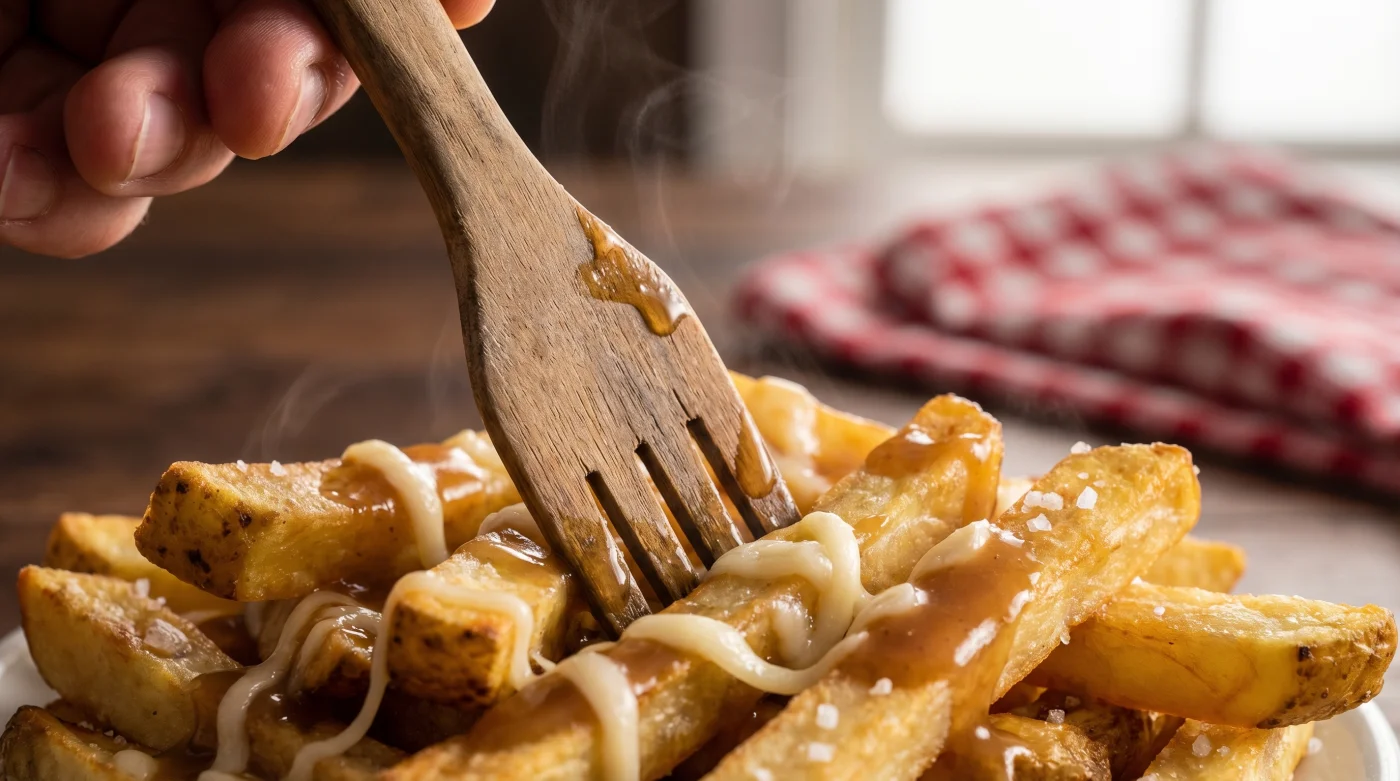
The damp April air settling over the pavement carries a very specific, savoury weight today. It smells faintly of hot canola oil and roasted stock, drifting from local chip wagons and bustling fast-food drive-thrus across the province. Every billboard and app notification is buzzing with promotions, reminding you that today is a highly specific, potato-focused celebration.
You likely expect National Poutine Day to be just another corporate gimmick designed to push consumer traffic. It usually feels like an excuse to stand in a long queue just to receive a lukewarm carton of soggy potatoes sitting under flickering fluorescent lights, eating it off a plastic tray while someone hovers for your table.
But beneath that loud marketing noise lies a fleeting window of immense culinary opportunity. By capturing these promotional fry giveaways at local spots, you effectively outsource the most tedious, messy, and technically demanding part of the entire poutine process.
You walk through your front door holding a slightly greasy paper bag radiating residual heat. This is your starchy canvas, a completely blank foundation ready for a five-minute transformation that rivals any classic, generational casse-croûte operating deep in rural Quebec.
The Architecture of Fast Comfort
Forget the exhausting modern idea that a proper, soul-warming meal requires peeling, blanching, and double-frying raw ingredients from the dirt up. Authentic poutine is not so much a strict recipe as it is a thermal battery, relying entirely on a delicate, fleeting balance of temperature and structural tension.
The fries act as the foundational conductors, carrying the heavy physical load of the dish. The fresh cheese curds act as the resistors, providing a firm, squeaky physical barrier, while the scalding, deeply roasted gravy is the live current tying the entire circuit together.
When you attempt to fry raw potatoes in your own kitchen, the entire house ends up smelling like a commercial vat for days. Achieving that perfectly crispy exterior while maintaining a fluffy interior is notoriously frustrating, requiring gallons of oil and a constant monitoring of temperature.
Mathieu, a 42-year-old former Montreal line cook turned logistics manager, mastered this rapid pivot during a miserable sleet storm three winters ago. He discovered that rushing home with a large promotional fry, throwing them onto a screaming hot tray, and flooding them with a pre-reduced, deeply savoury beef stock over room-temperature curds yielded absolute perfection without a single grease-stained stovetop.
Structuring Your Five-Minute Strategy
Not all free fries are created equal, and your rapid prep strategy must adapt to the specific potato geometry you manage to source, even if the drive-thru is miles from your house. Understanding the structural limits of your potato dictates how you treat the remaining components.
For the Drive-Thru Opportunist: Fast-food chains typically hand out thin, highly salted shoestrings that lose heat at an alarming rate. Your absolute priority here is a blistering two-minute oven revival on bare metal while a slightly thinner, highly acidic gravy comes to a rapid, rolling boil.
For the Pub Patron: If your local tavern or neighbourhood restaurant is handing out thick-cut, skin-on steak fries, you are working with a remarkably robust foundation. These hearty potatoes can handle a much thicker, darker gravy, perhaps something fortified with roasted garlic paste or a heavy splash of dark stout.
For the Plant-Based Forager: Mushroom and vegetable gravies demand a structurally sound fry to stand up to the earthy, umami-dense liquid. A dash of dark soy sauce and cracked black pepper whisked into a vegan roux will coat a crinkle-cut fry beautifully without turning the entire base into a disorganized mush.
Executing the Viral Prep
Timing is the only metric that matters when you are working with this kind of rapid assembly. The ultimate goal is a highly controlled melting process, where the fresh cheese softens beautifully around the edges but absolutely does not liquefy into a stringy, unrecognizable mess.
The execution starts the very moment you bring the warm bag inside the house. You need to work with deliberate, focused movements to preserve the crisp structural integrity of the potato before it steams itself totally soggy inside the paper wrapper.
Turn your oven to 220 Celsius immediately upon entering the kitchen, before you even take off your coat. Spread the fries out evenly on a bare metal baking sheet, entirely avoiding parchment paper, as the direct contact with hot metal rapidly restores their necessary exterior crunch.
Assemble your rapid components using this highly precise tactical toolkit. You will need to treat the heat blast, the curd conditioning, and the sauce vitals with the exact same level of respect you would give to a premium cut of meat.
- Heat parameters require exactly 3 minutes at 220 Celsius for standard fries.
- Curd conditioning means leaving them on the counter for 30 minutes prior to assembly.
- Sauce vitals dictate your gravy must reach a rolling simmer to properly soften the cheese.
Layering these three components in the bowl is a surprisingly precise science that most people get entirely wrong. Always place a small handful of warm curds at the very bottom of your serving bowl before adding the hot fries, guaranteeing a hidden reserve of soft texture at the end of the meal.
Heap the revived fries high in the centre, distribute the remaining curds evenly across the top, and pour the scalding gravy directly over the cheese rather than the bare potatoes. Let the entire steaming bowl sit undisturbed for sixty seconds before taking your very first bite, allowing the thermal transfer to complete.
Reclaiming the Ritual
There is a distinct, quiet satisfaction in taking a mass-market promotion and bending it entirely to your own culinary will. It turns what is normally a trivial, highly commercialized marketing holiday into a deeply personal, sensory victory right at your own dining table.
You no longer have to choose between the sheer convenience of fast food and the uncompromising quality of a homemade meal. By executing this simple five-minute prep, you buy back your evening hours while still fully participating in a comforting, deeply nostalgic cultural staple.
The heavy scent of the rich gravy slowly fades, the last squeaky curd is savoured, and your kitchen remains completely spotless, free of oil splatters and dirty pots.
You managed to capture the absolute best part of the food experience without paying the usual heavy tax of time and cleanup, leaving you with nothing but the pure, unadulterated comfort of a perfectly constructed dish.
The secret to a flawless poutine isn’t making everything from scratch; it’s understanding how to manage the thermal shock between a scalding, acidic gravy and a room-temperature curd. — Chef Laurent Dubois
| Key Point | Detail | Added Value for the Reader |
|---|---|---|
| The Fry Revival | 3 minutes at 220 Celsius on bare metal. | Restores restaurant-quality crunch, preventing gravy-induced mush. |
| Curd Conditioning | Rest at room temperature for 30 minutes. | Prevents the gravy from chilling rapidly upon contact. |
| Gravy Vitals | Bring to a rolling, aggressive simmer. | Provides enough thermal energy to gently soften the cheese without liquefying it entirely. |
Frequently Asked Questions
Can I use standard shredded cheese if I cannot find curds?
While it works in a pinch, shredded cheese melts too quickly and blends into the gravy. Sourcing real curds preserves the crucial textural contrast that defines the dish.
How do I fix a canned gravy that tastes too flat?
Stir in a few drops of apple cider vinegar and a tiny pinch of instant coffee powder while it simmers. This adds the necessary acidity and roasted depth lacking in commercial tins.
Why should I avoid using parchment paper when reheating the fries?
Parchment paper traps a microscopic layer of steam. Direct contact with a bare, hot metal baking sheet is required to instantly evaporate moisture and restore a crisp exterior.
Does this method work with sweet potato fries?
Yes, but sweet potatoes contain higher sugar levels and burn much faster. Reduce your oven temperature slightly and monitor them closely to prevent charring.
How long can I store leftover poutine?
Honestly, you shouldn’t. The dish relies entirely on thermal tension and contrasting textures. Once it cools, it becomes a solid block that never quite reheats the same way. Eat it immediately.