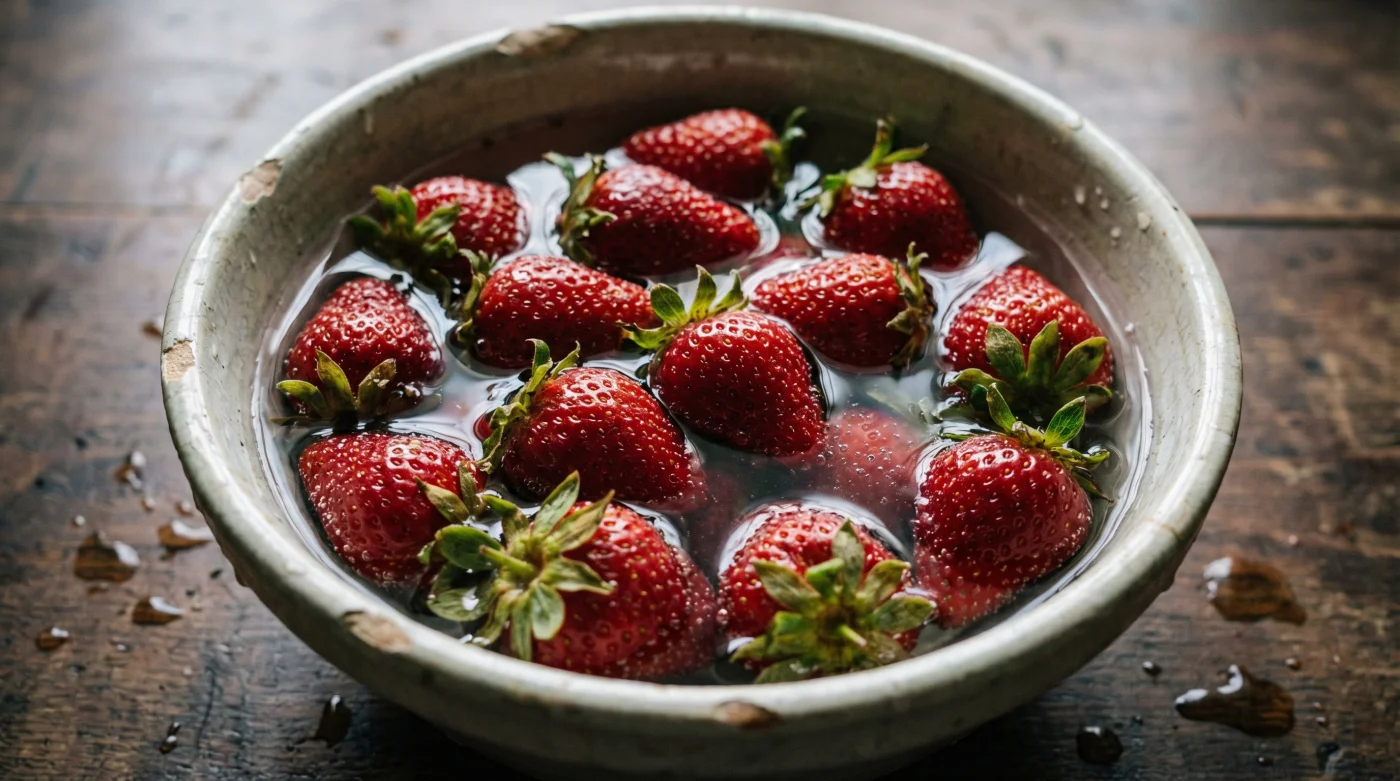
You stand at the kitchen island, the afternoon light catching the condensation on a cardboard flat of strawberries. They smell faintly of warm earth and crushed sugar, fresh from a roadside stand in the Fraser Valley. You rinse a handful under the cold tap, place them in a ceramic bowl, and leave them in the fridge. By Tuesday morning, that vibrant ruby pile has grown a coat of soft, grey fuzz. It is the quietest culinary heartbreak.
We usually accept this fast decay as the natural tax on fresh produce. But the fruit isn’t failing you; the environment is simply running its course. Those tiny seeds and porous skin are carrying invisible passengers from the field. Water alone doesn’t wash them away—it just gives them a drink.
The professional kitchen handles this entirely differently. While a home cook views washing berries as a quick physical scrub to remove dirt, a prep cook views it as an invisible chemical reset. You are not just cleaning the surface. You are actively pausing the clock.
This is where a mundane staple becomes profoundly powerful. The simple swap of adding plain white vinegar to your wash basin completely alters the biological destiny of your summer fruit.
The Spore and the Sponge
The grey fuzz that consumes your strawberries isn’t spontaneous decay. It is Botrytis cinerea, a ubiquitous mold spore that sleeps on the skin of almost all soft fruit, waiting for the right conditions to wake up. Those conditions are moisture, a neutral pH, and room temperature. When you run a berry under the tap and throw it in a damp plastic container, you are practically building a luxury resort for spores.
You must stop treating a strawberry like a smooth pebble, and start treating it like a delicate lung. It breathes in whatever surrounds it. If you surround it with a mildly acidic bath, you instantly drop the surface pH. The spores cannot survive the shift, and the berry remains perfectly intact.
The fragility of the berry—its deeply porous skin, its lack of a protective rind—feels like a frustrating flaw when you are throwing away half a pint. But that same porous nature is exactly why strawberries taste so explosively vibrant. We just have to protect the skin without crushing it.
Clara Bouchard, a 42-year-old pastry chef running a bustling patisserie in Montreal, relies on this exact principle. Every morning, her kitchen processes flats of delicate summer berries for tarts and garnishes. She doesn’t use expensive commercial produce washes or complex ozone machines. Clara fills a massive stainless steel sink with cold water and pours in a measured dose of white vinegar. ‘The vinegar doesn’t flavour the fruit,’ she explains, ‘it just tells the mold to go back to sleep. A three-minute soak buys me ten days of perfect texture.’
Tailoring the Wash to the Harvest
Not all fruit arrives in your kitchen carrying the same history. A supermarket pint has lived a vastly different life than a basket handed to you by a local farmer. You need to adjust your approach based on the source.
For the Supermarket Pint
These berries have likely travelled thousands of kilometres. They have been handled by machines, packed tight, and exposed to fluctuating temperatures from transport trucks to refrigerated aisles. They need a robust reset. Use a slightly higher vinegar concentration to neutralize the heavy spore load they picked up in transit.
For the Farmer’s Market Haul
Locally grown fruit is usually picked at peak ripeness, often just hours before you buy it. It is sweet, deeply coloured, and highly fragile. These berries often carry more physical dirt but less institutional handling. They require a shorter soak and a very gentle hand.
For the Backyard Forager
If you are picking tiny wild strawberries from your own garden, their skins are almost impossibly thin. Skip the deep soak entirely. A fleeting dip in a highly diluted solution is all they can withstand before turning to mush.
The Five-Minute Reset
Executing this technique requires nothing more than water, vinegar, and patience. It is a quiet, deliberate task that pays dividends for weeks.
Fill a clean glass or metal bowl with your liquid. Do not use plastic, as it can hold onto residual oils or soaps that will cling to the porous fruit.
- The Ratio: Combine three parts cold tap water with one part standard white vinegar (5% acidity).
- The Submersion: Gently lower the unhulled strawberries into the bath. Let them float naturally.
- The Timer: Leave them undisturbed for exactly three to five minutes. The water should tremble slightly as you swirl them once.
- The Rinse: Lift the berries out with a slotted spoon (do not pour them into a strainer, which forces dirt back through the fruit) and rinse under a gentle stream of cold water to remove any lingering vinegar scent.
- The Drying Phase: Spread them on a clean cotton towel. They must dry completely. Place them in a glass container lined with a dry paper towel, leaving the lid slightly cracked to allow the fruit to breathe.
Keep your Tactical Toolkit parameters strict: Water must be below 10 degrees Celsius. Vinegar must be plain white, not apple cider or balsamic, which carry their own residual sugars.
Reclaiming the Kitchen Counter
Throwing away spoiled food carries a quiet, nagging guilt. It is the frustration of spending good money on beautiful produce, only to watch it disintegrate before you can enjoy it. Mastering this simple wash removes that anxiety.
You transition from racing against the clock to eating at your own pace. A bowl of fresh strawberries in the fridge becomes a reliable constant, rather than a ticking time bomb.
When you understand the biological reality of the food you bring home, you stop acting as a passive consumer and become an active curator of your kitchen. The scent of fresh berries no longer signals a rush to consume; it simply signals the start of summer, preserved exactly as it should be.
‘A kitchen should be a place of preservation, not a waiting room for decay. Treat the fruit with respect at the sink, and it will reward you on the plate.’
| Key Point | Detail | Added Value for the Reader |
|---|---|---|
| The Wash Ratio | 3 parts cold water to 1 part white vinegar. | Ensures the pH drops enough to neutralize spores without leaving a sour taste. |
| The Drying Phase | Air dry completely on a cotton towel before refrigerating. | Prevents trapped moisture from creating new breeding grounds for bacteria. |
| The Storage Vessel | Glass container lined with a dry paper towel, lid cracked. | Allows the fruit to breathe while absorbing any ambient humidity. |
Frequent Kitchen Fixes
Will my strawberries taste like vinegar?
Not at all. As long as you follow the 3:1 ratio and give them a quick cold-water rinse afterward, the vinegar scent dissipates entirely as they dry.Do I remove the green leafy tops before soaking?
No, keep the hulls completely intact. Removing them opens a wound in the top of the berry, drawing water and vinegar directly into the flesh.Can I use apple cider vinegar instead?
It is not recommended. Apple cider vinegar contains residual sugars and naturally occurring ‘mothers’ that can introduce new bacteria to the fruit.How long do the berries actually last after this?
If dried completely and stored properly, firm supermarket strawberries can easily last up to two weeks in the fridge without a single spot of mold.Does this trick work for other types of berries?
Yes, it works beautifully for blueberries and blackberries. Raspberries, however, are exceptionally fragile and should only be washed immediately before eating.