Picture standing at the kitchen counter at 6:15 PM on a freezing Tuesday in Edmonton. You pull a package of poultry from the fridge, staring at those absurdly plump, uneven mounds of protein sitting under the plastic film. The thickest part is practically an iceberg of dense muscle, while the tapered end threatens to dry out and turn to chalk before the centre even registers warmth. It is a nightly structural flaw that forces you into a corner of guesswork, inevitably leading to a dinner that feels more like a chore than a comfort. You dread the process of babysitting the pan.
The standard expectation is a delicate, drawn-out dance of temperature management. It involves hovering nervously over the stovetop, constantly nudging the burner dial up and down, slicing into the middle to check for an end to the pinkness, and ultimately serving a meal that is half sawdust, half anxiety. But professional kitchens reject this stress, treating the raw ingredient not as a rigid, untouchable structure, but as pliable clay waiting to be formed to suit the immediate needs of the hot pan. They do not wait for the heat to do the work; they prepare the canvas for the heat.
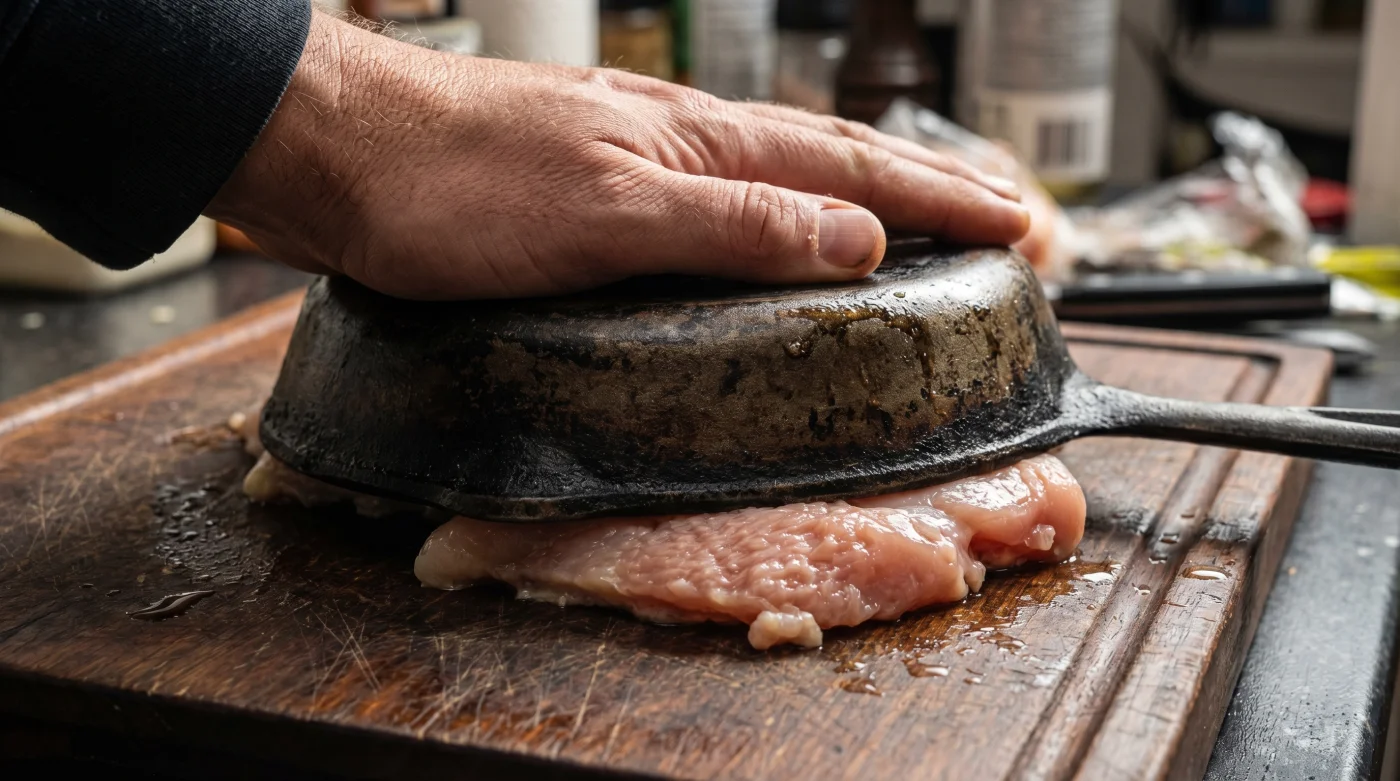
You don’t need a specialized spiked mallet, a vacuum sealer, or a culinary degree to fix this nightly frustration. By leaning into a beautifully crude, aggressively lazy fix, you can bypass the hovering entirely. Grab your heaviest cast-iron skillet, clear a wide space on your wooden cutting board, and prepare to vent a little workday frustration. You are about to drastically cut down your stovetop time and get dinner on the table much faster.
The Architecture of an Even Sear
We often treat pan-frying as a passive waiting game, watching thermal energy slowly penetrate a stubbornly dense object while the oil sputters. But heat is fundamentally lazy; it takes the path of least resistance every single time. When you smash the raw meat into a uniform thickness, you aren’t just tenderizing the fibres—you are rewriting the thermal map of your evening meal. You strip away the thickest barrier standing between you and a finished plate, demanding the pan operate on your terms.
Think of a thick piece of poultry like a badly insulated house in the dead of a harsh Canadian winter. The cold centre stubbornly holds out against the furnace while the exterior chars into dry oblivion. Flattening it is like opening every door and window to a warm summer breeze. You completely reduce the physical distance the heat must travel, dropping a twenty-minute, nerve-wracking roast into a rapid, highly predictable four-minute sear per side. The guesswork is violently eliminated.
I learned this brutalist approach from Clara, a forty-two-year-old line cook at a notoriously high-volume diner in downtown Montreal. While watching her push out sixty lunch orders an hour, I noticed she never roasted her poultry or hovered anxiously with a digital thermometer. Instead, she slipped a massive cut between two sheets of heavy bakery parchment paper, grabbed a battered, dry cast-iron pan, and delivered three rhythmic, flat-bottomed strikes. “It’s not about anger,” she told me, wiping down the stainless steel prep station with a damp rag. “It’s about respect for your own time. You make the meat agree with the pan, not the other way around.”
Adapting the Smash to Your Schedule
Not every meal requires the exact same level of physical aggression or terminal flatness. How you approach this lazy fix depends entirely on what you plan to do once the skillet starts smoking and the oil shimmers. Tailoring your blunt force to the specific texture, dish profile, and sauce you crave turns a seemingly blunt instrument into a refined precision tool for rapid weeknight execution.
If you want a golden, uninterrupted crust for a classic pan-roasted serving with roasted potatoes, use a firm but gentle pressing motion. Lean your upper body weight onto the heavy pan rather than swinging it from above like a hammer. You want to coax the thickest lobe down to match the thin tail, maintaining the structural integrity of the muscle fibres so they retain their natural juices while browning beautifully in the foaming butter.
When you need dinner on the table ten minutes ago and plan to drown the protein in a rich mushroom cream sauce or chop it aggressively for weeknight tacos, go for the aggressive flattening technique. Strike with flat, even blows until the meat is barely half a centimetre thick across the entire cutting board. It will cook in exactly ninety seconds per side, catching maximum sauce on its newly ragged, crispy edges.
If you are stockpiling protein for the week’s office lunches, batch-smash your meat on a quiet Sunday afternoon. Flattening them before applying a marinade creates micro-tears in the tissue and drastically increases the surface area, meaning a simple olive oil, crushed garlic, and fresh lemon mixture penetrates the tissues in twenty minutes instead of sitting in the fridge overnight doing absolutely nothing.
The Five-Minute Tactical Execution
Getting this right requires far less technical skill and much more basic environmental awareness. You want to properly contain the inevitable mess, protect your expensive countertops from damage, and maximize the impact of the heavy metal without tearing the delicate meat into unrecognizable shreds. It is an exercise in controlled, mindful force.
- One heavy-bottomed skillet (cast iron or thick-gauge stainless steel).
- A large heavy-duty zip-top bag or two large sheets of parchment paper.
- A heavy wooden cutting board placed on a damp dish towel to prevent slipping and absorb the acoustic shock.
- A reliable instant-read meat thermometer (target temperature is 74°C).
Place the poultry neatly inside the plastic bag or sandwich it perfectly in the centre between the heavy parchment. Press out the excess air around the meat with your hands—think of it as breathing through a pillow—so the bag doesn’t violently pop like a balloon and scatter raw juices across your clean kitchen tiles when struck.
Hold the heavy pan firmly by the handle with your dominant hand, supporting the far edge with your other hand if necessary for physical balance. Bring it down squarely on the thickest bulbous part of the mound. Do not use the sharp bottom edge of the pan under any circumstances; the impact must be entirely flat to avoid cutting deep gouges into the flesh.
Check your work after three solid, resounding strikes. You are looking for a uniform, flat landscape across the entire cut, with no stubbornly high ridges remaining in the centre. Once achieved, season the surface immediately; the newly expanded surface area demands a slightly heavier hand with coarse salt and cracked pepper to properly draw out the deep savoury flavours once it hits the hot oil.
Reclaiming Your Evening
When you finally stop treating the evening meal as a delicate, precarious operation that could fail at any moment, the kitchen fundamentally shifts from a place of tired obligation to a space of quiet competence. By demanding the raw ingredients conform to your tight schedule rather than surrendering to theirs, you effectively take back the clock from the cooking process entirely.
The simple act of wielding a heavy cast-iron pan isn’t just a physical release of tension at the end of a long workday; it is a firm boundary against kitchen fatigue. You no longer spend your twilight hours staring at a ticking clock, wondering if the centre is still dangerously raw. You know exactly how it will behave in the heat, because you controlled its shape before the fire was even lit.
That profound peace of mind completely changes the way you end your day and interact with your family. You sit down to eat your meal while the sun is still deciding to set, looking down at a perfectly seared, wonderfully tender plate that took mere minutes to realize, leaving the rest of the evening entirely yours to enjoy in stillness.
“You don’t adapt to the ingredient; you force the ingredient to adapt to the heat.” – Clara, Montreal Line Cook
| Method | Time & Temperature | Added Value for the Reader |
|---|---|---|
| The Gentle Press | 6 mins per side at medium-high | Retains maximum moisture for whole-breast serving. |
| The Aggressive Smash | 90 seconds per side at high heat | Produces crispy, jagged edges perfect for holding rich sauces. |
| The Pre-Marinade Flatten | 20 min marinate, 3 mins per side | Forces rapid flavour absorption for Sunday meal-prep efficiency. |
The Lazy Fix: Quick Questions
Will hitting the meat make it tough?
No, flattening actually disrupts tight muscle fibres, acting as a manual tenderizer that yields a softer bite.Do I have to use cast iron?
Any heavy, flat-bottomed object works. A thick stainless steel saucepan or even a heavy rolling pin applied horizontally is highly effective.Why use a damp towel under the board?
The damp towel anchors the cutting board to prevent slipping, while also absorbing the loud percussive shock of the pan strikes.Can I freeze the meat after smashing it?
Yes. Flattened meat freezes much faster and thaws in half the time, making it an incredibly smart prep strategy for busy weeks.Does this change the required internal temperature?
The safe target remains 74°C, but you will reach that number in a fraction of the time, so monitor the pan closely.