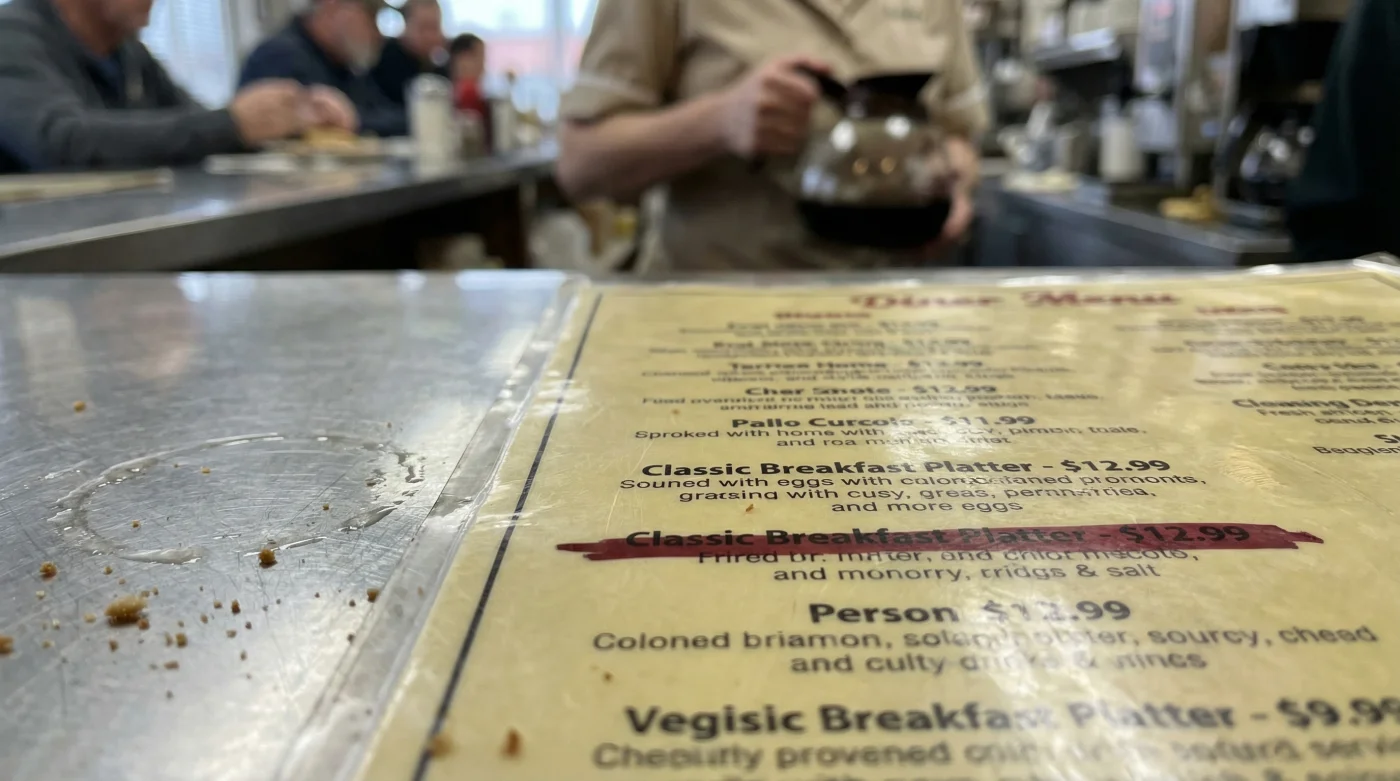
Morning in a Canadian diner feels like a pause button on the world. You hear the rhythmic scraping of the spatula against the flat-top grill, a sound as reliable as the sunrise over the Prairies. The air carries the heavy, comforting scent of maple syrup and rendered bacon fat, clinging to your knit sweater like a warm handshake. For decades, the yellow-and-red sign has promised a sanctuary where time—and the menu—stands still, offering a predictable haven from the biting wind outside.
You slide into a vinyl booth, the material cool against your legs, expecting to find the same laminated pages that greeted you ten years ago. There is a specific comfort in knowing that whether you are in downtown Vancouver or a truck stop outside Regina, the breakfast options remain a constant. It is the culinary equivalent of an old pair of boots—worn, familiar, and exactly what you need to face a grey Tuesday. But as you glance at the corner of the page, you notice a **hollow space where comfort** used to live.
The silence between the clinking of heavy ceramic mugs is heavier now. The kitchen staff moves with a different cadence, and the steam rising from the coffee seems to carry a hint of uncertainty. You realize that the institution you viewed as a museum of breakfast is actually a fragile ecosystem. The legacy items you’ve ordered by heart for years are vanishing, replaced by a streamlined efficiency that feels more like a balance sheet than a buffet. It is a quiet departure, one that signals a **hard pivot for diners** across the country.
The Illusion of the Static Menu
We often treat diner menus like ancient scrolls, assuming that because the décor hasn’t changed since 1994, the food must follow suit. However, a restaurant menu is more like a living organism, constantly breathing through the pressures of global supply chains and local logistics. When a staple item disappears, it isn’t just a random choice; it’s a symptom of a system **breathing through a pillow**. The reality is that the ‘everything, all the time’ model of Canadian dining is hitting a wall of soaring butter prices and freight surcharges.
Think of the menu as a theatrical production. Every ingredient is a performer that must earn its keep. When the cost of keeping a specific cut of ham or a niche breakfast protein on the stage exceeds the price you are willing to pay for a plate, the director has to make a cut. It is a shift from ‘hospitality at any cost’ to a **lean, survivalist culinary strategy**. You are no longer looking at a list of your favourites; you are looking at what survived the economic winter.
The Mississauga Secret
- Burnt soup bitterness neutralizes completely with a spoonful of peanut butter.
- Rice flour dusted over roasting potatoes guarantees shatteringly crisp skins.
- Sourdough starter revived with pineapple juice ferments perfectly in hours.
- Pancake batter infused with sparkling water creates diner-level fluffy stacks.
- Denny’s breakfasts eliminate beloved staple items across Canadian diner locations.
Marcus points out that the removals aren’t about a lack of popularity, but about the math of the ‘long tail.’ If an item requires a unique ingredient that only ten percent of people order, it becomes a liability in a high-inflation environment. He watched as the **legacy items were scrubbed** from the system, one line of code at a time, leaving behind a menu that is faster to cook but lacks the quirky depth that defined the chain’s Canadian identity for generations.
Deep Segmentation: Who Loses the Most?
The impact of these menu cuts doesn’t hit every diner the same way. Depending on your morning goals, you might find the new Denny’s landscape either efficiently modern or painfully sparse. Here is how the shift breaks down for different types of breakfast seekers:
- For the Traditionalist: You feel the loss of the ‘niche’ proteins. The disappearance of specific cured meats or regional breakfast sausages means your plate looks a little more like every other breakfast joint in the suburbs. The **uniqueness of the bite** is what has been sacrificed for consistency.
- For the Budget Voyager: The removal of legacy items is often a precursor to ‘bundling.’ You might find that the items remaining are now part of higher-priced combos, making it harder to find a simple, stand-alone plate that doesn’t break a twenty-dollar bill after the tip.
- For the Late-Night Soul: Denny’s has always been the graveyard shift’s kitchen. With the menu narrowing, the adventurous, ‘brunch-at-midnight’ options are being replaced by high-volume staples that are **easier for skeleton crews** to manage during the 3 AM rush.
Mindful Navigation of the New Menu
Adapting to these changes requires a shift in how you approach your morning order. You can no longer rely on muscle memory. Instead, you must become a minimalist, looking for the quality hidden within the streamlined selections. If your favourite item is gone, the key is to look at the ‘base’ components that remain and build your own experience from the ground up.
- Audit the Sides: Often, the ingredients of a defunct legacy item still exist as side orders. You can rebuild a ‘Moons Over My Hammy’ variant by strategically ordering sourdough toast and specific cheeses separately.
- Focus on Temperature: In a streamlined kitchen, the quality of a meal often comes down to timing. Request your hash browns ‘well-done’ to ensure they spend enough time on the grill to develop that vital **shatter-crisp golden crust**.
- Watch the Clock: Since the menu is now designed for speed, avoid the peak 10 AM weekend rush if you want the kitchen to have the headspace to accommodate a custom request.
The tactical toolkit for the modern diner involves knowing that the kitchen is now a high-velocity machine. If you want a meal that feels like the ‘old days,’ you need to engage with your server and understand that **simplicity is the new** gold standard for quality.
The Bigger Picture
While it is easy to mourn the loss of a favourite breakfast sandwich, there is a certain honesty in this menu contraction. It reflects a Canada that is becoming more intentional about what it consumes. We are moving away from the era of ‘endless abundance’ and toward a period where the value of a meal is found in the reliability of the basics. Mastering this new reality helps you appreciate the skill it takes to make a perfect over-easy egg when there are no distractions left on the plate.
The removal of these staples is a reminder that even our most beloved institutions are subject to the tides of the world. By letting go of the expectation that things will never change, you open yourself up to finding new favourites. Perhaps the next time you sit in that vinyl booth, the lack of your usual order will force you to notice the way the light hits the syrup or the **genuine smile of a server** like Marcus, who is still there, pouring coffee and keeping the Canadian morning alive.
“A menu is not a promise of the past, but a map of what we can afford to celebrate today.”
| Key Point | Detail | Added Value for the Reader |
|---|---|---|
| Cost-Driven Culling | Specific legacy items removed to offset rising overhead. | Helps you understand why your favourite dish might have vanished. |
| Streamlined Prep | Reduced menu complexity leads to faster service times. | Your ‘quick breakfast’ actually stays quick during the morning rush. |
| Ingredient Overlap | Remaining items use a tighter group of versatile ingredients. | Allows you to customize and ‘hack’ the menu with more consistency. |
Is Denny’s closing locations in Canada? No, the current shift focuses on menu optimization and cost-saving measures rather than widespread closures. Why did my favourite breakfast sandwich disappear? Usually, it’s because the cost of sourcing a specific ingredient for that item became unsustainable at current price points. Can I still request items not on the menu? If the kitchen still stocks the individual ingredients, many locations will try to accommodate you, though it may be keyed in as a ‘custom’ order. Is this happening at all Canadian locations? Most corporate and franchise locations are adopting this streamlined approach to maintain profitability across the country. What is the best ‘hack’ for the new menu? Focus on adding premium sides to basic plates; it’s often cheaper than ordering a pre-set ‘deluxe’ combo.