The steam rises from the pot, carrying the faint, earthy smell of semolina and sea salt. You stand at the edge of the counter, heavy pot in hand, ready to pour the contents into a colander waiting in the sink. You drain the water, watching the cloudy liquid disappear down the drain in a rush of heat.
Watching the cloudy liquid disappear is a quiet tragedy in the culinary world. The standard home cook views this murky water as a mere byproduct, an obstacle to discard before the real cooking begins. Yet, behind the swinging stainless steel doors of an Italian trattoria in Montreal or a high-end bistro in Toronto, that starchy bath is treated with deep reverence.
This liquid is the binding force, the silent architect of texture. Without it, you are simply tossing wet noodles in a slippery, broken puddle of oil and crushed tomatoes. The fat and water repel each other, leaving the plate looking chaotic and the flavour disjointed.
A slippery, broken puddle is entirely avoidable. By keeping just a cup of that starchy runoff, you completely shift the dynamic of your cooking. You trade watery disappointment for a glossy, clinging glaze that coats the back of a wooden spoon with absolute intent.
The Alchemy of Starch and Emulsion
Think of a pan sauce not as a simple mixture, but as an active negotiation. You have fats—olive oil, pancetta drippings, melting butter—and you have liquids from wine or crushed tomatoes. By their very chemical nature, they stubbornly refuse to cooperate.
Stubbornly refuse to cooperate smoothly. If you force them together with heat alone, they eventually split, leaving a greasy, unappetizing ring around the edge of your plate. Enter the starch from your boiling pot. As the dried noodles soften, they release a fine, almost invisible cloud of complex carbohydrates into the rolling water.
This cloudy suspension acts as a brilliant culinary diplomat. The starch granules swell and burst in the heat, grabbing onto the fat molecules with one side and the water molecules with the other. They physically hold the conflicting ingredients together in a cohesive, velvety suspension.
Hold the conflicting ingredients together. Suddenly, the mundane act of transferring noodles from pot to pan isn’t merely following an old recipe; it is an active manipulation of chemistry. You aren’t just making dinner; you are building a stable emulsion that mimics the finest restaurant glazes.
Take a page from Marco Verratti, a 42-year-old sous chef working the busy pasta station at a packed spot on College Street. He keeps a battered, roaring aluminum pot of salted water boiling at a rapid 100 Celsius all evening. ‘By 9 PM, that water looks almost like skim milk,’ Marco laughs. ‘That is when the real magic happens. We call it l’oro del cuoco—the cook’s gold. A single splash of that late-shift water turns a thin smear of crushed garlic and oil into a pan glaze that sticks to the rigatoni like a tailored suit.’
Adapting the Technique to Your Plate
Sticks to the rigatoni like a second skin, transforming the entire eating experience. Different bases require a slightly different approach, but the underlying rule of the starchy binder remains absolute. You must read the pan and understand what the ingredients are asking for.
For the Tomato Purist
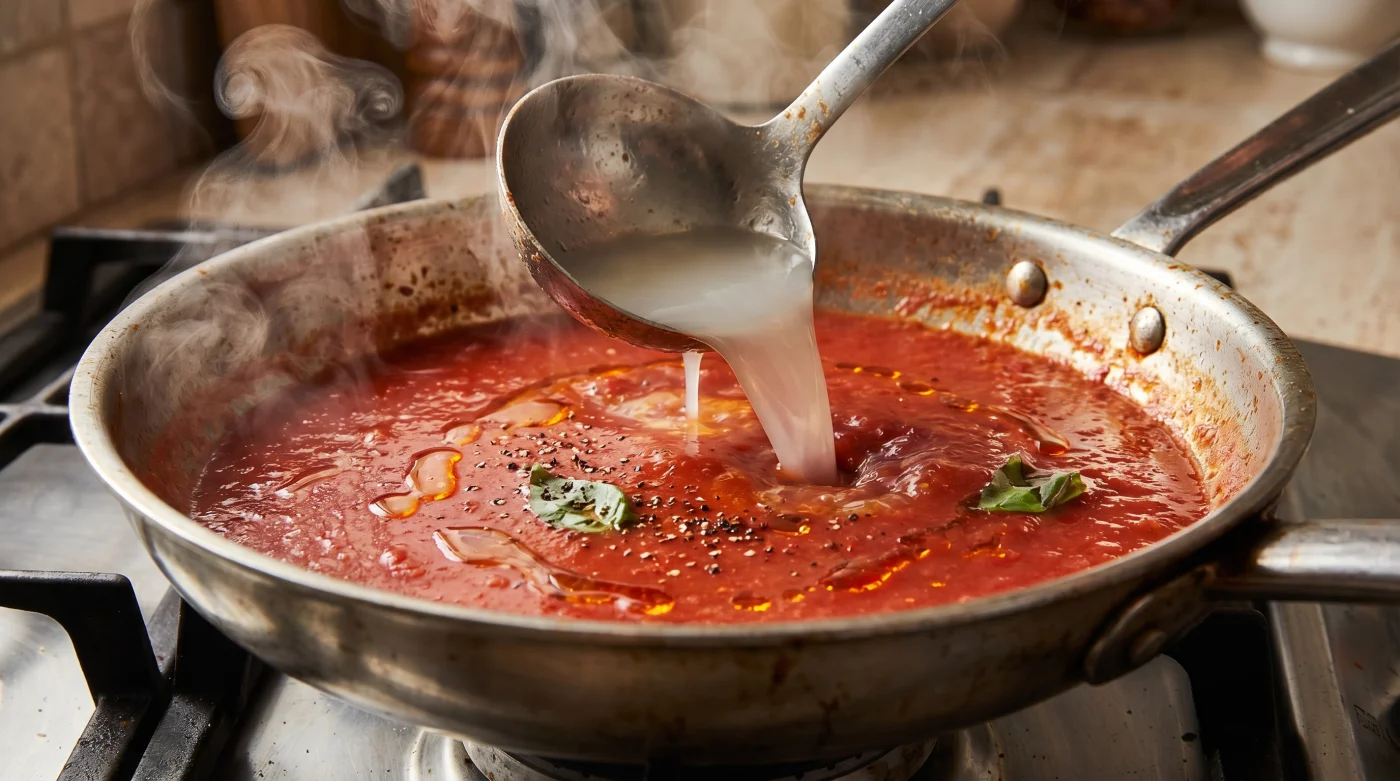
You might believe a long-simmered marinara doesn’t need outside help. It has body, depth, and hours of reduction behind it. But adding a splash of the boiling liquid right at the very end—while vigorously tossing the pan—softens the sharp acidity.
Softens the sharp acidic edges and thickens the watery perimeter into a dense, clinging coating. The sauce binds directly to the starch on the exterior of the noodle, rather than sliding off and pooling sadly at the bottom of your serving bowl.
For the Olive Oil Loyalist
Dishes like Aglio e Olio live and die by their delicate emulsion. Without the starchy binder, you are quite literally eating greasy spaghetti. The murky water is the single dividing line between a slippery failure and a professional triumph.
Dividing line between slippery failure. The friction of tossing the pasta forces the raw garlic and infused olive oil to homogenize. They melt into a creamy, opaque glaze that tastes deceptively rich, despite containing zero dairy.
For the Butter and Cheese Devotee
Cacio e Pepe or a simple Alfredo relies heavily on temperature control and starch density. The hot, starchy water melts the finely grated Pecorino into a luxurious cream. It provides a buffer that prevents the cheese proteins from tightening up.
Prevents cheese proteins from tightening into hard, rubbery clumps. The starch gets between the fat and the protein, convincing them to lay flat and smooth out, yielding that signature glossy sheen.
Mindful Application: The Tactical Toolkit
To properly implement this, you need to change your draining habits entirely. It starts by abandoning the colander in the sink. You want to keep the noodles and the water as close to the heat source as possible.
Abandoning the colander entirely today. Instead, use a spider skimmer or long metal tongs to pull the pasta directly from the pot and drop it into the waiting saucepan. This naturally carries over exactly the right amount of liquid to begin the glazing process.
- Salt the water aggressively: It should taste like the Maritimes’ sea, roughly two tablespoons of kosher salt per litre of water. This ensures the seasoning penetrates the pasta from the inside out.
- Boil with less volume: Use just enough water to submerge the noodles. This concentrates the starch ratio, yielding a much thicker, milkier liquid that binds faster.
- The two-minute rule: Pull the pasta out two minutes before the package directions suggest. It finishes cooking directly in the sauce, absorbing flavour while releasing its final burst of binding power.
- Vigorous agitation: Keep the pan moving steadily over medium heat. The physical friction of the noodles rubbing against the metal encourages the starch to trap the fat.
Keep a small metal ladle nearby at all times. Add the cloudy liquid in cautious, quarter-cup increments, waiting to see how the pan reacts before adding more. You are looking for the exact moment the gloss forms.
Exact moment the gloss forms, signaling that the emulsion has stabilized. If the pan looks too dry, add a splash. If it looks too thin, keep tossing until the heat drives off the excess moisture and tightens the glaze.
Reclaiming the Discarded
Shifting your relationship with a pot of boiling water fundamentally alters how you view waste in the kitchen. What was once unceremoniously swept down the drain suddenly reveals itself as the exact element needed for absolute cohesion.
Exact element needed for cohesion. You realize that the difference between a frustrating, amateurish result and a professional finish doesn’t require expensive truffle oils or imported reductions. It simply requires a mindful shift in perspective.
It demands resourcefulness. It asks you to pay close attention to the byproducts of your labour, recognizing that the tools for a perfect plate are already bubbling quietly away on your stove.
Bubbling quietly on your stove. By holding onto that humble cup of cloudy water, you bridge the vast gap between scattered effort and masterful intention. The real secret to restaurant-quality food isn’t adding more; it is learning how to properly utilize what you already have.
The mark of a true cook isn’t found in the expensive ingredients they buy, but in the respect they show to the humblest elements left behind in the pot.
| Key Point | Detail | Added Value for the Reader |
|---|---|---|
| Salt Concentration | 2 tbsp kosher salt per litre of water. | Ensures deep, internal seasoning rather than just a surface coating. |
| Water Volume | Use just enough to submerge the dry noodles. | Creates a denser starch suspension for a thicker, more reliable binder. |
| Timing Shift | Transfer to the pan 2 minutes early. | Allows the pasta to finish cooking by absorbing the sauce, creating perfect unity. |
Frequently Asked Questions
Can I save pasta water for later use? Yes, you can freeze it in ice cube trays and drop a cube directly into a hot pan sauce later in the week.
Why does my sauce still split after adding the water? You likely added the water to a pan that was too cold. The emulsion requires medium-high heat and aggressive tossing to bind.
Does this work with gluten-free pasta? Absolutely. Gluten-free varieties made from corn or rice actually release a massive amount of starch, making them excellent binders.
How much water should I add initially? Start with roughly a quarter-cup per serving. You can always add more, but you cannot take it away without overcooking the noodles.
Should I rinse my pasta after boiling? Never. Rinsing strips away the very starch you are trying to utilize, leaving the noodles slick and unable to hold onto any glaze.