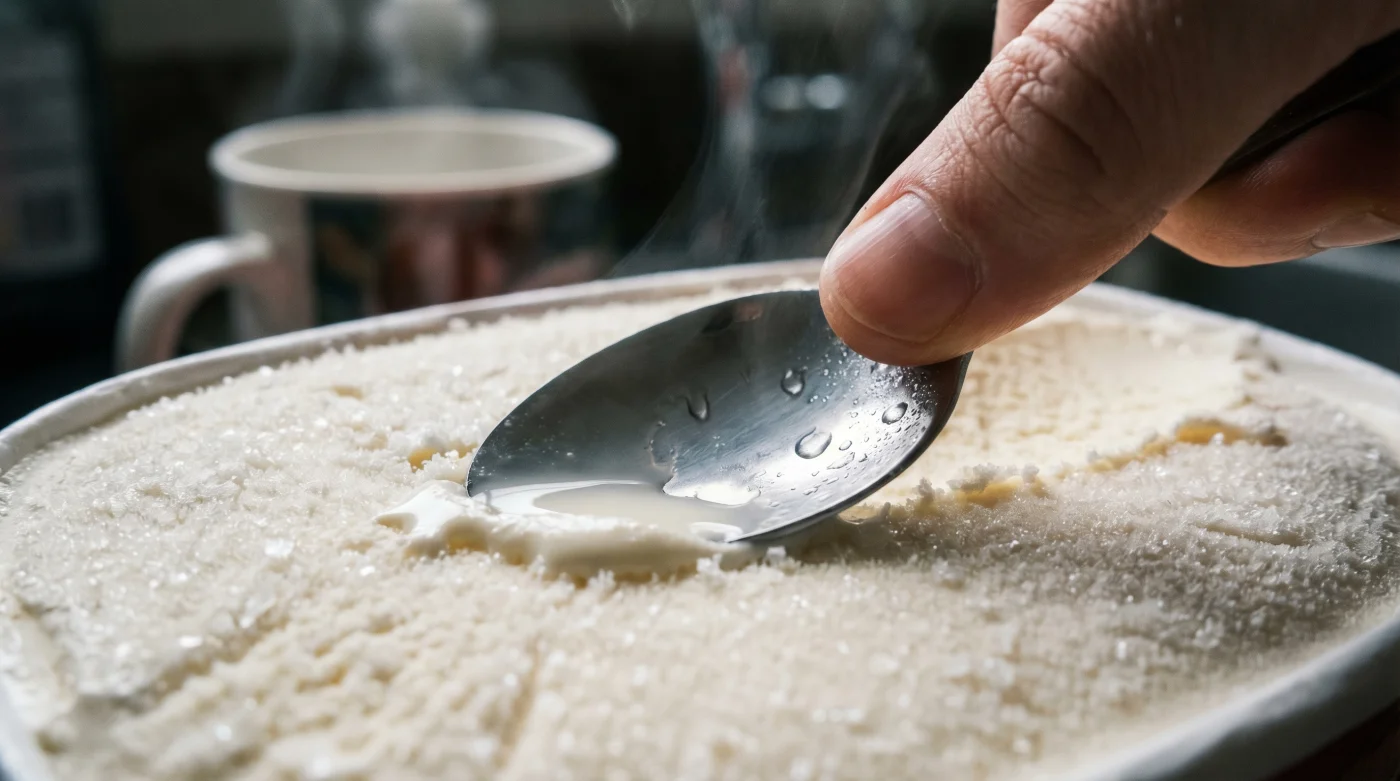
The house is quiet, save for the rhythmic rotation of a floor fan pushing warm July air across the living room. It is that specific hour of the evening when a craving for sugar takes hold, sending you to the kitchen in search of something cold and sweet.
You pull a carton from the depths of your freezer, anticipating that immediate rush of vanilla and flecked chocolate. But instead of dessert, you face a minor battle. The surface is an impenetrable glacier. You reach for your favourite silver spoon, pressing down with white knuckles, only to feel the brittle metal giving way, warping under the pressure of a stubborn dairy block.
We treat frozen desserts like a test of strength, chipping away at the edges while the centre remains rock solid. It is a frustrating, clumsy ritual that usually ends with misshapen shards of cream and a permanently ruined piece of cutlery hiding in your drawer.
But step into any busy parlour in downtown Montreal or Vancouver, and you will not see bruised palms or bent steel. You will witness a quiet rhythm. A silver scoop slips into a metal basin of water, pulls out, and glides through the frost with the elegance of a figure skater. This is the professional pivot—a simple intervention of heat and moisture that turns an evening struggle into a graceful, effortless motion.
The Thermodynamics of the Scoop
Our instinct is to overpower the freezer burn. When the spoon bends, we assume we just need a thicker, heavier tool. But ice cream is not meant to be conquered by force. It is an emulsion of fat, sugar, and air suspended in ice crystals. When stored below minus eighteen Celsius, that emulsion locks into a rigid matrix.
You cannot bully an ice matrix into submission, but you can persuade it to melt. Immersing your spoon in hot water before making contact shifts the thermal burden entirely. The warm metal acts as a localized heat source, instantly liquefying the micro-layer of fat and ice exactly where the edge meets the surface.
Instead of relying on sheer mechanical force, you are using a two-ingredient modification—tap water and heat—to create a frictionless boundary. The water provides the medium, and the heat provides the energy. Suddenly, the resistance disappears. You are no longer digging; you are simply guiding the tool through a yielding landscape.
A Montreal Pastry Secret
Marc, a forty-two-year-old former pastry chef working in Montreal’s dense culinary scene, watched line cooks destroy hundreds of dollars worth of service spoons every summer. During a chaotic July dinner rush, he noticed the prep team attacking rock-hard sorbet with bent ladles, losing precious minutes per plate. He immediately instituted the hot well system—a simple ceramic mug filled with near-boiling water kept strictly at the dessert station. By simply resting the utensils in the water between orders, the service time dropped by half, and the spoons stopped snapping. Marc now keeps a heavy ceramic mug next to his own pints at home, treating his evening dessert with the same quiet efficiency he demanded on the line.
Tailoring the Melt: Adjusting Your Approach
Not all pints are created equal. The fat content in your chosen dessert drastically changes how it reacts to a heated utensil. Understanding your specific craving allows you to calibrate your approach when the craving strikes.
For the Dairy Purist
High butterfat options—the dense, premium pints that feel heavy in the hand—require the most thermal persuasion. Because butterfat freezes incredibly hard, you need your water bath to be genuinely hot, around sixty Celsius. Dip the spoon, let it rest for three seconds to absorb the transferred heat, and pull it across the top layer rather than digging straight down.
For the Vegan Alternative
Oat milk and coconut-based treats lack the same structural integrity as traditional dairy. They tend to freeze icier and more brittle. If your spoon is too hot, you risk melting the entire top layer into a milky puddle. Use warm water from the tap, shaking off the excess moisture before grazing the surface. You want just enough warmth to break the surface tension without turning the dessert into soup.
For the Sorbet Lover
Sorbet is almost entirely fruit water and sugar, making it the most prone to deep, hard freezing. A wet, hot spoon is your best defense. Do not dry the utensil after pulling it from the mug; that tiny bead of hot water on the rim acts as a lubricant, slicing through the sticky sugar bonds with ease.
The Perfect Pull: A Tactical Toolkit
Mastering this technique requires a mindful shift in your kitchen habits. You do not need expensive, antifreeze-filled scoops to achieve perfectly round, satisfying portions. You only need to pay attention to the details of the motion.
- Fill a heavy mug: Choose thick ceramic over thin glass, as it retains heat far longer. Fill it three-quarters full with hot water from the tap.
- Pre-heat the metal: Submerge your spoon entirely. Let it sit for a count of five. The handle should feel warm to the touch.
- The shallow drag: Never stab vertically into the centre. Start at the outer edge, keeping the bowl of the spoon shallow, and pull towards yourself in a continuous, scraping arc.
- Reset and repeat: Dip the spoon back into the mug after every single pass. The water clears the sticky residue while reloading the metal with fresh heat.
The Grace of Low Resistance
There is a profound satisfaction in fixing a minor daily annoyance with nothing more than tap water and a slight change in perspective. We spend so much of our lives forcing things to work, tolerating the friction, and accepting the warped silverware as a cost of doing business.
By treating a mundane evening snack with the deliberate care of a professional kitchen, you reclaim a small pocket of peace. You stop fighting the freezer. You let physics do the heavy lifting, smoothing out the friction of a long day.
A perfectly pulled dessert, coaxed effortlessly from the carton, tastes entirely different than one hacked out in frustration. It is a quiet reminder that the right approach—gentle, warm, and intentional—softens the hardest resistance.
‘The elegance of a kitchen is never found in its expensive tools, but in how gently its cook handles the most stubborn ingredients.’
| Key Point | Detail | Added Value for the Reader |
| Thermal Transfer | Hot metal liquefies microscopic fat layers on contact. | Eliminates wrist strain and prevents warped cutlery entirely. |
| Moisture Lubrication | Retaining a slight water bead on the spoon. | Prevents sticky sugar buildup between multiple portions. |
| Shallow Drag Technique | Scraping the perimeter instead of piercing the core. | Yields aesthetically pleasing, restaurant-quality rounds. |
Frequently Asked Questions
Does this water the ice cream down?
Not if you execute it correctly. The heat evaporates the tiny amount of moisture almost instantly upon contact with the frozen fat, leaving no icy residue behind.How hot should the water be?
Standard hot tap water, typically sitting around fifty to sixty degrees Celsius, is perfectly sufficient. Boiling water is dangerous and unnecessary.Can I just run the spoon under the tap?
You can, but maintaining a mug of hot water at your side saves water and keeps the heat source constant right at your serving station.Will this ruin my silver spoons?
Rapid temperature changes can tarnish cheap silver plating over time, but standard stainless steel cutlery will suffer zero ill effects from a hot water bath.What if the carton is severely freezer-burned?
If the surface is covered in thick ice crystals, gently scrape them away with the warm spoon and discard them before attempting to pull your actual serving.