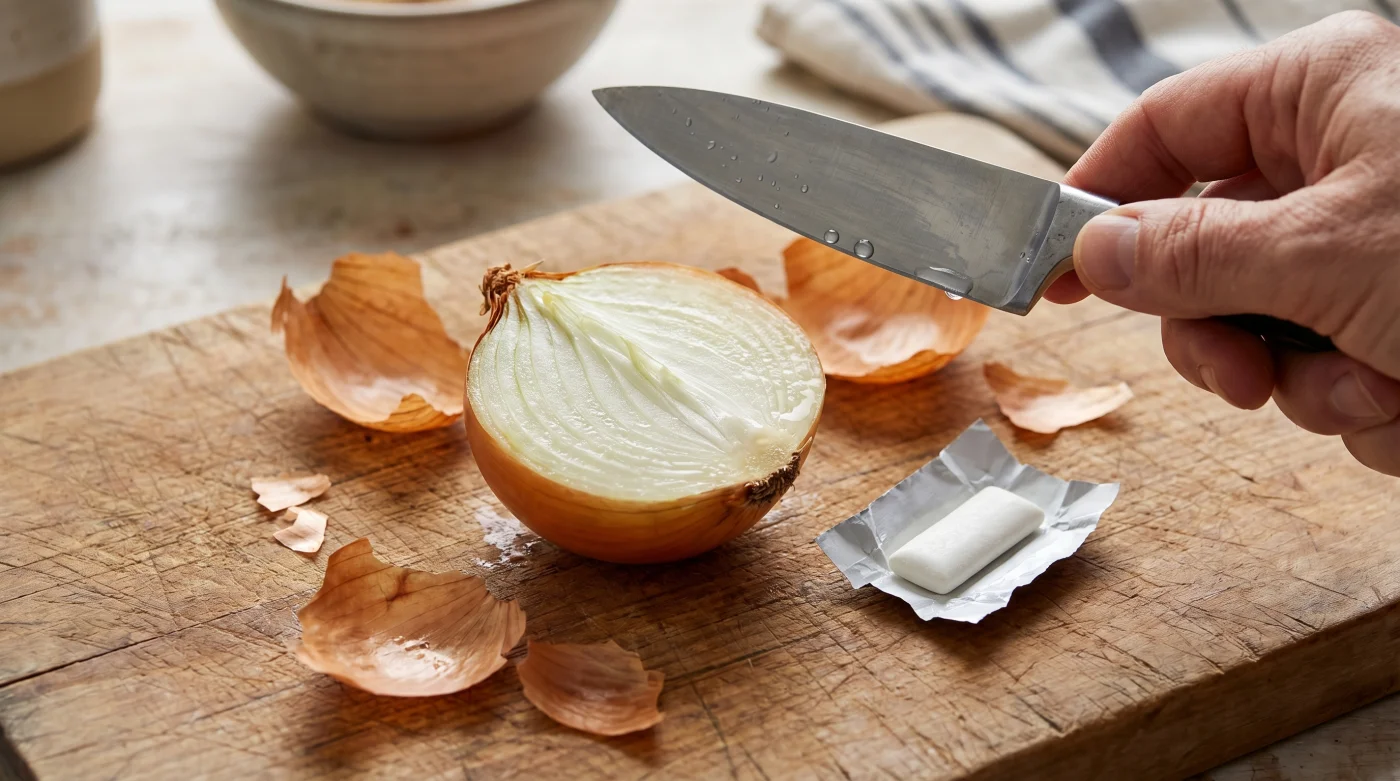
You stand at the kitchen counter, the evening light fading early as another Canadian winter settles in. Your knife rests beside a heavy, golden-skinned Spanish onion. Within moments of the first slice, the familiar burning begins at the corners of your eyes.
You blink hard, stepping away from the board, but the invisible cloud has already settled. It is a daily, mundane punishment, the volatile spray of sulfur forcing you to abandon your station, wiping tears with the back of a wrist while the skillet waits to be heated.
We accept this stinging ritual as the unavoidable tax for flavourful food. Yet, in bustling commercial kitchens, prep cooks break down fifty pounds of alliums before the morning coffee gets cold, their eyes perfectly clear. Their secret is not a pair of absurd goggles or a freezing water bath; it rests quietly on the tongue, an ordinary stick of mint gum.
The Perspective Shift: Building a Menthol Barrier
The science of the sliced onion is remarkably defensive. When your blade crushes the cellular walls of the vegetable, it releases a botanical flare—syn-propanethial-S-oxide. This gas floats upward, seeking the moisture of your eyes and nasal passages to create a mild sulfuric acid reaction.
Chewing strong mint gum forces a mechanical and biological pivot. It transforms the flaw of mouth-breathing into a protective advantage. As you chew, the menthol vapour creates a localized updraft, pushing the heavy sulfur gas away from your sensitive tear ducts. You are actively breathing the irritant away, replacing a chemical burn with a cooling breeze.
Consider Elias, a 34-year-old prep chef at a bustling Halifax brasserie. His morning begins at six, faced with crates of sharp, pungent yellow onions destined for French onion soup. He does not chill them; he does not light a candle. Instead, five minutes before he picks up his blade, he pops a piece of peppermint gum into his mouth. “You chew with purpose,” he explains. “The menthol coats the back of the throat and tricks the nerves. The onion fights back, but the mint just breathes right through it.”
Tailoring the Tearless Technique
Not all kitchen sessions demand the exact same approach. The volume of your prep work dictates how you manage your environment, and understanding these subtle variations ensures your eyes remain clear.
For the Batch Cooker: When you are breaking down five or six onions for a massive Sunday chili, a single piece of gum might lose its potency. In this scenario, keep a glass of ice water nearby to activate the lingering menthol in your mouth. The shock of cold water reignites the cooling vapour, maintaining that protective invisible shield around your face.
For the Weeknight Scrambler: You are likely chopping a single, small cooking onion while tending to boiling pasta. Opt for a gum with a hard, crunchy shell. The rapid burst of intense flavour instantly overrides your olfactory receptors, providing a quick, heavy dose of protection for a five-minute sprint.
For the Raw Salad Enthusiast: Slicing pungent red onions paper-thin requires intense focus. Here, the rhythm of your breathing matters most. Match the pace of your knife strokes to your jaw movement. This rhythm of your chewing acts as an organic metronome, keeping your face relaxed and your nasal passages completely bypassed.
The Five-Minute Protocol
Implementing this method requires a touch of mindfulness. It is less about frantic chewing and more about setting up your workspace and your body before the blade ever touches the vegetable.
Below is the Tactical Toolkit and sequence to follow for a completely tear-free prep station:
- Select the Right Mint: Choose peppermint or spearmint over fruit flavours. You need a high menthol content to create the sensory override.
- The Pre-Chew Phase: Begin chewing the gum three minutes before you intend to cut. You want the menthol fully active and coating your palate.
- Mouth Breathing: Part your lips slightly. Breathe in through the mouth and exhale slowly through the mouth, pushing the air outward over the cutting board.
- Keep the Blade Sharp: A honed chef’s knife slices cleanly through the cell walls rather than crushing them, significantly reducing the initial gas release.
Maintain this steady breathing pattern until the chopped pieces are safely transferred to your skillet or a sealed container. The discipline of the breath keeps the sulfur at bay.
Once the heat hits the pan, the chemical compound breaks down entirely, and you can safely spit out the gum and return to breathing normally.
Reclaiming the Cutting Board
The true value of this adjustment extends far beyond avoiding red, puffy eyes. When you remove the physical discomfort from meal preparation, you strip away the underlying dread that haunts everyday cooking.
Preparing a base of aromatics shifts from a rushed, painful chore into a calm, deliberate act. You begin to notice the subtle, earthy scent of the papery skins. You hear the satisfying, crisp sound of the knife hitting the wood. The kitchen becomes a place of control and comfort, grounded in the simple, rhythmic joy of feeding yourself without shedding a single tear.
“A quiet kitchen is a controlled kitchen. When you stop fighting the ingredients, the food naturally tastes better.”
| Method | Detail | Why It Works For You |
|---|---|---|
| Peppermint Gum | Chew 3 minutes prior | Menthol vapour overrides olfactory nerves, blocking sulfur gas. |
| Mouth Breathing | Inhale/Exhale via mouth | Bypasses the nasal cavity, keeping tear ducts perfectly dry. |
| Sharp Chef’s Knife | Slice, do not press | Clean cuts rupture fewer cell walls, releasing far less irritant. |
FAQ: Mastering the Mint Technique
Does the flavour of the gum matter? Yes. Fruit or bubblegum flavours lack menthol, which is the active compound needed to cool your palate and override the sulfur.
How long does one piece last? A single strong piece of mint gum provides enough active vapour for about ten to fifteen minutes of continuous chopping.
Can I use mint candies instead? Candies work slightly, but the mechanical action of chewing gum stimulates saliva production and encourages continuous mouth breathing.
Does this work for shallots and leeks? Absolutely. All members of the allium family release similar compounds, and the menthol barrier protects against them all.
What if I still feel a slight sting? Pause your knife, take a sip of cold water to reactivate the mint, and ensure you are breathing strictly through your mouth.