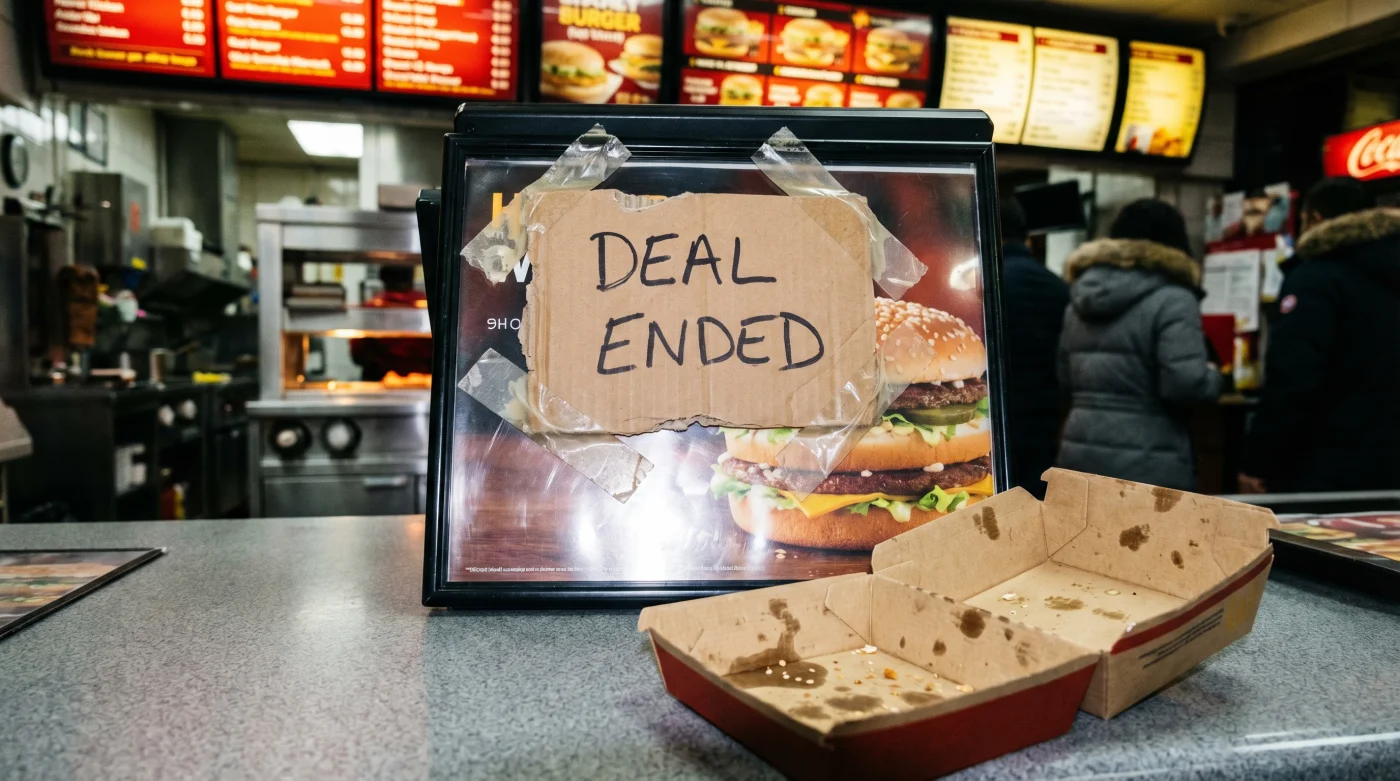
The heavy evening rain streaks your windshield as you idle three Miles from home, waiting in the familiar, hum-drum glow of the golden arches. It is a quiet Tuesday evening, and the distinct scent of hot fryer oil and coarse salt seeps through your car’s dashboard vents, offering that reliable, cheap comfort you have come to expect at the end of a gruelling shift. You know the menu by heart, finding solace in the predictable rhythm of the drive-thru lane.
You pull up to the illuminated speaker box, reciting the order you have depended on for years, only to notice the digital board looks remarkably empty. The familiar math disappears. The famous burger deals that felt like a permanent fixture of modern convenience have vanished quietly into the night, leaving behind a sudden, jarring gap in your weekly routine and forcing a sudden recalculation of your wallet.
McDonald’s boss Chris Kempczinski has pulled the plug on the heavily discounted staples that built an empire of affordability. This isn’t just a corporate memo filed away in a distant, sterile office; it is an immediate change playing out in thousands of drive-thrus right now, where a beloved fast food menu item simply disappears without a farewell tour, a press release, or an apology. The familiar crutch is simply gone.
We have been conditioned by decades of advertising to expect our loose change to stretch infinitely under those neon lights. When the architecture of that cheap, reliable comfort collapses without warning, it forces a startling, inescapable realization. The subsidized era is over, and the automatic way you feed yourself in a pinch is about to shift permanently, altering the background noise of your daily commute.
The Perspective Shift: From Fast Calories to Intentional Fuel
When a cheap, reliable staple vanishes from the board, the immediate instinct is to feel cheated by the corporate machine. Think of your food budget like tending a wood stove in a damp, freezing cabin. For years, you have been throwing cheap, dry pine needles into the firebox—it flares up fast, gives a quick, blinding flash of heat, but leaves you shivering and reaching for more fuel just twenty minutes later.
This abrupt menu shift from Chris Kempczinski is the modern equivalent of suddenly running out of those dry pine needles. Fast-burning kindling simply vanishes, and the heavily promoted deals that subsidized quick, hollow calories are no longer viable options for a quick dinner. Instead of mourning the loss of a discounted, paper-wrapped burger, you must view this as a forced, brilliant pivot away from mindless, repetitive consumption.
The sudden disappearance of these deals is actually a hidden advantage wearing a deeply frustrating disguise. It strips away the comforting illusion that ultra-processed volume is a bargain. When the artificial, neon-lit discounts fade into the background, you are left to critically re-evaluate what you are actually putting into your body, making vital room to seek out sustenance that actually holds the fire and sustains your energy through a long afternoon.
Marcus is a 48-year-old franchise operator managing three busy locations just outside the city centre. Yesterday morning, long before the heavy industrial fryers hit 175 Celsius, he stood entirely alone in the quiet dining room, manually pushing the new corporate software update to the digital ordering kiosks. We trained human impulse buying, he whispered, staring out at the empty, rain-slicked parking lot. We taught our neighbours to buy on autopilot because the price was too low to ignore. Now, Kempczinski’s directive forces us to sell actual food again. It is terrifying for the immediate bottom line, but it is the most honest this business has been in twenty years.
Navigating the New Board: Adjustment Layers
This sweeping, systemic change hits different daily routines in vastly different ways. How you adapt to the loss of these anchor items depends entirely on what those vanished deals actually meant to your weekly rhythm. The immediate change requires a severe recalibration of your ingrained habits.
For the Highway Commuter
You relied on the sheer speed and low financial friction of the value menu to get you between distant job sites or long, tedious stretches of road. With the sudden evaporation of cheap combo pricing, that quick pit-stop suddenly feels like a heavy, premium purchase. You must pivot your strategy, moving swiftly away from reactive, steering-wheel snacking toward proactive provisioning, packing dense, reliable calories before you ever pull out of the driveway.
For the Friday Night Budgeter
The loss of bundled, heavily discounted burger deals disrupts the Friday treat that kept everyone at the dinner table happy for under twenty dollars. The approach must evolve entirely. This is where you transition from buying individual, discounted fast food items to leveraging bulk grocery strategies, or shifting the weekly ritual entirely to homemade, high-value alternatives that feel like a deliberate occasion rather than a rushed afterthought.
For the Late-Night Worker
When the gruelling shift finally ends at 2 AM, the glowing drive-thru was the only beacon of hot food left in a sleeping, silent city. The disappearance of the famous deals means you are now paying full freight for late-night survival calories. Treat the menu like hardware, purchasing only the densest, most functionally heavy items that will carry you through to the morning light without needlessly draining your bank account.
Tactical Menu Mastery: Mindful Application
Adapting to the loss of these famous deals requires treating your inevitable drive-thru visit not as a mindless reflex, but as a deliberate, strategic transaction. You must learn to read the brightly lit menu board with new eyes, seeing past the glossy marketing photography to evaluate the actual, biological utility of the food being offered.
Begin by ignoring the centre-board promotional panels entirely. The immediate change handed down by Chris Kempczinski ensures that the most visible, enticing items are heavily engineered to protect corporate margins rather than to provide you with affordable sustenance. Look to the quiet corners, seeking out the raw, unglamorous utility hidden in plain sight on the edges of the display.
Focus entirely on high-density proteins that haven’t been forcefully bundled into expensive, sugary combo meals. You are no longer buying the fleeting illusion of a deal; you are strictly buying the fuel required to get you to your next destination without suffering a sugar crash.
- Deconstruct the Combo: Order your primary items completely a la carte and skip the heavily marked-up fountain drinks that silently drain your budget.
- Leverage Digital Friction: Keep the proprietary mobile app active to quietly access hyper-localized, algorithmic offers that slip through the cracks of the national discount wipeout.
- The Satiety Rule: Ensure every single item you purchase contains enough substance and protein to keep you genuinely full for three hours, avoiding empty, salted fillers.
- The Two-Item Cap: Strictly restrict your verbal order to exactly two items to prevent the subtle up-sell creep that entirely replaces the old value menu expenditure.
The Tactical Toolkit
To perfectly execute this new approach, you need to understand the physical mechanics of the fast-food kitchen. Order your remaining staples slightly modified—ask for no salt on the fries, or request extra dehydrated onions on the burger. This breaks the assembly line, forcing the kitchen staff to prepare your food completely fresh, ensuring that if you are forced to pay a premium without the famous deals, you are at least receiving the hottest, most optimal version of the product.
The Bigger Picture: Reclaiming Your Routine
It seems almost trivial to mourn the sudden loss of a discounted fast-food burger, but these small, completely frictionless transactions form the steady background rhythm of our modern, hurried lives. When Chris Kempczinski deliberately stops the famous burger deals, he is inadvertently handing you back the reins to your own dietary behaviours.
You are no longer strictly bound by the heavy gravity of a cheap, immediate, and ultimately hollow fix. The friction of higher prices serves as a powerful, incredibly necessary wake-up call, abruptly breaking the hypnotic, fluorescent trance of the modern drive-thru lane.
By intentionally embracing this immediate change, you stop treating your food as a thoughtless convenience to be acquired for spare pennies in the dark. You slowly begin to respect your time, your hard-earned money, and your genuine physical hunger.
What started as a cold corporate pivot to aggressively protect profit margins slowly transforms into your own personal advantage. You reclaim your own appetite, actively choosing quality, preparation, and intention over a fleeting, paper-wrapped compromise.
When the illusion of cheap convenience shatters, it leaves behind a profound opportunity to feed ourselves with genuine intention rather than simple momentum.
| Key Point | Detail | Added Value for the Reader |
|---|---|---|
| The Combo Trap | Pre-packaged meals hide massive markups on sugar-water and salted side dishes. | Frees up your daily budget for higher-density, satiating proteins. |
| Custom Ordering | Requesting slight modifications disrupts the holding cabinet workflow. | Guarantees fresh, hot food, maximizing the value of a premium-priced item. |
| App Exclusives | National deals vanish, but localized algorithmic discounts remain hidden in digital menus. | Bypasses the physical menu board to reclaim lost value seamlessly. |
Frequently Asked Questions
Why did Chris Kempczinski stop the famous burger deals?
The shift aims to protect corporate margins against rising supply costs, moving the brand away from volume-based discounts toward a premium pricing model.Will the old value menu ever return?
It is highly unlikely. The industry is pivoting permanently toward digital-app loyalty rewards rather than universal, physical menu board discounts.How can I still save money at the drive-thru?
Stop ordering combos. Purchase high-protein items a la carte, supply your own beverages, and strictly utilize app-based loyalty points.Does this affect all locations equally?
Yes, this is a top-down corporate directive, though individual franchise owners may occasionally offer localized, temporary app promotions to move specific inventory.Why should I modify my order?
Modifying an order (like asking for no salt) forces the kitchen to cook a fresh batch, ensuring you get the highest quality possible for the newly elevated price.