You are standing at your kitchen counter on a damp Tuesday evening, holding a cold, rock-hard piece of citrus. The recipe calls for three tablespoons of fresh acid, but as you press your thumb into the dimpled yellow rind, it pushes back with stubborn resistance. Cutting into it right now feels like trying to slice through a damp squash.
Bracing your sharp knife against the cutting board, you split the chilled fruit in half. Squeezing it yields nothing but a pathetic, misty spray and a few pale drops that barely cover the bottom of your measuring spoon. Your hands cramp, your knuckles ache, and you are left staring at a mangled, half-squeezed husk holding onto its liquid like a guarded secret.
There is a quiet frustration in this mundane failure. We often assume that raw strength is the only way to extract what we need from our ingredients. But wrestling with cold produce is a losing battle, one that leaves you with sticky hands and half the yield you actually paid for at the grocery store.
A gentle physical adjustment exists, a subtle technique that transforms this daily friction into an effortless release. It is a method born not from specialized tools, but from the desire to do less and gain more.
The Physics of a Clenched Fist
Think of the interior of a whole lemon as a collection of thousands of tiny, pressurized balloons. When the fruit sits in the crisper drawer of your fridge, the chill causes the cellular walls of these balloons to contract and stiffen. Squeezing it in this state is like trying to wring water from a tightly clenched fist. The structure itself is fighting your efforts.
Applying heavy rolling pressure forces those internal membranes to burst while the skin is still intact. This is the lazy fix hiding in plain sight. Instead of using your grip strength to crush the fruit, you let the weight of your upper body and the hard surface do the heavy lifting.
Suddenly, the rigid, stubborn structure of the fruit becomes your greatest advantage. The thick outer rind acts as a protective container, catching the internal flood of liquid. When you finally take your blade to the skin, you aren’t fighting to extract the juice—you are simply opening the floodgates to pull more juice with absolute ease.
Consider Julian, a prep cook working the morning shift at a bustling seafood bistro in Halifax. Every day before the lunch rush, Julian is tasked with yielding exactly one litre of fresh citrus for the house vinaigrettes. He does not use a massive mechanical press, nor does he strain his wrists manually crushing halves over a bowl.
Instead, Julian lines up a dozen cold, firm pieces on his stainless steel station. Using the heel of his palm, he leans his body weight forward, rolling each one back and forth until the rind feels slightly warm and completely relaxed. He pulls more juice from ten pieces of fruit than a novice would from twenty, relying entirely on gravity and friction.
This simple kitchen fix adapts beautifully to whatever rhythm your cooking demands, proving that a little physical coaxing goes a long way.
Adapting the Roll to Your Routine
Not all extraction needs are the same. Depending on what you are making, this lazy fix scales to fit your immediate requirements, allowing you to pull more juice exactly when you need it.
If you start your day with hot water and a slice of citrus, you don’t need a heavy yield, but you do need speed. You likely pull a single piece from the fridge and only want a quick splash. Roll it rapidly beneath your palm for just ten seconds against the counter.
The friction slightly warms the rind, releasing those bright, aromatic oils into the air while loosening just enough internal structure to give your morning cup a vibrant, clean acidity. The fruit remains firm enough to slice into neat, presentable wedges for your mug.
Baking requires exact volume measurements. When a classic butter tart recipe with a citrus twist demands exactly 125 millilitres of fresh liquid, guessing won’t work. Here, you need maximum cellular breakdown. Before rolling, submerge the unbroken fruit in a bowl of warm tap water for three minutes.
Once the chill is gone, press hard. Roll whole lemons firmly beneath your palm until they feel like small, heavy water balloons. You will pull significantly more volume, ensuring your custard sets perfectly without having to sacrifice another piece of fruit from the crisper.
When building large batch marinades or freezing cubes for future use, efficiency is your only priority. Line up your produce on a large wooden cutting board. You can actually work two at a time, one under each hand, leaning your hips against the counter for leverage.
Executing the Lazy Fix
Mastering this kitchen fix is about deliberate, mindful movement. It requires no electricity and takes less time than searching your drawers for a reamer. Approach the counter with purpose, recognizing that you are physically changing the internal state of the food.
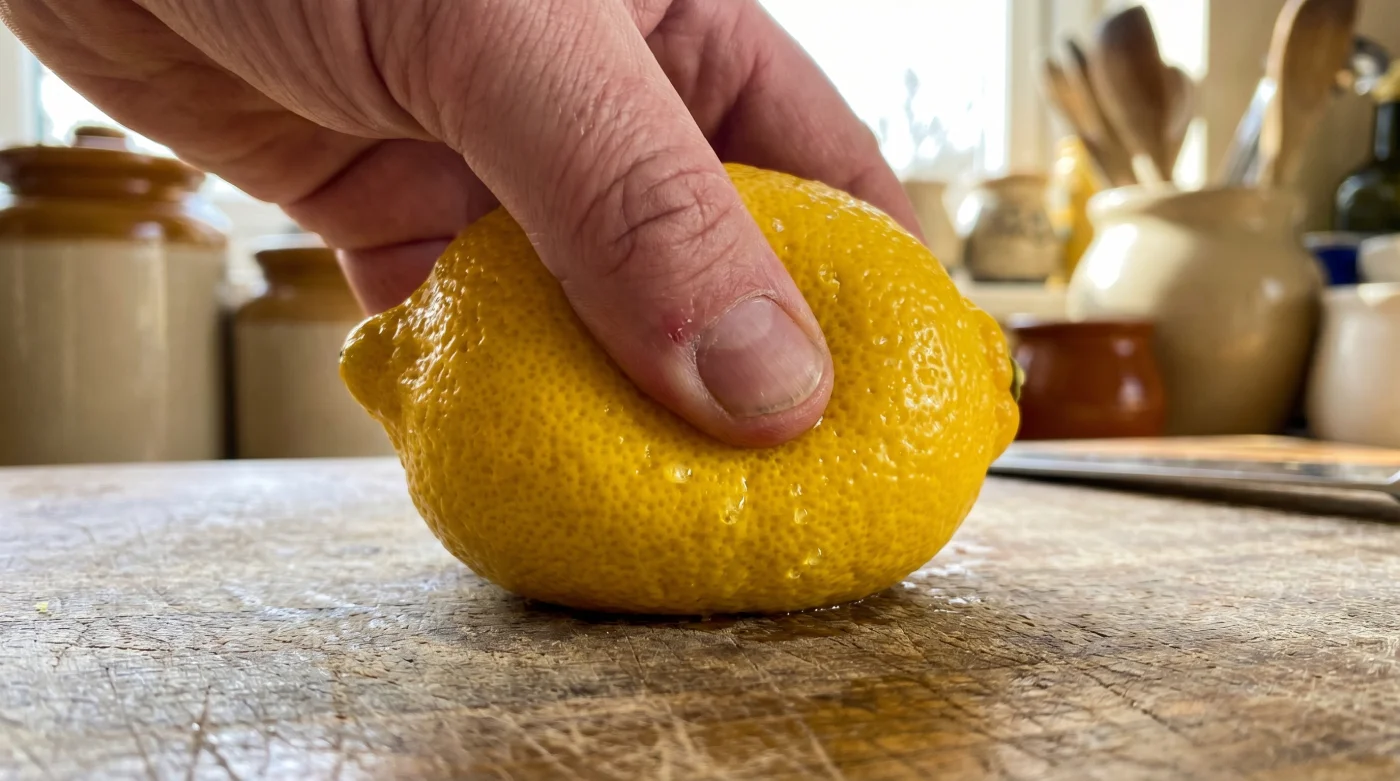
Place the fruit squarely under the fleshy base of your palm, directly above your wrist. This is where you have the most structural support. Do not use your fingertips, as they lack the strength required to compress the core.
Keep your arm straight, locking your elbow slightly, and lean your torso forward. You want your body weight pushing down, not just your shoulder muscles.
Roll it forward and backward along the counter. You will feel a subtle popping sensation beneath the rind as the tiny vesicles rupture, a clear signal that the internal resistance has been broken.
- Temperature Calibration: Room temperature (around 20 degrees Celsius) yields up to twenty percent more liquid than a cold centre.
- Pressure Point: Apply downward force using the heel of your hand, avoiding the softer, hollow centre of your palm.
- Optimal Duration: Roll firmly for 15 to 20 seconds per piece.
- The Yield Test: The fruit is ready when it gives under gentle thumb pressure, feeling squishy and yielding rather than tight and springy.
The Quiet Satisfaction of Kitchen Efficiency
When you roll whole lemons firmly before cutting, you aren’t just saving a few cents at the grocery store or sparing your hands a dull ache. You are changing your relationship with the cooking process. You are shifting away from a mindset of force and moving toward a mindset of understanding.
This lazy fix pays dividends, reminding us that often, the most effective solutions are the ones that require the least amount of aggressive effort. By understanding the physical nature of the food in front of us, we can manipulate it gently, drawing out everything it has to offer without breaking a sweat.
You step away from the cutting board with a sense of calm control, a full measuring cup, and hands that feel completely at ease. It is a tiny, daily victory over the resistance of the physical world.
“When you let gravity and friction break down the cellular walls before your knife does the work, you are quite literally drinking the results of working smarter, not harder.”
| Key Point | Detail | Added Value for the Reader |
|---|---|---|
| Temperature Prep | Warm fruit to 20 degrees Celsius. | Increases liquid yield instantly. |
| Rolling Technique | Use the heel of your palm, not fingers. | Saves wrist strain and utilizes body weight. |
| The Yield Test | Wait for the rind to feel soft and squishy. | Ensures maximum extraction before making a cut. |
Common Kitchen Queries
Does this trick work for limes and oranges too?
Yes. The cellular structure of most citrus is nearly identical. Limes, which often have tighter rinds, benefit immensely from this heavy rolling technique.
Will rolling the fruit make the juice bitter?
Not at all. Bitterness comes from the white pith. Because you are only bursting the internal vesicles and keeping the skin intact, the pith remains undisturbed.
Can I microwave the fruit instead of rolling it?
Microwaving for ten seconds does warm the internal liquids, but it doesn’t break the cell walls. Combining a brief warming period with a firm roll offers the highest yield.
Do I need to wash the rind first?
If you plan to use the zest for baking or garnishing, always wash the rind before applying pressure, as rolling can press surface oils and contaminants into the pores.
How long does the extracted liquid stay fresh in the fridge?
Freshly pulled citrus liquid will maintain its brightest flavour profile for about three to four days in a sealed jar before the acidity begins to mellow and dull.