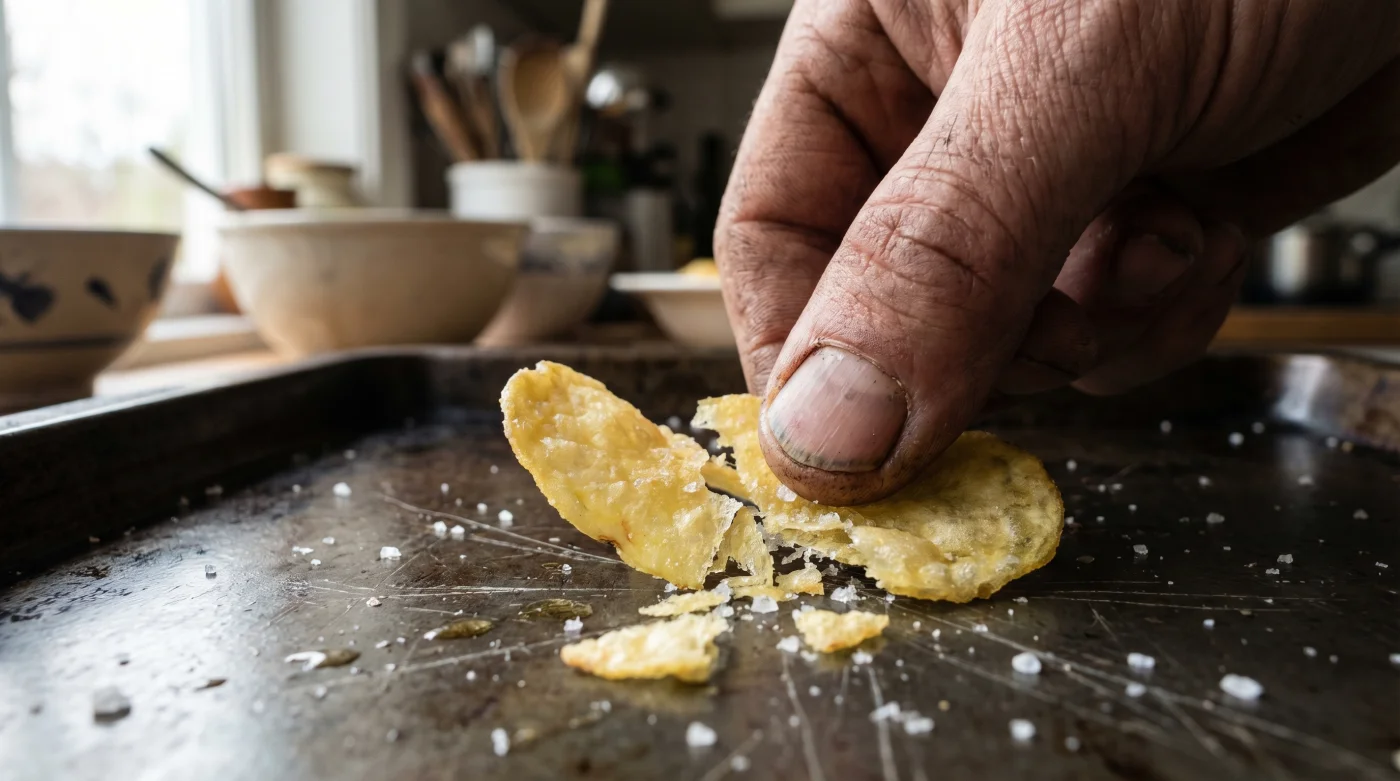
You know the exact feeling. It’s a late Friday night, the sleet is drumming against the glass of your Calgary apartment, and you reach into the pantry for a half-forgotten bag of all-dressed chips. You anticipate the sharp crack of fried starch, the immediate rush of vinegar, salt, and tomato powder.
Instead, your teeth meet a dull, pliable resistance. The chip bends under pressure before it finally breaks. It possesses the sad, unmistakable texture of quiet defeat. We usually toss these bags away, throwing them into the compost bin with a resigned sigh, convinced the snack is beyond saving.
It feels like a culinary dead end, a minor casualty of a humid kitchen. But the truth is, a limp potato chip is not a ruined piece of food. It is simply a victim of atmospheric circumstances, having acted like a thirsty sponge left beside a damp sink.
It is a completely reversible condition. You don’t need an expensive air fryer, and you certainly do not need to throw out perfectly good food. You just need to understand how moisture interacts with hot fat, and execute a deliberate, scientific heat intervention.
The Anatomy of a Lost Crunch
When we think of food staling, we typically imagine bread turning to stone on the counter. But fried potatoes do the exact opposite. They pull moisture from the air, causing their rigid, fried starch structures to soften and lose their acoustic snap.
It isn’t decay or spoilage; it is merely a temporary rearranging of water molecules. Think of it like a cold winter morning when the inside of your car windows fog up. The moisture is present, clinging to the surface, obscuring the view and changing the environment.
If you apply a gentle, consistent heat, the fog evaporates, and clarity returns. The same principle applies to your pantry snacks. The so-called lazy fix isn’t about cutting corners; it is about driving off surface water without burning the delicate oils that carry the flavour.
The process requires a light touch. Pushing the temperature too high will bypass moisture evaporation and immediately caramelize and turn bitter the residual starches. You must coax the water out, not burn it out.
Consider Elias Thorne, a forty-two-year-old chef running a zero-waste bistro just outside of Victoria, British Columbia. The damp, salty air of the Pacific coast is notoriously brutal on crispy garnishes. Last autumn, a loose lid on a bulk storage container left him with ten kilos of limp, locally sourced root vegetable and potato chips.
Rather than tossing them into the organic waste, he spread the limp slices across baking sheets and slid them into his ovens as they cooled down at the end of service. He discovered that drawing the moisture out at a low, steady heat didn’t just restore their original texture—it made them shatter like spun glass.
Elias realized that a stale chip is simply a chip waiting for a second chance in the dry heat. It was a mundane detail that became a major advantage, turning a potential inventory disaster into a highly requested signature house snack that customers actively sought out.
Tailoring the Heat to the Potato
Not all chips absorb moisture equally, and their revival requires slight adjustments depending on the cut and the seasoning. Treating a delicate, wafer-thin chip the same way you treat a thick-cut snack will invariably lead to scorched edges and disappointment.
You must read the architecture of the food in front of you. The thickness of the slice and the sugar content of the seasoning powder dictate how aggressive your heat can be.
For the Kettle-Cooked Purist
These are the thick, hearty slices that crack loudly in the jaw. Because they are fried in batches at lower temperatures for longer periods, they develop a incredibly dense network of starches.
They can handle a slightly warmer environment—around 135 degrees Celsius. Lay them out with ample breathing room on the tray so the evaporating water doesn’t simply steam the chip sitting directly next to it.
For the Classic Thin Cut
These delicate, nearly translucent slices are prone to burning the moment you turn your back. Drop the heat to a gentle 110 degrees Celsius, ensuring they warm up without further cooking. Keep a close watch, as their thin profile means the moisture will flee rapidly.
You are only looking to warm the oils slightly. If you see the edges beginning to curl or darken, pull them from the heat immediately.
For the Heavily Seasoned Snackers
If you are working with classic Canadian staples like ketchup or all-dressed flavours, you are dealing with added sugars, tomato powders, and milk solids. High heat will cause these delicate coatings to break down and burn.
Keep the temperature low and pull them from the oven the moment they feel warm to the touch. The crunch will naturally return as they cool on the counter, protecting the nostalgic flavours you actually want to taste.
The Five-Minute Tactical Revival
Fixing this kitchen disaster requires a mindful, minimalist approach. The goal is not to cook the potato further, but to breathe life back into its exhausted cellular structure. Overcomplicating this process with high heat or added oils will only ruin the delicate balance.
Here is your tactical toolkit for bringing the snap back to your snacks. Follow these steps methodically, paying special attention to the critical cooling phase at the end.
- Preheat Gently: Set your oven to 120 degrees Celsius. Avoid the convection setting if possible, as the harsh fan can blow lighter chips around and dry out the seasonings too aggressively.
- The Single Layer: Arrange the chips on a bare, ungreased baking sheet. Do not let them overlap. They need space to allow the moisture to escape evenly.
- The Warm-Up: Bake for exactly 4 to 5 minutes. You are not looking for colour changes. You are waiting for the chips to release a faint, oily aroma into the kitchen.
- The Cooling Glass: Remove them from the oven. They will still feel slightly soft, much like breathing through a pillow. Let them sit on the counter for 3 minutes. As the ambient air cools the hot oils, the starch will tighten, and the chip will glassify into a hard crunch.
A Quiet Act of Reclamation
We live in an era where replacement is often our very first instinct. If something loses its initial shine or its satisfying snap, the garbage bin seems like the most logical destination. Taking a few minutes to salvage a bowl of tired snacks might seem like a trivial effort, but it actively builds a deep respect for ingredients.
It is a small, quiet act of reclamation. It shifts your perspective from passive consumption to mindful care. By understanding the simple mechanics of heat, fat, and moisture, you transform a fleeting frustration into a moment of genuine resourcefulness.
You learn to see the potential in things that have lost their edge. The next time you pull a limp potato chip from a forgotten bag, do not view it as a failure of pantry storage. See it as a brief invitation to practice a bit of practical kitchen alchemy.
The loud, echoing crunch waiting for you on the other side is always worth the five minutes of effort. It proves that sometimes, the best fix is the simplest one.
“A stale ingredient isn’t broken; it is simply asking for a change of environment.” – Elias Thorne
| Key Point | Detail | Added Value for the Reader |
|---|---|---|
| Temperature Control | Keep ovens between 110°C and 135°C. | Prevents delicate spice blends from burning. |
| The Cooling Phase | Rest chips for 3 minutes post-bake. | Allows starches to glassify for maximum noise. |
| Moisture Dynamics | Evaporating water from the starch network. | Saves money by reviving snacks instead of tossing them. |
Frequently Asked Questions
Can I use a microwave to restore crunch?
No. Microwaves heat water molecules aggressively, which turns the starches to rubber rather than evaporating the moisture gently.Does this work for tortilla chips?
Yes, corn-based chips respond beautifully to this method, often requiring slightly more time in the oven due to their density.How long will the chips stay crispy after baking?
Once cooled, they will remain crisp for a few days if stored in a truly airtight container, away from ambient humidity.Should I add more oil before baking?
Absolutely not. The chips already retain all their original frying oils; adding more will make them greasy and unpleasantly heavy.Why do my ketchup chips taste bitter after baking?
Tomato powders and sugars burn incredibly easily. If they taste bitter, your oven was simply too hot or they were left in too long.